ARTists
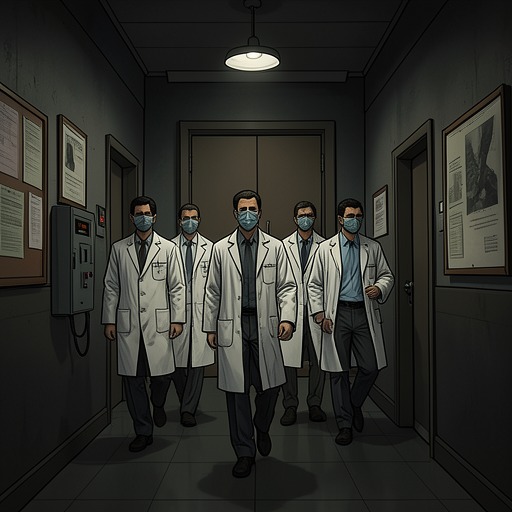
Gate CrashersARTists, the nickname for the Artifact Research Team, is the scientific collective that converts the mystery surrounding the object recovered by the AEUS Magellan into a workable theory of hyperspace. Its decisive significance lies not in a single invention or individual genius, but in the way people, machines, institutions, classified files, and anomalous matter assemble into a knowledge network. The team repeatedly encounters facts that established science cannot absorb: an object sixteen meters long that has no course, a signal whose apparent radio function is misleading, a sealed sphere containing another dimension, and a physical transition that leaves an energy echo. ARTists gives those anomalies names, experiments on them, and eventually makes them operational, while its dependence on institutional resources also exposes how fragile scientific discovery becomes when secrecy, politics, and scale enter the laboratory.
Formation and Initial Mandate
ARTists begins as a response to the artifact detected by the AEUS Magellan. The vessel’s survey equipment identifies an object less than two light-hours away, sixteen meters in length and unusually large for space dust. It is not on an intercept course—or any course at all—contradicting the ordinary expectation that every object in interstellar space must carry inertia. Spectrographic analysis later shows that it consists primarily of titanium with traces of other metals, an alloy unlikely to have formed naturally and unlike any metal mined on Earth or in the human colonies. The artifact also emits a signal, though the signal’s nature and purpose remain unclear.
Professor Eugene Graham, the head of AESA, brings Felix Fletcher into a project devoted to understanding the object. Felix is asked to construct a reverse-engineering department from the ground up. His requirements define ARTists as an infrastructure as much as a team: workspace, a quantum computer equipped with dynamic-modeling software, access to theoretical physicists, a molecular printer for rapid prototyping, and, above all, something that can be copied. Eugene and Jeffery can arrange the facilities, computing equipment, fabrication capacity, and vetted physicists, but the source material remains dependent on the AEUS Magellan. The group’s founding problem is therefore both intellectual and logistical: it must create new knowledge while relying on a distant vessel to supply the thing that makes such knowledge possible.
At ARTists’ introductory meeting, Graham presents Felix as a new member and recapitulates the case for the assembled researchers. Twenty-five days earlier, the AEUS Magellan had reported recovering an artifact of unknown origin. Its titanium-and-palladium shell used an alloy no human laboratory had seen before, isotopic testing showed that the metal was not mined on Earth or in any colony, and the device produced a bizarre, fascinating noise. The meeting turns an isolated discovery into a collective research object. The artifact is no longer merely something encountered in deep space; it becomes a shared problem, represented through a holo-projector, technical data, and a team whose members must learn how to interpret it together.
From Anomaly to Hyperspace Theory
ARTists’ early investigations destroy one ordinary assumption after another. Felix’s preliminary findings reveal that the artifact has no power source. It nevertheless contains abundant power and operates a transmitter, creating a distinction between having energy and receiving energy from a recognizable source. Later, Felix argues that the object is not fundamentally a radio transmitter even though it emits a radio signal. Radio output is a by-product of its actual purpose, much as an incandescent light bulb produces heat without being designed as a heater. This reinterpretation shifts the team away from asking how a conventional transmitter works and toward asking what kind of device could use radio emission as an incidental effect.
The same pattern appears in ARTists’ investigation of the shadowing vessel associated with the AEUS Magellan. Sensor reports show localized fuzziness from an aft sensor, with no corresponding mass or energy readings. The readings seem to cover the same region of space as the other sensors, but as if viewed through blurred glass. The anomaly is first treated as interference, possibly caused by electrical problems near Shuttle Bay Two, yet its failure to conform to ordinary sensor categories becomes evidence that something more consequential is occurring. ARTists’ method depends on preserving these contradictions rather than smoothing them into familiar explanations.
A decisive breakthrough follows the examination of a smaller sphere connected to the artifact. Steven Billings feeds a snake camera through a whistling opening, but the camera display remains black even when its light burns a bright orange spot into his vision. The crucial clue is auditory: the whistle does not change tone. Previous scans established that the sphere is sealed, and after Billings creates the opening there is still no outlet through which air could be pumped. The practical question—why has the sphere not filled with air?—forces the team beyond the assumption that its interior belongs to the same physical space as its exterior.
Video of Billings’s examination confirms the result for the entire ARTists staff. The sphere contains nothing in the ordinary sense, except another dimension. That dimension is not one of the thirteen predicted by the Third and Final Theory of Everything. Hundreds of radio transmissions cross it, most encrypted, and it contains repeats of the strange energy spike that accompanied the sudden disappearance of the vessel shadowing the AEUS Magellan. The spike is interpreted as an echo produced when something physically moves from one dimension to another. Felix names the new dimension hyperspace, and the team accepts the name because it gives a usable conceptual handle to an otherwise impossible observation.
Expansion, Specialization, and the First Window
Once hyperspace becomes a recognized research field, ARTists expands faster than its original leadership can comfortably follow. Months pass as the project gains momentum, and the team grows and subdivides into specialties. Its research proceeds along so many parallel lines that Eugene, Jeffery, and Felix struggle to remain current across all of them. The expansion demonstrates both the success and the danger of the organization: the problem is no longer a lack of ideas, but the inability of a small leadership group to coordinate the quantity of work that its discoveries have generated.
Felix identifies a second bottleneck. The staff physicists are overwhelmed, while computers cannot assume more of the work because they lack software for the unexplored problems ARTists is creating. The machines can provide computational capacity only after humans have supplied methods capable of instructing them. Eugene therefore proposes recruiting graduate students from universities, but the attempt largely fails. Most prospective workers do not remain in the company of eccentric fanatics, and only one new hire survives; she is taking night courses in abnormal psychology and finds the group suitable material for her doctoral thesis. The episode gives ARTists an unsettling social profile: its unconventional research culture is productive, but it also makes the organization difficult to inhabit.
Despite these problems, Felix eventually announces that the hyperspace window is ready for its first test run. Danielle Fenton has been pressing him about the pace of the research, while construction of the president’s “armed courier” has been halted so that the new technology can be copied. A successful test would therefore have immediate political and military value, not merely theoretical importance. ARTists is working under a deadline created by government expectations, with the prospect of a technological breakthrough functioning as a promised Christmas gift to the president.
The first test is physically dangerous. The reactor uses snow supplied by the countryside, but its ablative lining can survive only so many cycles at the required power level. Continuous exposure to high-energy particles makes even exceptionally durable materials brittle, and a loop of one-hundred-million-degree plasma threatens to escape if the team cannot solve the problem. Felix struggles to keep the geometries of the different emitters synchronized as the distortions seem to resist his calculations. At the critical moment, he stops trying to force the problem into submission and allows the current to carry him. The distortions fade, a power spike runs through the building, and observers later report seeing flashes like static in their eyes. The vacuum chamber contains a perfect hole that reflects no light: the first stable hyperspace window.
Institutions, Leaks, and the Politics of Scale
ARTists’ discoveries attract institutional pressure because hyperspace promises strategic power. The president’s armed courier has been paused pending replication of the technology, while the team’s expanding requirements demand more personnel, more equipment, and more access to expertise. Scientific work is therefore inseparable from administrative decisions. The group does not operate outside politics; its laboratory is already connected to executive authority, military planning, university recruitment, security procedures, and the material supply chain that makes its experiments possible.
The organization’s internal scale also creates a security vulnerability. Gladstone Rockwell confronts Eugene with a live feed from Loose Lips Ezine, which has published more than a terabyte of ARTists’ internal communications, including memos, technical papers, and schematics. The leak is immediately visible across the Web, and Rockwell states that the team has an insider. The exposed documents show that ARTists’ knowledge is no longer confined to its laboratories. Once its records circulate publicly, the group loses control over the boundary between classified research and general information, and its institutional competence becomes a question of governance as well as discovery.
The leak also reveals a structural irony. ARTists needs collaboration because hyperspace exceeds any one researcher’s knowledge, but collaboration multiplies the channels through which information can escape. The same subdivision and specialization that accelerate discovery make the project harder to supervise. Its scientific network becomes simultaneously more powerful and more porous. The organization’s crisis is not caused by ignorance alone; it is caused by the fact that successful knowledge production has outgrown the administrative form designed to contain it.
Function in the Larger Narrative
ARTists is the novel’s principal engine of technological paradigm change. It begins with a motionless object that cannot be classified, proceeds through evidence of impossible energy and dimensional displacement, and ends by producing a controllable opening into hyperspace. Each stage depends on an alteration in the team’s vocabulary: artifact replaces debris, anomalous emission replaces ordinary radio transmission, and hyperspace replaces an unpredicted dimension. Naming does not solve the problems by itself, but it allows the researchers to coordinate observation, experiment, and design.
The group also distributes agency across a network rather than assigning every breakthrough to an isolated hero. The AEUS Magellan supplies the artifact and the initial observations; Felix develops the reverse-engineering program and names hyperspace; Billings’s failed camera examination exposes the sphere’s physical contradiction; Eugene organizes personnel and resources; Jeffery supports acquisition and administration; and the wider staff turns individual findings into parallel research programs. Even the artifact itself actively shapes the course of events by resisting familiar categories and forcing the researchers to revise their assumptions.
By the later crisis, ARTists is still active and consequential. Eugene must deal with further operational obstacles while trying to reconnect with the Unicycle, and the fate of the research depends on securing people and equipment rather than merely possessing correct theories. The team’s arc consequently remains unresolved in a simple triumphant sense. ARTists has opened a new scientific frontier, but it has also created military pressure, institutional exposure, and coordination problems that its discoveries cannot automatically solve. Its lasting narrative role is to show that technological transformation is made through collective, improvised labor—and that every successful expansion of knowledge enlarges the political and organizational risks surrounding it.