Alien Buoy Escape Incident
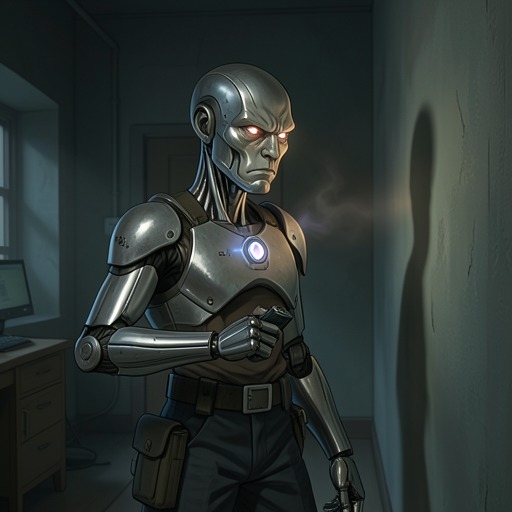
Gate CrashersThe Alien Buoy Escape Incident is the first major crisis caused by the alien buoy recovered by Magellan. What initially appears to be an impossible motionless object becomes a source of localized gravity, a threat to the ship’s structure and crew, and finally a self-operating device capable of opening a passage through the hull. Its escape changes the buoy from a scientific curiosity into an autonomous and consequential presence, establishing the pattern by which unfamiliar technology repeatedly outruns human interpretation.
Discovery of the Anomaly
Magellan first encounters the object while monitoring the darkness ahead of her. A ranging laser identifies something sixteen meters long less than two light-hours away. The object is unusually large for space dust, but it presents no direct collision threat and follows no course at all. That stillness is more disturbing than its size: Magellan has observed tens of millions of particles, projected their trajectories, and vaporized some of them, yet none has ever lacked inertia. An object cannot simply remain motionless in the void between stars according to the physical assumptions built into her navigation systems.
The anomaly also exposes the limits of Magellan’s autonomy. Her exploration-ship programming gives her curiosity but restricts command-level decisions to protecting the crew while they are incapacitated. Because the object does not initially threaten anyone, she is not permitted to alter course merely to investigate it. A closer examination would require waking the captain, turning an apparent scientific irregularity into a command decision before anyone understands its nature.
The Buoy’s Sudden Attack
The crisis erupts just as Allison Ridgeway is preparing to leave the bridge. After Magellan enters an artificial gravitational hole and begins accelerating, the ship is interrupted by a violent alarm. The vessel reports a hull breach in Shuttle Bay Two and begins venting air. Allison immediately orders the drive cut and asks whether the bay’s main doors have opened or the hull itself has ruptured; the doors are reported secure, leaving the source of the emergency inside the bay.
Magellan then identifies the underlying phenomenon: a gravitational anomaly localized just starboard of amidships, near the shuttle bay, holding its position relative to the ship. The anomaly causes Magellan to lose velocity at 0.7 meters per second. The buoy is not merely an inert object caught in the ship’s environment; it is affecting that environment with a force powerful enough to disrupt the vessel’s motion and atmosphere.
Inside the bay, Jacqueline Dorsett and Marcel Gruber find the physical consequences of the anomaly. The room still retains more than 70 percent pressure, but the air is escaping through a breach. Everything has been swept toward the far wall, where tools, hardware, and Chief Billings are piled as though that wall has become the floor. The buoy alone sits neatly in an artifact-shaped dent. Its position makes the scene look deliberate even before its mechanism is understood.
Jacqueline tests the apparent change in gravity with an eight-millimeter wrench. She throws it in a normal parabola, but the wrench abruptly turns in midair, accelerates straight toward the far wall, and sticks there. The experiment converts an abstract sensor reading into visible evidence: the buoy has generated an antigravity or gravitational-field effect strong enough to redefine orientation inside the bay. Jacqueline recognizes that Gruber is not simply walking toward Billings; he is moving across a room whose effective floor has shifted, and another step could have sent him into the lethal field.
Collapse of the Bay and the Buoy’s Escape
The danger intensifies while Jacqueline and Gruber consider how to retrieve Billings. Gruber estimates that the effect may be several gravities. Even reaching the chief could leave the rescuers too weak to climb back, and the diminishing air supply makes delay impossible. The tools stuck to the wall suddenly shift and crash to the deck. Billings falls in a heap, while the buoy drops with a thunderclap and exposes the tear in the aft bulkhead that had been covered by its body.
The displacement turns a dangerous breach into an immediate vacuum emergency. Remaining air is sucked from the bay, Gruber charges across the deck, and Jacqueline struggles to follow as her vision fills with stars and constellations. The scene’s violence comes from a reversal in the buoy’s relation to the ship: while it had seemed to anchor itself against the wall, its movement removes the accidental seal that had slowed the decompression. The object’s apparent stillness and apparent containment both prove temporary.
From behind the glass, Jacqueline sees that the buoy is not simply falling or being pushed. Blue engravings flash across its silver surface. A line of white light traces a circle in the skin; once complete, the circle moves outward, pivots down, and reveals a hole in the hull. Lights pulse and flow through the interior, producing the image of a transparent, bioluminescent organism. The buoy therefore possesses an integrated mechanism for cutting or opening the ship’s hull, and it activates that mechanism at the moment when the crew is already struggling to survive decompression. Its escape is technological, physical, and almost biological at once.
Consequences and Wider Significance
The incident destroys the assumption that the buoy can be treated as passive evidence. Its unexplained stillness, gravitational field, resistance to ordinary spatial expectations, and ability to open the hull form a progression from anomaly to agency. Human observers first classify it through familiar categories such as dust, artifact, or recovered object; the escape forces them to confront a device with capabilities that cannot be safely inferred from its appearance.
The event also establishes the connection between scientific discovery and immediate operational danger. Magellan’s curiosity is legitimate, but the ship’s restrictions prevent her from pursuing the object without Allison Ridgeway’s authorization. By the time its significance becomes clear, the crew is dealing with a breach, altered gravity, collapsing orientation, dwindling air, and a mechanism acting from within the ship. Investigation and survival become the same problem.
The buoy’s escape is important beyond the immediate damage to Magellan because it initiates the book’s larger movement toward interstellar contact and planetary-scale peril. Later encounters reveal that high-space technology can produce disasters that resemble supernatural monsters, erase worlds, freeze planets, or serve as instruments of geocide. Against that background, the buoy’s first appearance is a contained version of the same pattern: an object enters human space without explanation, human institutions misread its danger, and a device whose operation exceeds local understanding converts curiosity into crisis.
The incident’s dark irony lies in its scale. The crew faces a life-threatening emergency inside one shuttle bay, yet the event is also the first visible sign that humanity has touched a technological system belonging to a much larger and more dangerous history. The buoy is small enough to fit against a bulkhead, but its behavior opens the narrative toward forces capable of reshaping ships, worlds, and interstellar politics. What escapes from Magellan is therefore not only a physical object; it is the illusion that the unknown will remain passive until humanity is ready to understand it.