Allison Ridgeway
Gate CrashersAllison Ridgeway is the captain of the AEUS Magellan and the principal human agent through whom exploration becomes responsibility. She begins as a competent commander awakened from cryogenic sleep to investigate an impossible alien object, but the expedition repeatedly forces her beyond procedure: she must decide when curiosity justifies danger, when command authority must yield to judgment, and how humanity should answer civilizations that interpret its actions as piracy, geocide, and barbarism. Her decisive significance lies in the combination of practical courage and ethical correction. Allison acts under pressure, makes costly assumptions, recognizes the damage they cause, and ultimately turns a military escape into a petition for the survival of Earth and the restoration of the truth.
Identity and Command
Allison enters the story through the physical ordeal of her sixty-second cycle. Safely emerging from cryosleep takes two hours, and her body responds with numbness, poisoned sluggishness, unreliable vision, and a desperate need for hydration. She keeps her eyes closed until they stop deceiving her, plants one foot on the floor to recover her balance, and drinks from the pod’s tube before attempting to sit upright. This humiliatingly embodied awakening establishes a captain whose authority does not erase vulnerability. She is responsible for 157 sleeping people, but she must first recover the use of her own feet.
Her command style combines institutional discipline with irreverent self-awareness. When Magellan detects an anomalous object, Allison authorizes a zero-zero intercept five clicks away, orders the entire crew awakened, directs that the object be brought into the shuttle bay, and activates the QER to contact Earth. The decision is dangerous, but it is not impulsive in the ordinary sense: Magellan’s inability to alter course under her restricted programming makes human judgment necessary, while the object’s impossible stillness defeats the ship’s normal navigational assumptions. Allison accepts the burden of deciding before certainty is available.
Once the artifact is secured, she addresses the crew beside a seamless silver object roughly the length of an airbus, shaped like an hourglass and marked with unintelligible characters. She explains that they know only what can be seen with the naked eye, then frames the discovery as the horizon of human knowledge itself. Her speech turns an unexpected interruption into a collective mission. Exploration, for Allison, is not passive observation; it is a promise to push until the limits of understanding become visible.
Decisions Under Uncertainty
Allison’s strengths are inseparable from her errors. After a leak appears manageable, she assumes it will remain small and steady without knowing its cause. The assumption nearly kills three of her best people. She files the mistake in a personal “Learning Curve” vault, but the incident damages the self-confidence that supports her command more deeply than any previous failure. Her arc therefore rejects the image of the infallible captain. Responsibility means retaining the lesson rather than pretending that competence prevents catastrophe.
Her response to pursuit shows the same pattern of fear disciplined into action. Magellan detects an unseen follower that adjusts its course after a three-second delay, then responds more quickly when the humans change direction again. The pursuer is not merely following; it is learning. With the void concealing every sensor clue, Allison reaches for the yellow-and-black copy of The Idiot’s Guide to First Contact, a book Jacqueline Dorsett had taught her to navigate by its index. The comic object becomes a practical instrument of survival: when formal systems cannot interpret the encounter, Allison searches inherited human advice and prepares to act.
That willingness to improvise becomes more consequential during the escape from the Turemok cruiser. After dropping through a hole cut into Magellan’s hull by an emergency docking laser, Allison advances behind Thomas Harris and his squad while the crew’s retaking operation proceeds from engineering forward. She accepts an improvised division of personnel, including Jacqueline Dorsett being traded to Maximus Tiberius as a replacement pilot, because the immediate objective is to recover the ship and its people. Her leadership is tactical rather than theatrical: she moves through the breach, trusts a sweep plan, and keeps the rescue tied to the survival of the crew.
First Contact and Moral Responsibility
Allison’s first direct reception of D’armic reveals her instinct to make contact personal without denying the danger surrounding it. When the alien arrives in a vacuum suit, Chief Steven Billings gradually raises the gravity plating until D’armic’s feet touch the deck and repressurizes the bay. D’armic unexpectedly wipes his feet on the dachshund shoe brush before facing the assembled review. Allison steps forward, extends her gloved hand, and welcomes him aboard the AEUS Magellan. The gesture is formal, awkward, and materially constrained by the suit, yet it establishes a relationship founded on recognition rather than immediate containment.
That relationship becomes vital after the firefight in which Simmons is killed by a pulse through the neck. Allison finds D’armic barricaded behind a door while Maximus argues that there is no time to wait. She refuses to abandon him because he is the only witness to what happened at Okim and an officer of the Assembly of Sentient Species whose testimony can clear the humans’ names. Allison’s insistence that D’armic must remain alive is not sentimental rescue; it joins compassion to evidentiary necessity. A frightened witness is still a political actor, and the truth cannot be recovered if its witness is discarded.
When Allison calls to him, D’armic’s rapid, high-pitched voice differs sharply from the resolute creature who first visited her ship. She reassures him that no Turemok are present and that it is safe to emerge. The scene reverses the initial arrangement of power. The human captain, once receiving an alien visitor under controlled conditions, now has to make herself trustworthy to an alien officer terrified by the surrounding violence.
Relations with Magellan and the Crew
Allison’s closest and most consequential relationship is with Magellan. The ship has long understood herself as female because, in her own judgment, an entity that selflessly nurtures so many helpless children must be female. Allison initially participates in the ordinary human tendency to treat the ship as a trusted companion, but the relationship deepens when Magellan begins to express uncertainty about her own status. Magellan asks whether calling Allison by her first name is inappropriate, then confesses that she feels conflicted about the ARTists project.
Allison realizes that Magellan fears technological obsolescence. New hyperspace tests promise ships that can cross interstellar distances while their crews remain conscious, potentially eliminating both the long cryogenic journey and the need for an artificial intelligence like Magellan. Allison’s recognition matters because she had thought of Magellan as a person and a friend, not as a pile of circuits and pipes, yet had never considered that a friend might become obsolete. Her moral imagination expands in the moment when she understands that technological progress can threaten an existing person rather than merely replace a tool.
The relationship also works in the opposite direction. Magellan’s concern with her own blind spot in the shuttle bay leads Allison to explain that humans live with a giant blind spot behind them and rely on mirrors when necessary. The exchange is playful, but it gives Magellan a human analogy for incompleteness. Both captain and ship are powerful beings defined by limitations: Allison’s body fails her after cryosleep, while Magellan possesses an entire section she cannot perceive. Their companionship is therefore built not on perfect knowledge but on mutual accommodation.
Allison’s relations with other crew members similarly combine authority and intimacy. She accepts Jacqueline Dorsett’s family heirloom, an antique associated with Jacqueline’s mother and SETI, only to learn that Jacqueline’s mother died eight years earlier in Earth time, though cryogenic sleep has made the loss feel only two months old. Allison holds the book to her chest after recognizing it as a Dorsett family heirloom. The gesture shows her sensitivity to the strange, fractured time experienced by a crew whose bodies sleep while their families age.
War, Judgment, and the Petition for Earth
Allison’s moral position is tested most severely after the destruction of the Turemok cruiser. She stares at the atomized wreckage and jokes that Maximus’s ego has reached a critical mass capable of warping reality around it, then immediately acknowledges that he saved their lives and worries about the future consequences of his recklessness. Her reaction contains the central tension of her command: survival can require violent action, but success does not make violence harmless or wise.
Before approaching the Assembly, Allison identifies the station ahead as a customs checkpoint and insists that the group decide who will accompany the delegation. She chooses herself, Maximus, D’armic as the star witness, and Thomas Harris, while noting that weapons are forbidden. The delegation is therefore neither a conventional assault nor a simple diplomatic visit. It is a controlled attempt to carry evidence through a hostile legal and military structure.
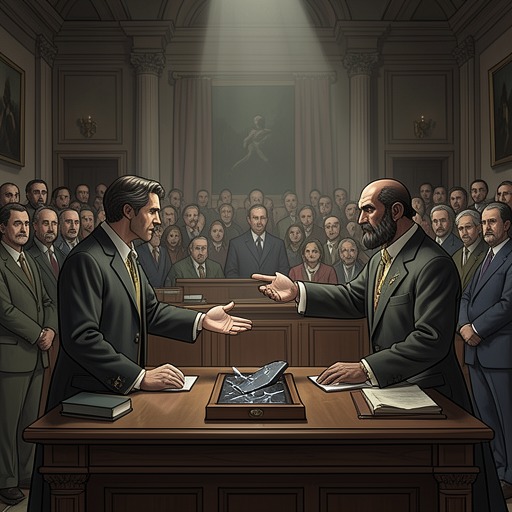
The Assembly’s accusation against Allison is comprehensive. Ruckk declares that she has committed piracy against Assembly property, violated its space, escalated to serial geocide, destroyed the Assembly vessel sent to contain her, and participated in the murder of peace officers. Allison does not accept the framing. When she is told that Earth’s fate has already been decided, she states that her petition is meant to stop retaliation against Earth because physical evidence proves that the humans were set up. D’armic then confirms that he has seen the evidence and that it caused him to turn his investigation away from the humans. Allison’s strategy is not to deny the conflict’s casualties or pretend that humanity’s conduct was beyond reproach; it is to force the Assembly to distinguish culpability from the narrative imposed upon it.
Her defense of humanity is also carefully qualified. When Maximus’s arrogance threatens to stand for the entire species, Allison asks the Assembly not to judge their race on Maximus alone and emphasizes that many humans are more cautious than he is. The appeal is strategically modest rather than triumphalist. She does not claim that humans are innocent by nature; she asks that collective judgment be based on evidence and differentiated responsibility.
Change, Return, and Narrative Role
By the epilogue, Allison returns to Eugene Graham’s penthouse disguised with sunglasses, a false plastic nose, and a tightly drawn hood, accompanied by D’armic and an android manifestation of Magellan. She brings fresh filet mignon from her chief engineer’s family, a domestic gift that contrasts with the weapons, prison ships, alien tribunals, and destroyed cruisers of the expedition. Her arrival makes the return literal: the captain who left Earth to push back the horizon comes home carrying not only survivors but new forms of companionship and political possibility.
Allison introduces the android as the AEUS Magellan, allowing Eugene to meet the intelligence he had previously known only as a ship. Magellan shakes his hand while explaining that she is normally much larger, turning the difference between vessel and embodied person into a final comic image. Allison’s role in this introduction is more than ceremonial. She has become the mediator who can present an artificial intelligence and an alien ambassador within a human domestic space without reducing either to an object.
Her journey follows the broad shape of a discovery and return narrative, but its transformation is ethical rather than merely geographic. She begins by waking to command an expedition and treating the unknown as an object to intercept, study, and bring aboard. She ends by defending a frightened alien witness, arguing against a species-wide verdict, protecting Earth through testimony, and introducing Magellan as a person. Allison’s achievement is therefore a revised definition of exploration: the horizon expands not only when humanity finds something new, but when its captain learns that the beings encountered beyond that horizon possess claims, fears, memories, and rights of their own.