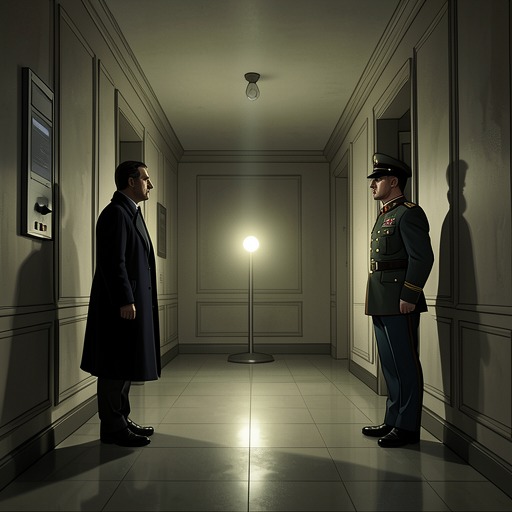
Allison Ridgeway–Maximus Tiberius relationship
Gate CrashersThe Allison Ridgeway–Maximus Tiberius relationship is one of the book’s most productive antagonistic partnerships. Allison Ridgeway treats command as a moral burden, especially when lives and the fate of Earth are at stake; Maximus Tiberius treats crisis as familiar territory, meeting existential danger with veteran bravado and an appetite for risk. Their exchanges often resemble combat, but the conflict is not empty hostility. Allison repeatedly acts as Maximus’s brake, while Maximus becomes an instrument of action when hesitation would be fatal.
Opposed Command Temperaments
Allison’s leadership is defined by incomplete information and the obligation to preserve life. When Maximus presses for immediate violence against unknown beings, Harris reports that the Bucephalus cannot be raised and asks whether Allison authorizes firing. Allison’s response rejects the premise that uncertainty permits slaughter: she questions ordering men to kill “these … people” without first speaking to them. The decision places her ethical caution directly against the time pressure imposed by the Turemok, but it also establishes the relationship’s central pattern: Maximus may accelerate events, yet Allison determines what their actions mean.
Maximus’s attitude toward danger is grounded in experience but expressed as insouciance. When Allison tells him that the fate of Earth is at stake, he answers that he has already driven nuclear-armed drone-carrier submarines through two wars and has become desensitized to missions described as the end of the world. Allison finds the statement alarming not merely because of his cavalier tone, but because it confirms that this apparently reckless man has repeatedly held Earth’s destiny in his hands. His confidence is therefore both a liability and a credential: it makes him difficult to control, but it also explains why he remains valuable in situations that would overwhelm less seasoned commanders.
Conflict as Tactical Complement
The relationship becomes clearest when their priorities collide during the confrontation involving D’armic. After a firefight in which Simmons is killed and the assault shuttle loses a pilot, Maximus argues that D’armic should be left barricaded inside. Allison refuses. D’armic is the only witness to what happened at Okim and an officer of the Assembly of Sentient Species; keeping him alive is necessary if the humans are to clear their names. Maximus huffs at the decision, then takes a covering position without further resistance. His compliance matters as much as his disagreement. He does not become less forceful, but he accepts Allison’s judgment when the larger objective requires restraint.
The same pattern appears after Maximus helps destroy a Turemok cruiser. Allison stares at the atomized wreckage, recognizing that he has saved their lives while fearing the consequences of his ego. She jokes that his personality has reached a point at which reality warps around it, then immediately asks how long it will be before they regret his intervention. The exchange captures the relationship’s unstable balance: Maximus’s aggressive initiative produces survival, but Allison remains responsible for measuring the danger that his initiative creates. Gratitude never cancels apprehension.
Public Friction and Private Amusement
Their hostility is also theatrical. During the Assembly hearing, Ruckk treats Maximus’s belligerence as evidence of human barbarism. Allison steps between them physically, throwing an arm across Maximus’s chest and pushing him back when his confrontation threatens to become another fight. She tells the Assembly that humanity should not be judged by Maximus alone and insists that many humans are more cautious than he is. The gesture makes her role visible: she is not simply arguing with Maximus but actively containing him before his manner can become political evidence against their species.
Maximus responds by enjoying the effect he has on her. When Allison sharply denies that she is his mate and says that the two posturing opponents can fight after the humans are finished, Maximus smiles and privately observes through the implanted communication system that he is pleased to provoke such strong feelings. His amusement turns their antagonism into a form of intimacy, though not a settled romance. He tests her composure, and she answers with irritation rather than submission; the resulting rhythm gives their scenes a charged, combative energy.
Trust Under Catastrophic Pressure
Despite their constant friction, Allison and Maximus trust one another where it matters. Allison does not permit Maximus to decide every question by force, but she relies on him in combat and on his ability to recognize opportunities that a more cautious commander might miss. Maximus, in turn, accepts her authority even when he considers her choices too slow or too humane. His willingness to take a covering position for D’armic shows that their partnership is not merely argumentative: he can subordinate his immediate preference to Allison’s strategic reasoning.
Their relationship also develops through shared responsibility rather than reassurance. When the Assembly has already judged the humans as pirates, violators of its territory, perpetrators of geocide, and killers of peace officers, Allison tries to separate humanity from Maximus’s conduct. She again places herself between his behavior and the judgment directed at their people. Yet the defense is complicated by her own awareness that his actions have helped produce the crisis. She cannot simply disown him, because his courage and combat effectiveness have repeatedly contributed to survival; neither can she endorse his methods without compromising the principles she uses to defend humanity.
Narrative Function and Significance
The Allison–Maximus relationship dramatizes two competing models of action under uncertainty. Allison represents deliberation, moral liability, and the effort to preserve a future beyond the immediate battle. Maximus represents speed, confidence, escalation, and the belief that survival often belongs to whoever acts first. Their arguments give those values distinct voices rather than reducing the conflict to a simple opposition between heroism and recklessness.
The partnership’s significance lies in its refusal to resolve that opposition. Allison does not tame Maximus, and Maximus does not convert Allison into an aggressor. Instead, each exposes the other’s insufficiency. Allison’s caution needs Maximus’s willingness to act when the window for action is vanishing; Maximus’s aggression needs Allison’s insistence that enemies may be witnesses, persons, or potential allies rather than targets. Their relationship therefore turns rivalry into a survival mechanism: the friction that threatens unity is also what prevents either commander’s governing instinct from becoming absolute.