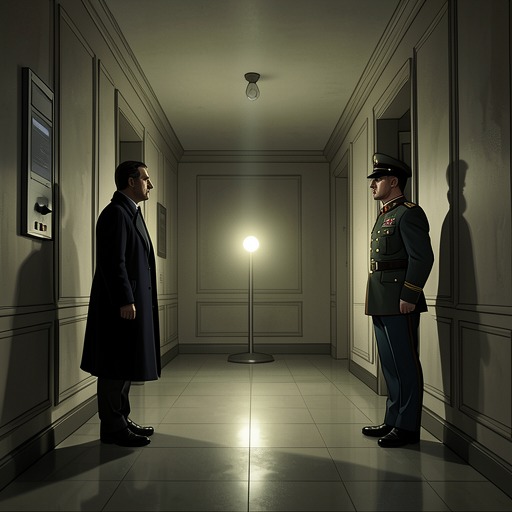
Allison Ridgeway–Maximus Tiberius rivalry and partnership
Gate CrashersThe Allison Ridgeway–Maximus Tiberius rivalry and partnership defines the uneasy alliance between two human captains whose ships, temperaments, and institutional loyalties pull in different directions. Allison Ridgeway commands the exploratory AEUS Magellan and treats first contact as a diplomatic responsibility; Maximus Tiberius commands the newer Bucephalus and approaches command as a performance of military authority. Their relationship is therefore neither simple antagonism nor easy friendship. It is a working partnership continually tested by pride, incompatible risk judgments, and the necessity of trusting someone whose instincts often seem reckless.
Opposed Commands and First Impressions
Maximus enters the bridge of the Bucephalus in a perfectly tailored AEU Navy dress uniform, immediately provoking Felix Fletcher’s dread and establishing the theatrical confidence that shapes his dealings with Allison. He insists that the Bucephalus is a warship because it is made for war, regardless of how its crew or administrators might describe it. With dignitaries, politicians, and media expected to arrive for a launch ceremony, he demands Felix’s assurance that the vessel will be ready within a week. Felix answers that it will not, and Maximus initially mistakes the blunt refusal for compliance before recognizing the challenge.
The contrast becomes explicit when Allison and Maximus review their new partnership. Allison Ridgeway considers Maximus an officer who acts like an action-vid hero rather than a real naval commander. Her judgment is sharpened by his preference for spectacle and intimidation, while his confidence appears to her as a liability in an uncertain expedition. Yet the same qualities that make him abrasive also give the human mission a military force that Allison’s exploratory command lacks. Their alliance begins not with mutual admiration but with a division of labor neither can safely ignore.
Conflict Over Risk and Responsibility
The relationship is tested almost immediately by a maneuver that places both crews in danger. When Allison contacts Maximus, her face appears hard with anger, and she tells him that his stunt nearly killed both crews. Maximus responds with his characteristic jovial posture, but the exchange does not erase the seriousness of the accusation. Allison is forced to acknowledge that she has jumped to conclusions and apologizes; Maximus accepts the apology without making much of it. The moment establishes a recurring pattern: their arguments are severe because the stakes are real, but operational necessity requires them to resume cooperation before resentment can be settled.
Their disagreement is not merely personal. Allison’s command ethic values restraint, evidence, and the preservation of diplomatic options, whereas Maximus treats visible force as a form of deterrence. In the crisis involving D’armic Ytol ev Shamel, Allison introduces herself as captain of the AEUS Magellan and describes the human mission as a peaceful expedition of exploration and discovery. Maximus interrupts with an uncompromising refusal to surrender and orders the alien vessel to withdraw, threatening to fill it with holes if it does not comply. Allison is so startled by the escalation that she orders the channel closed.
Allison then confronts Maximus directly, warning him that this is not the time for a contest of bravado and that the human sensor records may resolve the situation peacefully. She argues that the last thing required is for first contact to end in explosions. Maximus counters that D’armic’s ship has followed the humans for years and that D’armic may be trying to frame them for the destruction of Culpus-Alam. Allison recognizes that his theory fits the available evidence, even while refusing to let suspicion authorize the first shot. Their partnership works precisely through this collision: Maximus supplies an aggressive hypothesis and the willingness to act, while Allison subjects it to evidentiary and diplomatic constraints.
Negotiating a Common Mission
The disagreement continues after the immediate threat. Allison wants D’armic received with full diplomatic courtesies and an honor guard; Maximus wants guards assigned to escort him to the Bucephalus’s brig. Lieutenant Harris resolves the dispute by volunteering to lead the honor guard while also following D’armic closely enough to prevent him from getting lost. The compromise preserves Allison’s public commitment to hospitality without abandoning Maximus’s security concerns.
The captains also argue over which ship should host their visitor. Allison believes that receiving an alien aboard a warship would communicate the wrong intention. Maximus believes that his warship would communicate exactly the right one. Allison eventually prevails by pointing out that the six-decade-old Magellan poses less of a security risk and asking whether Maximus truly wants an inquisitive alien inspecting the Bucephalus’s new equipment. The solution is revealing: Allison defeats Maximus not by denying the military dimension of the encounter, but by converting his concern for secrecy and security into an argument for diplomatic control.
Their cooperation therefore depends on procedural negotiation rather than emotional harmony. Allison does not simply overrule Maximus, and Maximus does not simply abandon his position. Each forces the other to specify what is at stake: the appearance of peaceful intent, the protection of classified technology, the safety of the crews, and the possibility that the humans themselves are being manipulated. The partnership is strongest when their differences remain visible and are made to yield a practical compromise.
Rivalry as a Strategic Asset
The relationship’s value becomes clearest when the humans face a civilization that has already judged them. D’armic identifies Allison as the captain of the AEUS Magellan and declares his intention to place her and her crew in custody for the geocide of Culpus-Alam. Maximus’s aggressive response initially threatens to turn an accusation into a battle, but his suspicion that D’armic is constructing a case against them also proves strategically important. Allison’s caution prevents the suspicion from becoming an uncontrolled attack, while Maximus’s readiness prevents the humans from appearing helpless.
Their rivalry also exposes the unstable meaning of human action in interstellar contact. The humans understand themselves as explorers, but the Assembly’s account recasts their conduct as piracy, trespass, serial geocide, and murder. When Allison later attempts to defend humanity before Ruckk, she asks that the species not be judged solely by Maximus. The plea is itself an acknowledgment of his symbolic danger: his impatience and appetite for confrontation can become evidence against everyone. At the same time, the fact that Allison must defend the distinction between Maximus and the rest of humanity shows how indispensable his presence has become. He is the embarrassing extreme of the human response, but also one of the people willing to stand between the crews and annihilation.
The relation consequently follows a rivalry pattern rather than a reconciliation pattern. Neither captain is transformed into the other. Allison remains the advocate of restraint and interpretation; Maximus remains the advocate of force and decisive action. Their partnership survives because the mission repeatedly requires both positions, even when each regards the other as dangerous. Their arguments become an informal check-and-balance system within the human expedition.
Narrative Significance
Allison Ridgeway–Maximus Tiberius rivalry and partnership gives the book a human-scale form for its larger question about first contact: whether survival depends on appearing peaceful, being prepared to fight, or knowing when each posture must yield. Allison’s diplomacy and Maximus’s militarism are not presented as interchangeable virtues. Each can become disastrous when applied without the other. Allison’s caution risks delay and vulnerability; Maximus’s bravado risks provoking the very violence he claims to prevent.
The relationship also complicates the book’s treatment of authority. Allison commands the older exploratory vessel and carries the burden of representing humanity’s intentions. Maximus commands the technologically advanced warship and treats institutional power as something that must be displayed. Their encounters repeatedly make command visible as both responsibility and performance. The sharpness of their exchanges is not ornamental rivalry: it determines where the alien visitor is received, whether weapons are fired, how evidence is interpreted, and whether contact remains a dispute or becomes a battle.
By the time the human case is judged, their partnership has become one of the expedition’s necessary instruments, though not a peaceful one. Allison’s willingness to apologize when she has misjudged him and her insistence on limiting his escalation show that cooperation does not require surrendering principle. Maximus’s willingness to advance a dangerous theory and confront an apparent enemy shows that partnership does not require waiting for certainty. Together, they embody a divided but functional human response—exploratory conscience paired with military defiance—and the uneasy fact that both may be needed before either can claim to understand the universe beyond Earth.