American·European Space Administration
Gate CrashersThe American/European Space Administration (AESA) is humanity’s principal space institution and the organizational force that turns the alien buoy from an unexplained object into a scientific, political, and military crisis. Its importance lies not only in sending ships into deep space, but in deciding what discoveries mean, who may study them, how knowledge is secured, and whether a technological breakthrough will serve exploration or weaponry.
Formation and Institutional Position
AESA enters the story through Eugene Graham’s abrupt transformation from dean of Cornell University into the agency’s director. Danielle Fenton, one of Graham’s former students, achieved a stable political orbit and was elected to the American/European Union Parliament; she submitted Graham’s name for consideration to lead the agency, and the president soon offered him the post. Graham accepted in an uncharacteristic fit of ambition, leaving behind an academic life for an organization whose decisions carried global-security consequences.
Although AESA’s headquarters are in Berlin, the agency maintains Fleet Com at the Stack in Washington, D.C. The Stack is a five-sided tower that began as the Pentagon and grew through centuries of added layers. Its placement makes the distinction between civilian exploration and national security deliberately unstable: the securest location for AESA’s network of quantum entanglement radios is also the center of America’s most security-conscious building. The heavily fortified approach, automated air-traffic controls, weapon systems, and increasingly invasive checkpoints present AESA not as a detached research institution, but as part of a security state.
The Buoy and the Production of Knowledge
AESA’s scientific authority develops through a network of ships, instruments, specialists, and administrative decisions. When the AEUS Magellan detects a sixteen-meter object less than two light-hours away, the object’s static position already violates ordinary expectations about inertia and interstellar motion. Its titanium composition, later found to include traces of other metals in an alloy unlikely to occur naturally, establishes that the object is manufactured rather than geological. The discovery becomes an AESA problem because the agency possesses the personnel and communications infrastructure needed to investigate it.
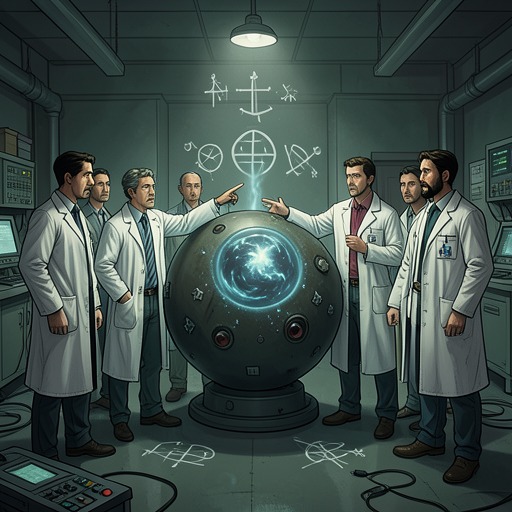
Eugene gathers a team around the Artifact Research Team, known as ARTists, and recruits Felix Fletcher into the project. In a briefing at the Stack, he explains that the shell is made from a titanium-and-palladium alloy unknown on Earth or in the colonies, while the object emits a bizarre signal. AESA therefore functions as more than a sponsor of research: it assembles the interpretive community that converts raw readings into an institutional fact. The buoy’s mystery is stabilized through Magellan’s observations, laboratory analysis, holographic schematics, team discussion, and Graham’s authority to define a research agenda.
The investigation repeatedly forces AESA’s experts to revise their categories. The buoy has no identifiable power source, even though it contains ample energy for its transmitter. Felix later concludes that the radio signal is not the device’s true purpose, comparing its radio emission to the incidental heat produced by an incandescent light bulb. The object’s interior produces another rupture in scientific expectation: after Billings burns a hole into its sealed shell, the examination reveals nothing inside except another dimension. In this sequence, AESA’s authority is built through anomalies rather than certainty. Each failed explanation becomes evidence that the agency’s existing conceptual tools are inadequate.
The breakthrough arrives when Felix stops trying to force the unstable geometry of the emitters into submission and allows the current to carry him. The distortions fade, a power spike runs through the building, and the vacuum chamber displays a perfect hole that reflects no light. AESA’s research apparatus has moved from observing an alien device to reproducing part of its operating principle. Scientific discovery is thus shown as a collective institutional achievement: intuition, dangerous experimentation, equipment, technical records, and organizational tolerance for risk all contribute to the first workable opening into hyperspace.
Administration, Resources, and Military Pressure
The buoy’s implications transform AESA’s political environment. Once officials learn that as many as six intelligent alien species may share humanity’s galactic neighborhood and that those species are effectively fencing humans off, disbelief gives way to indignation. The ARTists project receives a dramatic budget increase because superiors want every usable technology extracted from the buoy as quickly as possible. Allison Ridgeway and her team are prepared to resume their shifts through the quantum entanglement radio network, while the research groups continue operating at expanded capacity.
The new resources come with a cost. Eugene and the senior members of the team are increasingly uncomfortable with the military’s growing influence through AESA defense collaboration. The agency becomes a contested institutional space in which civilian exploration, scientific curiosity, strategic anxiety, and weapons development compete for control of the same discoveries. The buoy is not merely an object to be understood; it is a source of capabilities that powerful organizations immediately seek to appropriate.
This pressure reflects a recurring institutional logic: new technology is first evaluated according to whether it can make killing easier, while peaceful applications become secondary. AESA’s research environment therefore carries the contradiction of modern space administration. It expands knowledge in the name of exploration while operating inside structures prepared to convert knowledge into coercive power.
Secrecy, Leaks, and Organizational Vulnerability
AESA attempts to contain the ARTists project through classified communications and controlled access, but its secrecy proves fragile. Gladstone Rockwell confronts Eugene with a live feed from Loose Lips Ezine showing more than a terabyte of internal ARTists communications, including memos, technical papers, and schematics. The leak exposes not only sensitive research but the agency’s inability to preserve the boundary between an officially managed project and the wider information network surrounding it.
The leak also changes the balance of power around the project. Rockwell argues that the ARTists team possesses the sum total of human experience in hyperspace research, but lacks experience in other areas relevant to institutional control. His evidence implies that scientific brilliance does not guarantee administrative competence, operational security, or political durability. AESA’s research community can interpret the buoy, yet the agency remains vulnerable to journalists, insiders, military interests, and officials who can redirect its resources.
The organization’s chain of command is equally visible in its emergency operations. When Eugene needs to act, he relies on assistants, secure communications, and the agency’s networked infrastructure. At one point, with Kiefer and his associates confined under Specialist Balog’s supervision, Eugene attempts to connect with the Unicycle and demands immediate contact with Lemieux. The scene places AESA’s director inside a frantic administrative machinery: authority depends on communication links, intermediaries, and the ability to reach the right person before a crisis outpaces procedure.
Exploration, Contact, and the Limits of Institutional Vision
AESA’s mandate extends beyond laboratory work into exploration and first contact. The Magellan’s discovery is initially a problem of detection: the ship finds an object that is sixteen meters long, stationary, artificially composed, and broadcasting a signal. Later, sensor irregularities during acceleration suggest that the agency’s instruments themselves may be unable to register an approaching danger; one aft sensor reports localized fuzziness without mass or energy readings, as though it were viewing ordinary space through smudged glasses. AESA’s technological superiority therefore remains conditional. Its instruments can reveal the impossible, but they can also conceal what lies directly beyond their interpretive range.
The agency’s work eventually encounters a deeper challenge to human assumptions when a ground team meets a short, unclothed woman carrying a blowgun and marked with blue-and-white paint. Beneath those superficial differences, she is unmistakably human. This discovery gives AESA’s outward-looking project a historical and political dimension: space exploration does not encounter only machines and distant civilizations, but human populations whose existence unsettles official accounts of human expansion and isolation.
AESA consequently stands at the junction of several forms of control. It maps space, classifies artifacts, manages communication, recruits experts, protects secrets, distributes budgets, and negotiates the boundary between civilian research and military action. Its institutional reach makes extraordinary discoveries actionable, but its structures also reproduce the hierarchies and strategic reflexes that threaten to determine how those discoveries will be used.
Narrative Significance
As an organization, AESA embodies the book’s movement from scientific anomaly to civilizational conflict. The alien buoy passes through its laboratories and command centers, and each institutional response alters the stakes: detection becomes investigation, investigation becomes technological reproduction, reproduction becomes political controversy, and controversy becomes a struggle over military control and public knowledge.
AESA is neither a simple instrument of progress nor merely a villainous bureaucracy. It is a network of people and machines whose capabilities depend on cooperation but whose incentives pull toward secrecy, competition, and weaponization. Eugene’s leadership gives the agency an unusually inventive center, while the ARTists project supplies the intellectual energy that makes the impossible operational. Yet the agency’s dependence on security institutions ensures that every scientific advance arrives already entangled with questions of ownership, authority, and force.
Its decisive significance is therefore institutional rather than merely technological. AESA makes humanity capable of responding to the alien presence, but it also reveals how quickly humanity’s oldest political habits follow it into space.