Artists Superspace Generator
Gate CrashersThe ARTists hyperspace generator is the central technological breakthrough of the Artifact Research Team’s work: a machine that turns the alien buoy’s seemingly impossible mechanisms into a controllable passage through hyperspace. It begins as an object of scientific bewilderment and ends as an operational drive aboard the Bucephalus, making the device both a research instrument and the foundation of humanity’s first practical hyperspace travel.
Discovery and Scientific Problem
The generator’s origin lies in the artifact recovered by the Magellan. When the object first appeared, it was sixteen meters long, made primarily of titanium with traces of other metals, and anomalously stationary in the void. Its material composition was unlike naturally occurring space debris, and its signal created further confusion. The ARTists initially approached the artifact as an unknown machine, but each examination undermined familiar assumptions: it had no identifiable power source despite possessing abundant energy, and its apparent radio transmission was not its true purpose.
The artifact’s interior presented an even more radical challenge. After Billings burned a camera lead through the sealed sphere, the unchanged whistle revealed that air had not entered the opening as expected. Playback of the examination showed that the sphere contained nothing ordinary—nothing except another dimension. That discovery invalidated the prevailing physical framework, since the dimension did not correspond to any of the thirteen dimensions predicted by the Third and Final Theory of Everything. The generator therefore emerges from a chain of anomalies rather than from a straightforward engineering program: the immobile object, the unexplained energy, the misleading signal, and the impossible interior all become clues to a new physical order.
Construction and First Test
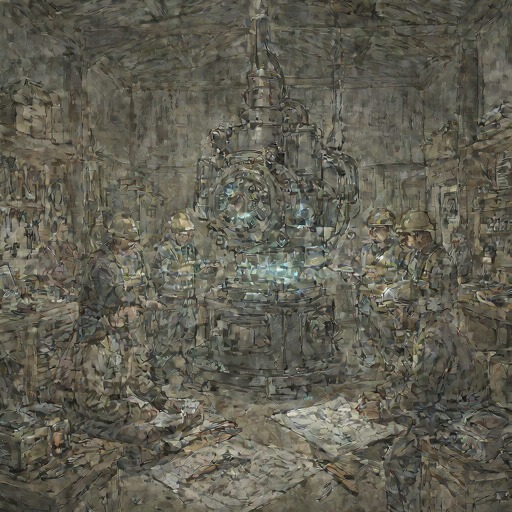
Felix Fletcher’s team spent the following year studying and copying the mechanisms at the heart of the buoy’s transmitter. The work became an all-consuming obsession for Felix and was described as the most important human project since the development of gravity manipulation. The research also exposed the institutional character of the breakthrough. The ARTists’ findings were assembled from raw data sent by the Magellan, laboratory examinations, technical papers, schematics, and the coordinated judgments of scientists working under Professor Eugene Graham. Even the team’s secrecy became part of the device’s history when classified ARTists communications were leaked through Loose Lips Ezine.
The first test could not safely be conducted in a densely populated part of Washington, D.C. A secondary facility was therefore built in northern Wisconsin, where the isolation served both security and safety. The machine was not treated as a harmless laboratory apparatus. Its reactor consumed mass rapidly, its plasma containment lining was eroding under repeated exposure to one-hundred-million-degree plasma, and a failure could have released the plasma loop into the building. The test was consequently a race between scientific control and material exhaustion.
Felix initially tried to force the geometries of the different emitters into alignment as they slipped out of synchronization. The decisive moment came when he stopped trying to dominate the instability and allowed the current to carry him through the problem. The distortions vanished, a power spike flashed through the building, and the vacuum chamber revealed a perfect hole that reflected no light. The generator had not merely produced an unusual energy pattern; it had opened a spatial absence that could be maintained.
Operation and Capabilities
The first successful result was announced with a precise limitation: the team had created and maintained a stable hyperspace window half a meter across for almost thirty seconds. That modest aperture was nevertheless a historic threshold. It demonstrated that the buoy’s mechanisms could be reproduced, that the resulting passage could remain stable, and that human operators could control a phenomenon previously accessible only through an alien artifact.
The team’s confidence rested on repeated simulations and safeguards copied from the buoy, supplemented by additional protections of their own. Felix acknowledged that an almost negligible probability of catastrophic failure was not the same as no possibility of failure, while Jeffery pointed out that outsiders would regard the team’s work as madness. The generator thus carries a persistent double identity: it is a rigorously simulated scientific instrument, and it is also a device whose operation appears to violate the laws of physics so completely that insanity becomes a joking defense.
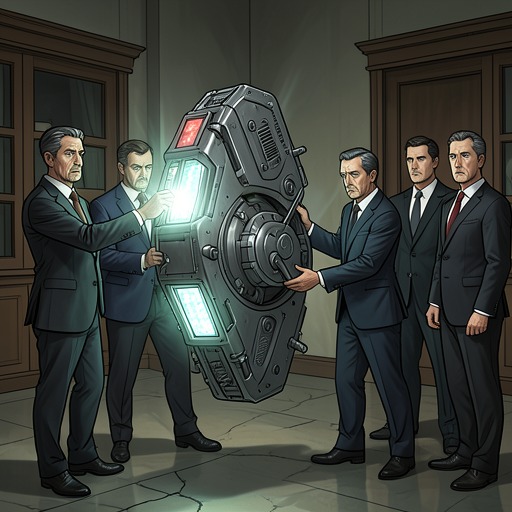
Its shipboard form requires more than simply activating a reactor. On the Bucephalus, the hyperspace system uses three projector heads mounted behind small portals in the ship’s shield dish. The projectors require line of sight, so armor plating must move aside and expose the delicate electronics and biological systems inside the hull. Felix powers the generator and makes final adjustments from his console, while the ship’s protective architecture temporarily opens to permit the drive to function. The system’s effectiveness therefore depends on a carefully coordinated relation between power, geometry, projection, shielding, and the operator’s judgment.
Deployment Aboard the Bucephalus
The generator’s first major political consequence follows the bargain that places it aboard the Bucephalus. The ship receives the ARTists’ hyperdrive on loan, with Felix as its chaperone. This arrangement makes the generator inseparable from the scientist who understands its operation, while also transferring the technology from a protected research environment into a vessel capable of independent missions. Felix’s presence ensures technical continuity, but it also shows that the device remains experimental rather than fully domesticated by an institution.
During preparation for the ship’s operation, Felix is already buried in the console, powering up the generator and performing last-minute adjustments. The work is largely complete after two weeks of preparation, yet the scene emphasizes the importance of his visible activity: technical control is practical, ceremonial, and psychological at once. The three projector heads slide into position, the armor moves out of the way, and the machine’s power becomes a navigational capability rather than a laboratory curiosity.
Narrative and Historical Significance
The ARTists hyperspace generator marks a paradigm shift in the story’s treatment of knowledge. The buoy’s properties first appear as disconnected impossibilities: an object with no course, an alloy that does not belong to Earth or its colonies, a transmitter that is not really a transmitter, a sealed sphere that contains another dimension, and a power supply with no source. The generator is the point at which these anomalies become operational knowledge. What had resisted measurement is copied; what had seemed metaphysical becomes engineered; what had belonged to an alien civilization becomes a contested human technology.
The device also gives material agency to the artifact itself. Human researchers do not invent hyperspace from an autonomous theoretical insight; they follow the buoy’s clues, reproduce its mechanisms, adapt its safeguards, and learn through encounters with matter that refuses ordinary explanations. The alien object therefore participates in the development of the technology, directing human attention and limiting human certainty even after its secrets begin to yield.
At the same time, the generator exposes the political risks of scientific success. Its construction is pressured by Danielle Fenton’s demand for progress and by plans connected to the president’s armed courier. Its secrecy is compromised by the ARTists leak. Its operation requires an isolated facility because an accident in a population center could be catastrophic. Once installed aboard the Bucephalus, it is no longer only a scientific answer to an alien puzzle; it becomes a means of travel, a strategic asset, and a device capable of placing humans inside conflicts and spaces that conventional propulsion could never reach. Its decisive significance is therefore double: the generator opens a new physical route through the universe while simultaneously closing the era in which humanity could treat interstellar contact as a distant theoretical possibility.