Authorization and launch of the Expedition to Punish the Earth
Gate CrashersThe Assembly’s authorization and launch of the punitive expedition against Earth is the decisive institutional escalation of the human crisis. What begins as an investigation into planetary geocide becomes an irreversible military operation: the Assembly accepts a case against humanity under the Treaty of Pu’Lan, authorizes action against Earth and its colonies, and dispatches an armada before the human delegation can prove its innocence. The expedition’s danger lies not only in its destructive power but in the gap between legal judgment and practical control. By the time the Assembly acknowledges that the evidence may be false, the fleet is already in motion and the remaining hours have become a countdown to Earth’s possible destruction.
Causes and Political Background
The expedition grows out of a civilization-wide security panic. Space had traditionally remained largely free of weapons. The Outer Space Treaty formally prohibited nuclear weapons in space and military bases beyond Earth, while a broader gentlemen’s agreement had extended the prohibition to offensive weapons generally. The discovery of humanity’s technological frontier therefore threatened to revive the arms-race logic of the Cold War. For Lockheed-Boeing-Raytheon, whose influence reached from Warsaw to Walmart, the prospect of militarizing space represented defense contracts worth untold trillions. The political presence of Gladstone Rockwell, whose real constituency was understood to be the defense contractor rather than the Chicago-Milwaukee metro area he represented on paper, embodies the economic pressure surrounding the emerging crisis.
The immediate pretext was the destruction of Culpus-Alam. D’armic discovers that the fiery worm encountered in high-space has the same estimated mass as the material missing from the destroyed system, revealing that the phenomenon was not an illusion but the remnant of a geocidal attack. He then explains that, millennia earlier, the Lividite war machine had overreached during its war against the Pu’Lan and other opponents. To punish the Pu’Lan, the Lividites opened a high-space portal through their world, creating a magma tunnel whose collapse shattered tectonic plates, disrupted the planet’s core and magnetic field, and triggered an apocalypse. This history gives the present accusations their terrible weight: planetary destruction is not an abstract possibility but an established military method.
Humanity is nevertheless framed for crimes it did not commit. Maximus asks why the Turemok are blaming humans for destroying planets, including one with human inhabitants. D’armic attributes the deception to the Turemok’s suspicion of outsiders and their fear of humanity’s rapid technological progress. Their alleged plan is to persuade the Assembly to take punitive action against Earth. The Assembly’s response converts that deception into formal authority, demonstrating how a threat narrative can become policy before its evidence has been adequately tested.
Authorization Under the Treaty of Pu’Lan
After J’quol’s death, Jak’el and Grote identify an Assembly order of action among the files scattered across the floor. The order is based on the Treaty of Pu’Lan and applies against Earth and its colonies. Jak’el states that it takes effect immediately, provided the document can be found again, and declares that the Kumer-Vel will lead the attack from the bridge of the Xecoron. His proposed commemoration of J’quol is not mourning but revenge: Earth itself is to become the dead man’s funeral pyre.
The scene makes the expedition’s legal foundation appear both consequential and disturbingly physical. A treaty clause, an order of action, and a hurried search through discarded files are enough to connect bureaucratic paperwork with planetary annihilation. The language of authorization gives violence an administrative shape, while Jak’el’s personal promise of vengeance reveals the emotional motive beneath the formal instrument. The order is therefore neither purely legal nor purely retaliatory; it is a political mechanism through which grief, suspicion, and military power reinforce one another.
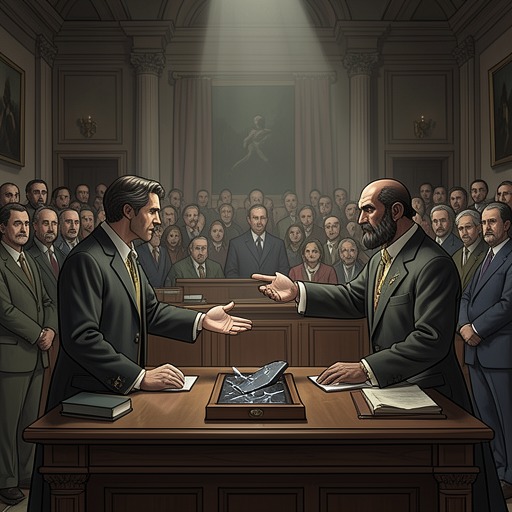
The institutional logic becomes explicit during the Assembly hearing. D’armic reports that, after examining the human records, he has conclusively eliminated both human vessels as possible perpetrators of the geocide of Culpus-Alam. Allison accepts the finding as confirmation of what the humans already knew, but the discovery does not automatically stop the process. Bloon Representative explains that the Assembly is obliged to investigate the new evidence, yet cannot halt the punitive expedition already authorized against Earth. The distinction is devastating: the Assembly may be procedurally willing to reconsider the accusation, but its authority cannot instantly reverse the consequences of its earlier decision.
Dispatch and the Countdown to Earth
Bloon clarifies that the armada was dispatched weeks earlier, after the destruction of Kulla was reported. The expedition is therefore not merely an order awaiting execution; it is an already moving force distributed across interstellar space. Allison emphasizes that thirty billion people live on Earth and argues that destroying the planet despite evidence of human innocence would be monstrous. Maximus demands that the fleet be recalled, citing the human delegation’s succession of near-deaths—drowning, shooting, poisoning, explosions, crushing, burning, torture, eating, and asphyxiation—as evidence that the humans will not passively accept institutional delay.
D’armic supplies the crucial operational explanation. There is not enough time for a recall order to reach the armada. The Xecoron will arrive at Earth shortly, while the remaining ships are scheduled to reach the colony worlds and begin enforcing sequestration at the same time. The punitive expedition thus combines direct attack with the isolation of human colonies. Its reach is not limited to the alleged site of the crime: Earth and its off-world settlements are treated as a single population subject to collective punishment.
The approaching attack is repeatedly represented as a disaster that outruns comprehension. Allison cannot sleep after multiple firefights, captivity, the threat of torture, and witnessing the death of a planet; above all, the unresolved possibility of Earth’s destruction keeps her awake. In another scene, Felix sees a gargantuan red-hot inverted cone rising beyond the horizon over a quivering city, a scale of destruction too large for ordinary vision to contain. These images place administrative delay beside planetary catastrophe: while officials discuss authorization, individuals experience the approaching consequences as insomnia, horror, and physical disorientation.
Eugene eventually receives confirmation that the retaliatory strike against Earth has already been launched before the human effort to prevent it can arrive. The attack is described as imminent, possibly occurring at any moment. This reversal closes the gap between warning and event. The expedition is no longer a distant diplomatic threat or a legal possibility; it has become an active operation whose timetable may defeat every attempt at correction.
Interception and Consequences
The expedition’s immediate consequence is the conversion of the human case into a race against military momentum. The Assembly’s recognition of new evidence does not restore the status quo, because the armada has already been dispatched and its ships are operating according to a schedule. The process exposes a structural failure of interstellar justice: investigation can produce exculpatory knowledge, yet that knowledge arrives too late to control forces released by an earlier decision.
The Xecoron becomes the visible instrument of this failure. Bloon identifies it as the ship due to reach Earth shortly, while Maximus responds with bitter disbelief that a single vessel is being sent against the human home world. The apparent modesty of the attacking force does not lessen the danger, because the human technology involved is capable of planetary-scale destruction. The same wider history that explains geocide also makes the expedition’s threat credible: a ship need not resemble a conventional armada to end a world.
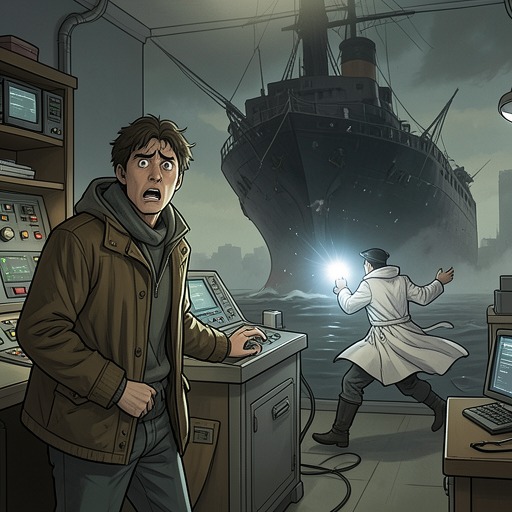
The humans ultimately act against the Xecoron rather than waiting for institutional rescue. Renée pushes the Unicycle’s targeting control after the crew has spent nearly an hour disabling a dozen fail-safes designed to prevent precisely such an action. Charged particles pour from emitter assemblies hundreds of kilometers from the hub, and five seconds later a 32.4-terawatt particle beam strikes the target. The result is presented through an intentionally absurd domestic comparison—an uncooked egg wrapped in aluminum foil and placed in a microwave powered by the output of the nearest nuclear plant—which reduces incomprehensible energy to a model of total physical violation. The interception is therefore both a survival measure and a grim continuation of the technological escalation that made the punitive expedition possible.
Narrative and Thematic Significance
The event dramatizes a security dilemma in which each civilization interprets technological change as evidence of impending aggression. The Turemok fear humanity’s rapid advancement; humanity reads the punitive expedition as an existential attack; the Assembly responds to reported planetary destruction with exceptional force. None of these perceptions remains merely rhetorical. Each becomes a justification for action, and each action supplies the next side with further evidence that its fears were justified.
The expedition also tests the relationship between law and justice. The Treaty of Pu’Lan gives the attack a recognizable legal basis, but the procedure is compromised by deception, collective punishment, and the inability to suspend an operation once it has begun. The Assembly’s officials are not simply portrayed as ignorant of the truth: they receive new evidence and acknowledge the possibility that the humans are innocent. The tragedy is that acknowledgment cannot keep pace with the machinery of enforcement. Law remains present, but its procedures have been overtaken by military logistics.
Finally, the event extends the book’s recurring contrast between ordinary human absurdity and extinction-level violence. A politician smells of oak and bacon grease while space militarization promises unimaginable contracts; a scout reports encountering people in an alien forest; a soldier remains relaxed with narcotic candy while a crimson weapon rises over a city; and a recall order fails because the fleet is already too far along its route. The punitive expedition gathers these contrasts into one governing irony: the fate of Earth depends on paperwork, suspicion, and communication delays, even though the forces unleashed by those small institutional acts are large enough to erase a planet.