Beiwisconsin Test Base
Gate CrashersThe northern Wisconsin beta site is the secluded experimental facility built to test humanity’s first hyperspace generator. Far from the dense population and political visibility of Washington, D.C., it converts the alien buoy’s incomprehensible mechanisms into an operational human technology. Its decisive significance lies in the contrast between its deliberately unremarkable setting and the event conducted within it: in a former paper mill surrounded by snow and old-growth forest, Felix and his team open the first human-made portal to hyperspace, an act that immediately triggers an automated alien response.
Purpose and Secluded Setting
The site was established after Felix’s research team spent a year studying and copying the mechanisms at the heart of the buoy’s transmitter. Developing the first hyperspace generator became an all-consuming project and was described as humanity’s most important undertaking since the development of gravity manipulation. The test could not safely or securely be conducted in a population center as dense as Washington, D.C., so a secondary installation was constructed in northern Wisconsin, a place chosen precisely because almost nothing exciting was expected to happen there.
The surrounding climate reinforces the site’s isolation. The winter cold is portrayed as bitter, persistent, and almost cunning, with frosts capable of opening carelessly unlatched windows and a rumored cold snap that once jump-started a car before crashing it several blocks later. Harris treats the conditions as ordinary compared with his Alaskan cold-weather training, while Felix can barely hear him through his hat and hood. The landscape nevertheless has a stark grandeur: glacier-formed hills, old-growth pine forest, and the muted quiet of deep snow stand opposite the steel, glass, and concrete of the city.
Security and Physical Infrastructure
The generator is housed in an unassuming industrial building that had previously been a paper mill. Woodchips still litter the grounds, preserving the appearance of an abandoned or repurposed industrial site rather than a center of revolutionary research. Almost no one had visited the location for nearly a decade. The visible signs of renewed activity were limited to heavy equipment tracks in the snow, a new aircar pad, and sentry androids.
Security at the approach is overtly military. Two army Mk XXII infantry-support androids, modified for winter environments, guard the facility. They are taller and bulkier than the Mk VI android stationed at the QER Center, their splayed feet functioning like snowshoes. Their mounted weapons appear designed for combat rather than for minimizing collateral damage, making ordinary cover behind trees, buildings, or low hills effectively useless. The site therefore combines concealment from civilian society with conspicuous force against anyone who attempts to penetrate it.
The Hyperspace Test
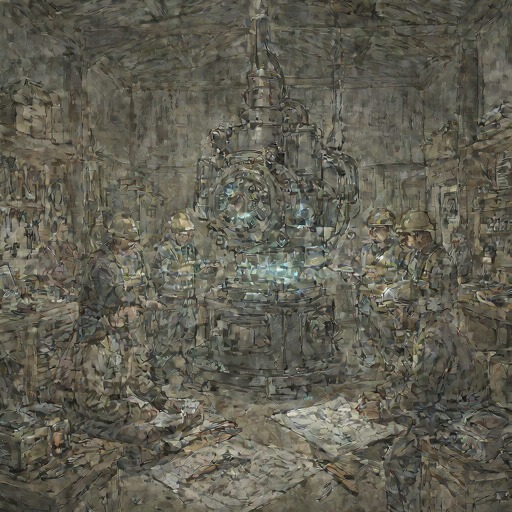
Inside the facility, the research team faces a problem that is both technical and catastrophic in scale. The reactor cannot sustain unlimited cycles at the required power. Its ablative lining is being eroded by constant exposure to high-energy particles, and continued operation risks allowing a loop of one-hundred-million-degree plasma to escape the containment chamber. The test is thus constrained by a material countdown: the researchers must stabilize the generator before the machine destroys itself or breaches its containment.
Felix struggles to keep the geometry of the different emitters synchronized as their distortions slide out of alignment. The solution arrives when he stops trying to force the problem into submission and instead allows the current to carry him. The distortions diminish and disappear. A power spike surges through the building, intense enough that everyone later reports seeing flashes like static in their eyes.
The camera inside the vacuum chamber then shows the result: a perfect hole that reflects no light. The image provides the first visible confirmation that the generator has worked. The site has not merely reproduced an alien component or produced an anomalous signal; it has created an actual portal, making hyperspace an engineered possibility rather than an unexplained property of the buoy.
Immediate Consequences
The test’s consequences extend beyond the Wisconsin facility almost at once. Deep inside an asteroid orbiting past Mars, an automated sensor platform detects the portal signature. Its instructions tell it to call home when such a signature is found, and it transmits the relevant data. It then begins the next programmed step, self-destruction, but the evidence cuts off as the platform protests and attempts to interrupt the sequence. The portal therefore functions as a signal as well as a physical opening: human experimentation is immediately visible to an alien monitoring network.
The site also represents a change in the interpretation of the buoy. Earlier observations had accumulated as anomalies: the object was sixteen meters long, less than two light-hours away, and not moving on any course at all, despite the impossibility of an object remaining in interstellar space without inertia. Later examination revealed that the sphere appeared to contain nothing except another dimension, while Felix recognized that its radio emission was not its true purpose. The northern Wisconsin test is the point at which those separate contradictions become technically actionable. What first looked like inexplicable space debris, then an impossible sealed sphere, becomes the model for a working hyperspace device.
Narrative and Thematic Significance
The beta site’s location gives the breakthrough an ironic form. A former paper mill in a place celebrated for uneventfulness becomes the setting for an event that changes humanity’s relationship with distance, alien technology, and the wider galaxy. The ordinary building, residual woodchips, snowbound landscape, and armed androids make the extraordinary appear almost accidental, while the containment calculations and the portal’s black perfection reveal how much danger is compressed beneath that modest exterior.
The facility also embodies a transition from observation to intervention. The buoy had initially been something Magellan detected and could not fully explain; its signals and physical structure forced human investigators to revise their assumptions repeatedly. At the beta site, the research team no longer merely records an anomaly. It copies the alien mechanism, subjects it to human control, and produces a portal whose signature alerts an external civilization. Scientific discovery consequently becomes an act with strategic and political consequences, and the quiet Wisconsin installation becomes the first place where humanity announces its technological arrival beyond its own immediate sphere.