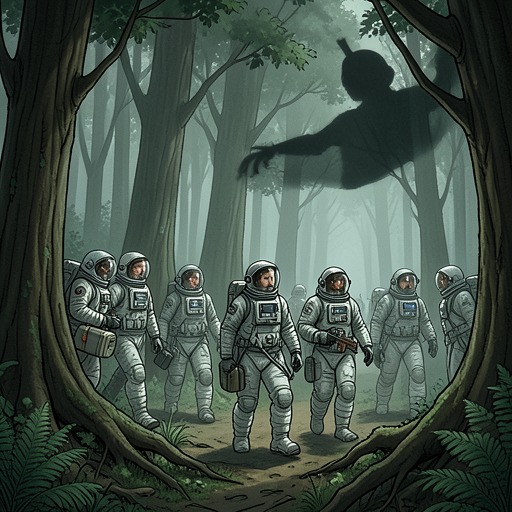
Cave of the Creators
Gate CrashersThe Cave of the Creators is a network of tunnels and chambers beneath the settlement of the Pirikura on Culpus-Alam. First identified through a child’s reference to a forbidden, dangerous place, it becomes the decisive site where the human explorers uncover the machinery behind the tribe’s origin story. The cave is not a supernatural sanctuary but an engineered observation post, built by the civilization that removed human populations from Earth and placed them on the planet for controlled study. Its walls therefore preserve both a local myth and the concealed history of interstellar human experimentation.
Discovery and Local Meaning
The cave enters the expedition’s awareness through the Pirikura community rather than through human instruments. While Allison Ridgeway and her team attempt to locate Felix Fletcher, a Pirikura child recognizes that the explorers’ map corresponds to the geography of her home: the village, the river, and the forest. She points toward the forest and speaks rapidly, prompting Allison to ask about the “Cave of the Creators.” The child’s mother reacts with fear and prohibition, describing the place as forbidden and dangerous and indicating that the village men are not warriors or heroes capable of taking the explorers there. When Allison asks only for the cave’s position on the map, the mother admits that she does not know it, but says that Tolo does.
The Pirikura name gives the location a sacred and genealogical force. The cave is understood as the domain of creators, and the community’s repeated attention to it suggests that the tribe has inherited an incomplete memory of its makers. That belief is later reinterpreted rather than simply dismissed: the “creators” were real, but their work was technological and experimental rather than divine. The cave thus preserves a truth in mythic form, even though the Pirikura do not possess the historical framework needed to explain what they have been observing.
The Underground Expedition
Thomas Harris leads a three-person unit into the cave’s tunnels, leaving a two-person detachment at the entrance to prevent an attack from behind. The darkness is nearly total, but the team’s armor converts the environment into something navigable and measurable. Integrated radar records a three-dimensional scan of the route, while the helmet visors display a false-color, real-time rendering of the cave interior. The technology allows the unit to move quickly and quietly through a space that would otherwise reduce them to stumbling, noisy bodies.
The expedition makes the cave legible in two different ways. The armor maps its physical structure, while the explorers’ questions map its historical function. Felix Fletcher notices that a chamber has been cut with tool marks too evenly spaced to have been produced by hand. Because the Pirikura possess no metal in their weapons or jewelry, he concludes that the room was carved by whoever brought the people to the planet. The cave is therefore not merely a natural refuge later occupied by the tribe; its architecture is a surviving trace of the population-transfer operation itself.
The Hidden Door and the Observation Post
Felix identifies a concealed door in the rough-cut antechamber by combining the cave’s tool marks with the behavior of the Pirikura leader. The leader had been listening to one section of the wall, which suggests to Felix that someone or something had once emerged there and that the event became the foundation of the community’s creator myth. The Pirikura have apparently continued returning to the site to listen to their gods, while in material terms they have been approaching a sealed technological installation.
The explorers cannot find a release mechanism for the door. Allison Ridgeway’s survey team eventually uses a powerful laser brought from the shuttle to break through, an act that makes the technological asymmetry between the investigators and the Pirikura unmistakable. Felix observes that the builders probably never expected the inhabitants to possess a megawatt-range laser. The cave’s security was designed against the capabilities of an isolated tribal population, not against a spacefaring expedition arriving with advanced equipment.
Once the doorway opens, the chamber responds to the explorers’ entry. Organic webs of iridescent wires pulse along smooth walls in a pattern resembling the interior of an alien buoy. Images then appear across the walls, showing the Pirikura village from a dozen viewpoints. Women and children walk along dirt roads and boulevards, unaware that observers beneath the ground are watching them. The cave’s true identity is consequently immediate and disturbing: it is an observation post, a concealed apparatus for turning an entire community into an object of surveillance.
Culpus-Alam and the Human Experiment
The cave’s significance becomes clear when Vel Noric identifies the planet as Culpus-Alam, a world set aside many generations earlier for the controlled observation of humans. The experiment was left unattended for many cycles while isolated tribes developed distinct cultures. Its intended next phase was to encourage contact among those groups and study their interactions, producing knowledge that might help the Assembly of Sentient Species predict humanity’s eventual integration into galactic society.
The human populations on Culpus-Alam were not native to the planet. When Allison Ridgeway asks where they came from, the explanation is direct: they were taken from Earth. Isolated tribes were preferred as the base stock, while random sampling was added to reduce the danger of inbreeding. The cave therefore belongs to a larger system of removal, isolation, classification, and observation. Its sacred meaning for the Pirikura conceals a history in which their ancestors were selected, transported, and placed within an environment designed by outsiders.
The experiment arose from the Assembly’s uncertainty about humanity. Its observers had watched Earth broadcasts that presented humans as cooperative and capable of working with other species, while other broadcasts depicted humans destroying one another and aliens. The contradiction produced no confidence about which image was authentic, so the Assembly created an artificial setting in which human behavior could be studied directly. The Cave of the Creators is the local, architectural expression of that distant epistemological problem: human lives become data because the observers cannot reconcile humanity’s nobility with its violence.
Surveillance, Protection, and Narrative Significance
The cave mirrors the wider network of buoys surrounding Earth. Gladstone Rockwell describes humanity as being caged like zoo animals, while the official explanation insists that the buoy network is a buffer intended to warn outsiders away from Earth space, not to imprison humanity. The same ambiguity governs the cave. From the Assembly’s perspective, the installation is research infrastructure supporting a controlled preserve; from the Pirikura perspective, it is a forbidden realm belonging to powerful creators; from the explorers’ perspective, it is an invasive surveillance system hidden beneath the people it studies.
This contradiction exposes the political vocabulary of protection. The Assembly calls Culpus-Alam an anthropological experiment and describes the Earth perimeter as a preserve, but the experiment depends on the unilateral relocation of humans and the denial of their authority over the world where they have been made to live. The cave makes that arrangement visible through machinery that watches women and children without their knowledge. It is a shelter only in the language of its administrators; materially, it is also a laboratory, a border instrument, and a monument to the assumption that a powerful civilization may define another species’ territory and future.
The location also changes the status of the Pirikura’s story. Their creator myth is not simply false, and the explorers’ technological explanation does not erase its social importance. The concealed door, the chamber’s responsive lights, and the images of village life show how a real intervention was transformed into ritual memory. By moving from a child’s warning and a mother’s fear to radar scans, laser entry, and iridescent observation machinery, the narrative shifts the cave from mystery to disclosure while preserving the unsettling fact that the local people were never invited to understand the experiment conducted around them. The Cave of the Creators thus stands at the intersection of archaeology, surveillance, and colonial power: it is where a sacred origin story becomes proof that humanity’s history has repeatedly been written by observers who regarded humans as subjects before recognizing them as political equals.