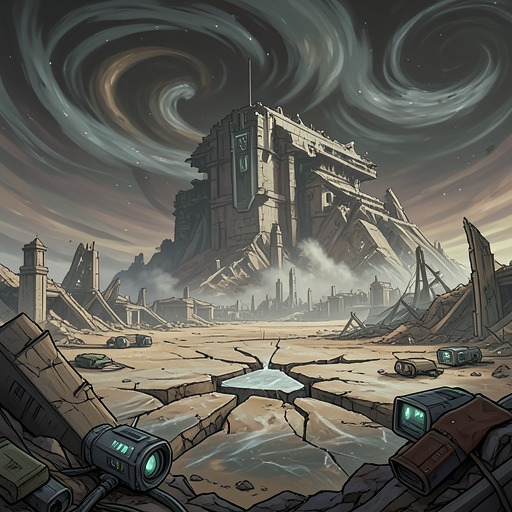
Chimanis
Gate CrashersThe Chimanis are a human people inhabiting Culpus-Alam, the planet that human explorers call Solonis B. They are decisive to the novel’s reversal of perspective: what appears from orbit to be an abandoned world of vacation homes and rotting resorts is, in fact, the surface of a civilization whose cities and industry lie underground. The Chimanis therefore show that the human expedition’s first survey was not merely incomplete; it was shaped by assumptions about where a civilization ought to be visible.
Identity and Hidden Habitat
The Chimanis are one of the human populations established on Culpus-Alam. Their settlements are concentrated on the planet’s third world, while the fourth planet appears to contain only abandoned leisure infrastructure. That apparent emptiness initially misdirects the human vessels, which orbit the fourth planet after failing to locate the Chimanis’ inhabited centers.
Their actual cities and industrial systems are almost exclusively underground. The reason is environmental: the Chimanis built below the surface to preserve moisture in a desert world. This adaptation makes their society difficult to detect with a cursory scan and turns the landscape’s blankness into a misleading surface effect. The absence of visible cities does not indicate the absence of civilization; it indicates a civilization organized around concealment and environmental necessity.
Discovery and Misreading
The Chimanis enter the immediate plot through a sensor report announcing that the human ships are orbiting the fourth planet. Vel Noric questions the choice because, to his knowledge, it contains nothing but empty vacation homes and decaying resorts, whereas the Chimanis’ cities and industry are on the third planet. J’quol corrects that assumption by explaining the subterranean construction and the desert’s demand for moisture conservation.
The exchange also reveals a recurring weakness in Vel Noric’s command. J’quol’s correction is formally respectful but makes Noric appear foolish once again. Noric recognizes the insult without receiving anything actionable enough to punish, since J’quol’s words could be recorded as a compliment to his superior’s wisdom. The Chimanis’ hidden infrastructure thus contributes not only to the strategic situation but also to the tense power relationship aboard the Turemok vessel.
The human survey’s failure to find the Chimanis echoes the wider encounter with the human tribes of Culpus-Alam. A survey party meets people who look unfamiliar because of clothing, paint, language, and custom, yet are unmistakably human. Allison Ridgeway tries to map the territory and locate the forbidden Cave of the Creators, while the Pirikura villagers can offer only partial knowledge and fear-bound testimony. Felix Fletcher likewise attempts to interpret local practices, material culture, and technology despite having no anthropology training. Against this background, the Chimanis represent another form of human life that the explorers cannot understand simply by looking for familiar signs.
Place in the Culpus-Alam Experiment
The Chimanis’ existence becomes intelligible only after the Assembly’s larger purpose is explained. Vel Noric states that Culpus-Alam was an anthropological experiment running for many generations, designed to model how humans would react when exposed to new cultures. The Assembly had taken human populations from Earth, favoring isolated tribes as base stock while also using random sampling to reduce the danger of inbreeding.
The experiment was prompted by contradictory human broadcasts. Some programs presented humans as noble and tolerant collaborators with other species; others depicted humans and aliens destroying one another. The Assembly could not determine which image was accurate, so it created a controlled setting in which human populations could develop distinct cultures and eventually be brought into contact. The Chimanis are consequently not simply an indigenous alien species or an incidental human colony. They are part of a population-transfer and observation system imposed by the Assembly, with their history and environment treated as experimental material.
This origin gives their hidden cities a political meaning. The Chimanis adapted to Culpus-Alam over many generations, developing a society suited to its desert conditions, yet the planet remains classified by the Assembly as an Assembly world under Assembly jurisdiction. When Allison Ridgeway’s side refers to the destruction of Solonis B, Bloon does not even recognize the human name; D’armic explains that it means Culpus-Alam. Bloon then asserts that because Culpus-Alam was an Assembly world, humans had no authority in the matter. The Chimanis are therefore caught inside a dispute over who may define a world, name its history, and claim jurisdiction over its inhabitants.
Narrative and Thematic Significance
The Chimanis sharpen the novel’s critique of observational power. They are watched, classified, and discussed by civilizations that presume the right to place humans in controlled environments, while the human explorers in turn attempt to survey and interpret other human cultures. The pattern repeats at different scales: the Assembly studies humanity, human teams study the populations on Culpus-Alam, and each observer risks mistaking partial visibility for complete knowledge.
Their underground cities also make environment an active force in social history. The Chimanis’ architecture is not presented as a decorative oddity but as a response to desert conditions and the need to conserve moisture. Their concealed infrastructure challenges the explorers’ surface-based expectations and demonstrates that technological and cultural development can take forms invisible to an outsider’s standard instruments.
Finally, the Chimanis help transform Culpus-Alam from a remote setting into evidence in a political case. Their presence proves that the planet contained organized human societies whose origins were connected to Earth, yet whose lives had unfolded through generations of isolation. The revelation makes the dispute over Solonis B more than a question of military retaliation: it concerns displacement, experimental governance, cultural identity, and whether a population created and managed by an outside power can ever be treated as merely someone else’s jurisdiction.