Creator's Cave
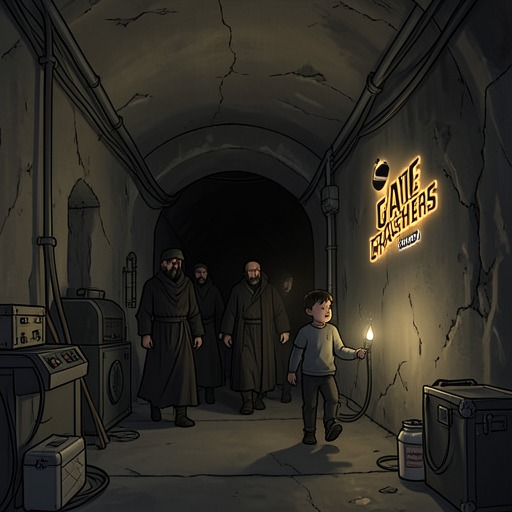
Gate CrashersThe Cave of the Creators is a concealed underground observation station on Culpus-Alam, the world known to humans as Solonis B. To the Pirikura people, it is a forbidden sacred place associated with mysterious creators; to the human survey team, it becomes proof that their apparent isolation was engineered and continuously watched. The cave therefore joins archaeology, surveillance, and colonial control: it is at once a mythic site, a functioning scientific installation, and a physical record of how human beings were removed from Earth and made into subjects of an experiment.
Discovery and Local Meaning
The cave enters the human expedition through a Pirikura child, who identifies a feature on the team’s map and speaks of a “Cave of the Creators.” Her mother warns the visitors away, calling the place forbidden and dangerous, while explaining that the tribe’s men are not warriors or heroes. When Allison Ridgeway asks only for the location on the map rather than demanding that the Pirikura guide the team, the mother admits that Tolo knows where it is. This exchange establishes the cave as more than a convenient expedition target: it is embedded in local knowledge, taboo, and a history the Pirikura can describe only through inherited legend.
Felix Fletcher and Thomas Harris eventually reach the site and recognize that the room was carved by whoever brought the people to Culpus-Alam. The Pirikura name suddenly acquires a literal dimension. Their “creators” were not necessarily gods, but technological agents who constructed the settlement’s hidden infrastructure and left behind an installation capable of watching its inhabitants. The discovery thus does not simply replace superstition with science; it shows how technological domination can survive as religion after its operators have disappeared from the community’s visible world.
The Hidden Door and Observation System
Inside the rough-cut antechamber, Felix finds a concealed door in the wall. Harris’s infrared visor reveals a warm shape matching the door, confirming that the apparent stone surface conceals an active or recently active mechanism. Felix infers that someone once emerged from the opening, an event that may have generated the Pirikura’s story of divine beings. The tribe’s leaders have apparently continued coming to the wall to listen for their gods, turning a remnant of an old access point into a site of ritual attention.
The expedition cannot locate a manual release, so the team returns to the surface to obtain a laser. Felix’s response is direct: they will call in Allison Ridgeway’s survey team “to break in.” The sequence gives the cave a revealing double structure. It is a place that resists entry to the people who live above it, yet yields to the tools of an interstellar military-scientific expedition. The human visitors are investigating an installation built to observe others, but their own method repeats the logic of technical intrusion.
Once the doorway opens, the room responds to the cameraman’s passage. Iridescent organic webs of wire pulse along smooth walls in a pattern resembling the interior of the alien buoy. Images then appear across the surfaces, showing the Pirikura village from a dozen viewpoints. Women and children move along dirt roads and boulevards without knowing that observers beneath the ground are watching them. The cave is consequently not a dead ruin but an observation post, and its screens make the asymmetry of the experiment visible: the villagers possess neither the information that they are being studied nor the power to refuse the study.
Beds, Androids, and the Machinery of Management
Beyond the surveillance room lies another chamber containing two parallel rows of tiny, impeccably tidy beds. The orderly beds suggest a prepared population and an institutional setting rather than an accidental shelter. Their small scale and arrangement imply that the cave was designed around the care, containment, or supervision of children, although the immediate evidence does not establish how long the chamber was used or what became of its occupants.
Two human-looking figures stand rigidly against the far wall. Their perfect posture and artificial appearance reveal them as androids, and Allison Ridgeway’s team guesses that they served as automated nannies. The androids extend the cave’s function beyond passive observation. The station appears to have included systems for maintaining and managing human life, making the supposed “creators” not only watchers but custodians with the authority to shape the conditions under which the isolated population developed.
The contrast between the village above and the chambers below is central to the cave’s meaning. Above ground, the Pirikura experience their world as home, culture, and inherited sacred geography. Below ground, that same world is rendered as an image archive, while beds and artificial caregivers reduce human inhabitants to a population requiring organized supervision. The station turns a lived society into data without making the society cease to be fully human.
Culpus-Alam as an Interstellar Experiment
After the human vessels depart, Vel Noric watches Culpus-Alam disappear from view and identifies it as a world set aside many generations earlier for the controlled observation of humans. The experiment was allowed to run unattended through many cycles while separate human tribes developed distinct cultures. Its intended next stage was to facilitate contact among those tribes and observe their interactions, generating knowledge that might help predict humanity’s eventual integration into the wider galactic community.
The later explanation to Allison Ridgeway and the human representatives confirms that Culpus-Alam’s population originated on Earth. The Assembly of Sentient Species preferred isolated tribes as its base stock but also used random sampling to reduce the dangers of inbreeding. This revelation changes the cave from an isolated local mystery into one component of a deliberate transplanetary relocation program. The people observed beneath it were not native to Culpus-Alam in any simple historical sense; they had been selected, transported, separated, and placed within an environment designed for observation.
The experiment arose because the Assembly could not reconcile its contradictory impressions of humanity. Human broadcasts depicted both cooperation with other species and the destruction of humans and aliens in mutual violence. The Assembly therefore constructed a living model rather than relying on mediated information. The cave is the experiment’s architectural expression of that uncertainty: it converts cultural development into a spectacle that can be monitored from hidden rooms, with technology standing between the researchers and the people whose behavior they hope to understand.
Surveillance, Preservation, and Political Consequences
The cave’s logic resembles the larger Human Wildlife Preserve surrounding Earth. Rockwell describes humanity as being caged like zoo animals, while Eugene Graham argues that a network of buoys may instead mark territory reserved for humans. The Assembly later insists that the preserve’s fence was meant as a buffer to keep outsiders out while humanity developed, not as a barrier intended to imprison humanity within its own space. Yet the cave complicates that defense. Even when the stated purpose is protection or research, the people being protected are still classified, relocated, watched, and denied control over the terms of their existence.
The missing buoy that creates “a hole in the fence” exposes the fragility of this administrative system, just as the cave exposes its hidden interior. The buoys mark and defend a boundary, while the observation station penetrates the supposed privacy of the population inside it. Together, they reveal a regime that claims to preserve humanity by converting human territory into managed space. The cave is thus not merely evidence of benevolent preparation for first contact; it is evidence that recognition and domination can coexist.
Its political status becomes especially clear when Assembly representatives discuss the destruction of Solonis B. Bloon does not initially recognize the human name, and D’armic explains that Culpus-Alam is the same world. Bloon then asserts that it was an Assembly world under Assembly jurisdiction, denying humans authority over the place. The cave’s discovery therefore carries legal consequences as well as historical ones: the humans have uncovered proof of an imposed past, but the Assembly uses jurisdiction over that past to prosecute them for events connected with the planet. The station survives as a silent witness to a dispute over who may name a world, claim its inhabitants, and define the violence done there.
The Cave of the Creators is decisive because it makes invisible power tangible. Its hidden door, responsive walls, village images, tiny beds, and android attendants give physical form to the Assembly’s remote management of humanity. What the Pirikura preserve as a sacred memory, the human expedition reads as a technological crime scene and a scientific archive. The cave’s final significance lies in that collision of interpretations: it shows that a population can be protected and imprisoned, studied and displaced, preserved and possessed at the same time.