Earth
Gate CrashersEarth is the novel’s absent yet decisive center: the birthplace of humanity, the point of departure for Magellan and its crew, the source of the isolated populations used in extraterrestrial experiments, and the home whose continued existence turns survival into a personal and political question. Its significance is repeatedly refracted through distance, cryogenic time, institutional power, and the unsettling discovery that other civilizations have treated humanity as both a subject of study and a potential threat.
Ancestral Home and Point of Departure
Earth first appears as a measure of distance and origin rather than as an immediate setting. In 2345, Magellan carries 157 sleeping people a little more than thirty light-years from Earth while the ship manages its deuterium power source, calculates the trajectories of stellar dust, and vaporizes particles that threaten its course. The crew’s voyage therefore begins as a separation from a familiar world, but Earth remains the fixed reference point against which the expedition’s scale is understood.
The distance from Earth is also experienced through radically unequal time. Cryogenic sleep allows the crew to cross interstellar space while their bodies advance only in intermittent periods of consciousness. Allison Ridgeway’s recovery from cryosleep is physically punishing, and Jacqueline Dorsett’s grief makes the temporal rupture personal: Dorsett’s mother died eight real years earlier, although only two months had passed for Dorsett during the voyage. Earth is thus not merely a location left behind. It is a society continuing through decades while the travelers experience their own lives in discontinuous fragments.
Earth’s institutions remain active across that distance. Eugene Graham’s title of professor recalls his former position as dean of Cornell University, but his life changes when Danielle Fenton, once his student and now a member of the American/European Union Parliament, nominates him to lead the American/European Space Administration. His acceptance places Earth’s political machinery behind the expedition and links the voyage to administrative decisions made at home.
Human Expansion and Displacement
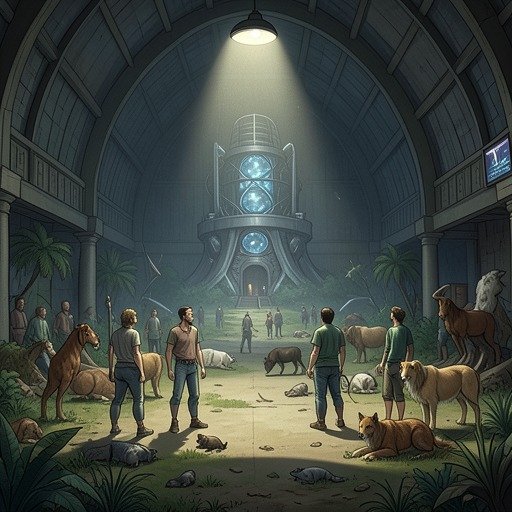
Earth’s importance becomes more troubling when the crew learns that extraterrestrial human populations did not arise independently. On Culpus-Alam, known to humans as Solonis B, the Assembly established an anthropological experiment to model how humanity might respond to contact with other cultures. The population had been taken from Earth: isolated tribes supplied the preferred base stock, while random sampling was added to reduce the danger of inbreeding. Earth therefore functions as both origin and reservoir, the place from which people were removed and transformed into objects of long-term observation.
The experiment exposes a colonial structure beneath the language of research. The transplanted humans develop distinct cultures over many generations, but their world is identified and administered by outsiders, who decide that the next stage should be contact between the tribes so that their interactions can be observed. The human inhabitants are not treated as a people with an independent claim to their world; they are treated as experimental material whose history can be arranged by a distant authority.
The encounter also reveals how Earth is represented from outside. Assembly observers have watched human broadcasts but found them contradictory: some depict cooperation with other species, while others depict humans and aliens destroying one another. Unable to determine whether humanity is noble and tolerant or irrational, violent, and bigoted, they construct an experiment to resolve the contradiction. Earth’s cultural output consequently becomes evidence in an extraterrestrial argument about what humans are, while the experiment itself confirms how dangerous it is to convert incomplete representations into political judgments.
Earth in Interstellar Politics
Earth’s relationship with the wider galaxy is defined by a struggle over jurisdiction and naming. During the hearing concerning the destruction of Solonis B, Allison Ridgeway refers to the world by its human designation. D’armic explains that the same planet is known to the Assembly as Culpus-Alam, and Bloon responds that Culpus-Alam was an Assembly world under Assembly jurisdiction. The disagreement is not a minor terminological problem: the competing names encode competing claims to authority, history, and the right to decide what happened there.
Earth’s expanding reach also creates suspicion before humanity fully understands the political order it has entered. A mystery ship reaches the vicinity of Magellan less than two weeks after an emergency message is broadcast. Eugene Graham reasons that, even at a speed just below light speed, the vessel must have been less than a light-week away when it received the signal, despite the absence of anything apparently valuable in that region for many light-months. The inference is that someone was already watching or waiting, and that Earth’s exploratory activity has entered a larger network of attention.
The resulting contact is shaped by asymmetric knowledge. Humans are trying to determine where the buoy’s warning came from and why another vessel is monitoring them, while established galactic powers already possess classifications, historical assumptions, and jurisdictional frameworks concerning humanity. Earth is consequently introduced to the galaxy not as an isolated pioneer alone, but as a newcomer being interpreted by civilizations that have already placed it inside their own systems of surveillance and law.
Memory, Return, and Home
Earth’s emotional force emerges through objects and bodily experience as much as through politics. Jacqueline Dorsett gives Allison a book that belonged to her mother, who had worked with SETI and kept the antique in case it might someday matter. The gift connects the expedition to a terrestrial history of listening for other civilizations, while the mother’s death makes the book a family heirloom rather than a simple research tool. Allison presses it to her chest after realizing what she is holding, turning Earth’s scientific past into an intimate inheritance carried into deep space.
The travelers’ bodies repeatedly register the cost of leaving Earth. Allison wakes from cryosleep with impaired balance, dehydration, and the sensation of toxins accumulated during suspended metabolism. Later, she recognizes the irony that time can become scarce on an expedition designed to last almost a century and a half. The contrast between the mission’s immense planned duration and the immediate limits of bodies, decisions, and opportunities gives Earthly life a paradoxical value: even when centuries seem available, individual moments remain perishable.
Earth also persists as a source of humor and social memory. Maximus Tiberius urges Felix Fletcher to place faith in anything from God and the mission to shipmates or Bucephalus, then leaves after making a shooting gesture and complimenting Felix’s red uniform. Jeffery compares the encounter to being put in place by a Jack Russell terrier. The exchange is comic, but it demonstrates how the human crew carries familiar Earth-bound forms of personality, rivalry, and cultural reference into an environment that otherwise threatens to make every interaction alien.
The Meaning of Home After Survival
By the epilogue, Earth is no longer only the origin from which the expedition departed; it is the home to which survivors can return. Eugene Graham opens the door of his penthouse to Felix Fletcher and Harris, embraces them, and admits that he feared they would never all be standing together again. Felix answers that everyone is safe and that home is safe as well. The reunion gives the word “home” a concrete human meaning after the novel’s long sequence of distances, experiments, captures, jurisdictional disputes, and planetary danger.
Earth’s final significance lies in this tension. It is the source of humanity’s expansion and the population base for an intrusive experiment; it is a political entity judged by outsiders and a world vulnerable to consequences it may not yet understand; it is also the place represented by a dead mother’s book, remembered through cryogenic time, and recovered in the embrace of friends. The novel refuses to make Earth either an innocent Eden or merely an outdated launch point. It is an inherited home whose inhabitants carry their contradictions outward, encounter civilizations that have already made them into objects of knowledge, and return with a sharper awareness that survival requires more than reaching another world.