Earth–Assembly of Sentient Species relationship
Gate CrashersThe Earth–Assembly of Sentient Species relationship is defined by profound asymmetry: the Assembly has watched, relocated, classified, and judged humanity long before Earth understands that the wider galactic civilization exists. What first appears to be an invitation to interstellar contact is therefore also a confrontation with an institution that has already made humanity an object of study, assigned legal meanings to human actions, and authorized the destruction of Earth on evidence later shown to have been manipulated.
Observation Before Contact
The relationship’s hidden foundation is the Assembly’s decision to study humans at a distance. Culpus-Alam, called Solonis B by humans, was established as an anthropological experiment in which human populations were placed in an isolated, controlled setting. The Assembly had taken people from Earth, preferring isolated tribes as base stock while also using random sampling to reduce the risks of inbreeding. Human communities consequently developed distinct cultures away from their home planet, while the Assembly observed them as material for a prediction about humanity’s eventual entry into galactic society.
This arrangement places the Assembly in the position of curator and humanity in the position of specimen. The humans on Culpus-Alam are not initially treated as a sovereign population with an acknowledged history; they are part of an experiment designed to answer questions posed by alien observers. The Assembly’s concern was not merely whether humans could travel into space, but how they would respond to unfamiliar cultures. Its plan was to facilitate contact between the separated tribes and observe their interactions, turning cultural encounter into a controlled test.
The Assembly’s justification was uncertainty. It had watched human broadcasts for centuries, but those broadcasts contradicted one another. Some depicted humans cooperating with other races; others showed humans and aliens destroying each other. From the Assembly’s perspective, humanity appeared simultaneously noble and tolerant, irrational and violent, generous and bigoted. Rather than accept that these contradictions might all belong to the same species, the Assembly built a world-scale experiment to determine which version was true. The resulting research was presented as rational preparation, but it also reveals a confidence that the observers had the right to remove human populations from Earth, rename their world, and arrange their lives for scientific purposes.
Warning, Naming, and First Encounter
Before direct diplomatic contact, humanity receives a compressed warning: “HUMAN WILDLIFE PRESERVE. KEEP OUT.” The message is both practical and political. It identifies a protected zone, denies entry, and places humans inside the vocabulary of wildlife management. The wording does not announce an equal civilization seeking communication; it marks territory and presumes the authority to regulate who may approach it. The warning’s meaning is especially destabilizing because the humans must first decode it without knowing who created it or why their own species has been placed under a preserve designation.
The field encounter on Culpus-Alam exposes the contradiction between the Assembly’s classification and the humans’ lived reality. A woman emerges from foliage carrying a blowgun, wearing body paint and little clothing. Her surface difference initially distinguishes her from the visiting teams, yet beneath it she is unmistakably human. The encounter thus undermines the assumption that the experiment has produced something alien or lesser: the people being observed remain human, even as their separation from Earth has allowed them to develop their own cultures.
The human investigators approach the local population through translation, maps, and negotiation, but communication remains incomplete. Allison Ridgeway tries to obtain information about a dangerous location without demanding that the villagers physically guide the expedition. A mother warns her that the place is forbidden and dangerous, explains that the men are not warriors or heroes, and directs her toward Tolo as someone who may know the route. The exchange shows the humans attempting to treat local knowledge as useful testimony, while also revealing how easily an outside expedition can press against a community’s taboos. The relationship between Earth and the Assembly is therefore already a contact-zone struggle over who may name danger, who may interpret custom, and who has the authority to enter.
From Exploration to Criminal Charge
When Allison Ridgeway’s ship, the AEUS Magellan, encounters D’armic Ytol ev Shamel, she presents the mission as a peaceful expedition of exploration and discovery and requests that the unidentified vessel state its intentions. D’armic answers not as a fellow explorer but as a frontier manager of the Bureau of Frontier Resources. He identifies his purpose as bringing Allison and her crew into custody to await judgment for the geocide of Culpus-Alam. The same conduct is thus framed in opposite terms: human exploration becomes, in Assembly jurisdiction, planetary destruction.
The accusation is made more powerful by the Assembly’s control over official categories. D’armic explains that English functions as an unofficial bridge among member races, while the Assembly officially preserves the cultures of its constituent peoples. Even this apparently pluralistic system carries a tension between cultural preservation and centralized authority. The Assembly can defend diversity in principle while imposing a common legal framework in which humans are outsiders accused of violating rules they did not know existed.
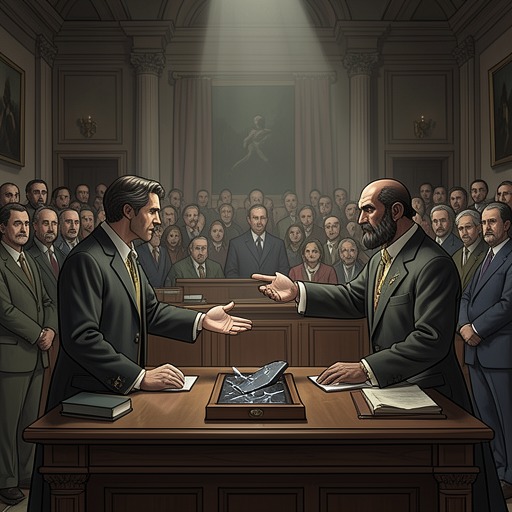
The dispute over the planet’s name intensifies the conflict. Humans call it Solonis B, while the Assembly calls it Culpus-Alam and regards it as an Assembly world. At the hearing, when Allison seeks to stop retaliation against Earth, Bloon Representative asks what Solonis B is. D’armic supplies the translation between the competing names, but Bloon immediately places the world under Assembly jurisdiction. Because Culpus-Alam belongs to the Assembly, humans are declared to have no authority in the matter. Naming is therefore inseparable from sovereignty: the planet’s identity determines whose law applies and whether the humans can claim any right to defend their actions.
The Assembly’s judgment initially arrives before the evidence does. Ruckk declares that Allison has already been judged and lists a supposed progression from piracy of Assembly property and violation of Assembly space to serial geocide, murder of peace officers, and the destruction of the Assembly vessel sent to contain human madness. Allison counters that the officers had been discharging their weapons, but the institution treats her reply as impudence from a convicted criminal. The exchange shows a legal system in which the narrative of criminality has become self-reinforcing: every human attempt at resistance is read as further proof of barbarism.
The Petition and the Threat Against Earth
D’armic’s decision to accompany the humans to Ulamante marks the first major shift in the relationship. He requires transport to Ulamante, the Assembly’s home system and governmental seat for much of the civilized galaxy. His change of position follows the discovery that the Turemok antagonists may have staged the evidence against humanity. Their actions might have been autonomous, or they might have followed clandestine orders; either way, D’armic believes that their reports were probably altered. The humans’ sensor records and the high-space generator aboard the AEUS Bucephalus become the physical basis for proving mutual innocence.
The stakes are explicitly planetary. If the humans and D’armic fail, a Turemok fleet will enter the Human Wildlife Preserve, destroy Earth, and impose a generation-long sequestration on each human colony world. The Assembly’s relationship with Earth has therefore moved beyond observation and prosecution into collective punishment. Earth is not merely threatened with a trial or diplomatic isolation; it is treated as a site whose destruction and containment can be administratively scheduled.
The journey to Ulamante makes the Assembly’s scale visible. The human convoy is detected seven light-years from the system, escorted as it approaches, and confronted by a civilization whose passive sensors reveal more than seventeen thousand vessels. D’armic must negotiate through several layers of Bureau bureaucracy merely to secure permission to enter and obtain an audience for himself and the human co-accused. The immense fleet and procedural hierarchy embody the same power in two forms: overwhelming military capacity and institutional control over access, testimony, and recognition.
The Assembly’s own history complicates its impending punishment of Earth. The Pillar at Ulamante was created through a unanimous Assembly project after the system’s twin planets entered decaying orbits and faced eventual collision. Construction lasted seven centuries and enabled the evacuation and relocation of two industrialized planets full of sentient beings and their ecosystems. The Pillar became a symbol of united effort and the permanent home of the Assembly. Yet an institution capable of organizing such a rescue also permits a punitive expedition against Earth when its legal process is driven by corrupted reports. The contrast exposes the gap between the Assembly’s ideal of coordinated protection and its capacity for catastrophic administrative violence.
Hearing, Irreversible Orders, and Aftermath
At the hearing, Bloon warns D’armic that the Turemok representative has moved to censure the human co-defendants. The vote stands evenly divided, three for and three against, so the humans enter the proceeding under an uncertain but still hostile institutional balance. Allison’s petition is not to negotiate the release of prisoners; it is to stop retaliation against Earth by presenting evidence that the humans were framed. D’armic supports her claim, stressing that the evidence is physical and that he has personally examined it.
Bloon agrees that the new evidence must be investigated, but the Assembly cannot halt the punitive expedition already authorized against Earth. The distinction between unwillingness and inability becomes the central moral fact of the hearing. The Assembly may now suspect that the humans are innocent, yet its procedures have already produced an armada that cannot be recalled in time. The authorization has acquired a momentum more powerful than the evidence that prompted it.
The timetable makes the threat immediate. The Xecoron is expected to reach Earth shortly, while the remaining ships are scheduled to arrive at the human colony worlds and begin enforcing sequestration at the same time. The Assembly’s response to uncertainty is consequently divided between investigation and execution: it opens a path toward exoneration while allowing the machinery of punishment to continue toward a population of thirty billion people.
The later political consequences do not restore trust. Allison asks what will happen to the Turemok, since the Assembly nearly destroyed Earth for crimes they committed. D’armic replies that official punishment appears unlikely. The investigation into Culpus-Alam and the other planets has stalled because much of the admissible evidence and many witnesses are gone, while the Assembly wants the episode to disappear from public scrutiny. The Turemok are not formally cleared of responsibility, but the repeated defeats have damaged public confidence and weakened their military and police monopoly; discussion has already begun about breaking that monopoly apart.
The relationship therefore ends in neither reconciliation nor simple war. Earth survives the immediate danger, but its first meaningful encounter with the Assembly reveals an order that can preserve cultures, save worlds, and yet reduce humanity to wildlife, convict, experiment, or target according to the institutional frame of the moment. The Assembly’s later suspicion of the Turemok does not erase its own responsibility. Its deepest failure lies in having converted observation into jurisdiction, jurisdiction into certainty, and certainty into an authorized planetary death sentence before the truth could arrive.