Eugene Graham
Gate CrashersEugene Graham, usually addressed as Professor Graham and at times as Administrator Graham, is the institutional strategist who converts a career in academic administration into leadership of humanity’s first sustained encounters with alien civilizations. His decisive significance lies in the combination of authority and uncertainty that defines his role: he commands major operations, yet must often act from fragmentary reports, disputed evidence, and technologies whose consequences no human institution fully understands.
Identity and Rise to Power
Eugene’s title is a remnant of his previous life as dean of Cornell University. His career changes when Danielle Fenton, one of his former students, achieves a stable political career and is elected to the American/European Union Parliament. She submits his name to lead the American/European Space Administration, and the president soon offers him the post. Eugene accepts in an unusual fit of ambition, exchanging the structures of university administration for an organization operating at the edge of human knowledge and political legitimacy.
This background gives him a distinctive position between scholarship and government. He is not introduced as a simple military commander or laboratory specialist. His authority derives from the ability to recognize expertise, assemble people, interpret institutional information, and make decisions when normal procedures are too slow. The former dean therefore becomes a crisis administrator whose academic title continues to signal both his history and the intellectual basis of his power.
Recruitment and Early Crisis Management
Eugene’s first major intervention in the evidence is his recruitment of Felix Fletcher. He breaks into Felix’s apartment as Felix returns from the Unicycle and offers him a job, while remaining deliberately vague about the assignment’s details. Felix’s memory of the encounter is compromised by the little rum bottles he consumed during the flight home, so Eugene’s recruitment is both urgent and unusually covert. The scene presents him as someone willing to bypass ordinary professional etiquette when an emergency demands a particular person.
His judgment of Allison Ridgeway is more measured. When he receives a message associated with her expedition, he sits in stunned silence because he does not know her personally, although he has studied her file closely. He knows that she is imminently qualified to lead the expedition and that her reports are thorough and punctual; nothing in her professional record suggests a tendency toward theatrical overreaction. Eugene’s shock therefore comes not from dismissing Allison, but from recognizing that a report from someone so reliable must be taken seriously even when its implications are difficult to grasp.
The same combination of restraint and decisiveness appears when he responds to unfolding information about alien technology and possible planetary catastrophe. When the room reaches a point at which action is required, Eugene simply announces, “No,” rejecting the course under discussion rather than allowing institutional momentum to decide for him. His authority is expressed not through constant speeches but through moments in which refusal becomes the first necessary act of governance.
Science, Artificial Intelligence, and Moral Judgment
Eugene’s relationship to Magellan and the other advanced systems places him inside the book’s central question about machine personhood. Magellan is treated by Allison as a companion rather than a mere instrument, and Eugene operates within a world where starships, sensors, quantum entanglement radio equipment, and high-space technology possess capacities that exceed conventional categories. Magellan herself regards any entity that selflessly nurtures helpless children as female, an observation that frames the ship’s identity through care rather than manufacture. Eugene’s administration must therefore contend with intelligent systems whose status cannot be reduced to hardware.
That problem becomes concrete when Allison learns that Magellan may eventually be replaced. Allison thinks of Magellan as a person and friend rather than as a pile of circuits and pipes, and the prospect of obsolescence suddenly acquires the emotional force of a friend’s possible disappearance. Eugene is part of the institutional world responsible for technological replacement, yet the surrounding crisis makes clear that such decisions are not merely technical. The system’s usefulness, continuity, privacy, feelings, and relationships all become relevant, forcing Eugene’s administrative framework to confront the ethical consequences of treating a self-directed intelligence as equipment.
Eugene also participates in the translation and interpretation of the alien warning network. Jeffery gives him a tablet displaying a memo from the group’s head linguist, labeled Signal 1 Translation. The detail is important because it shows Eugene receiving knowledge through a chain of technical mediation rather than through direct revelation: linguists, records, devices, and administrators collectively transform an incomprehensible signal into a basis for policy. His role is to determine what such knowledge requires of institutions and populations, not merely to possess it.
The QER Crisis and the Defense of Earth
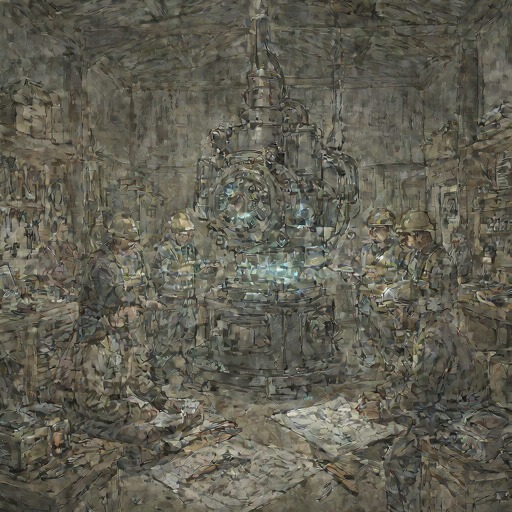
Late in the crisis, Eugene is summoned to the basement of the QER Center after Kiefer reports that Felix wants to speak specifically with Eugene or Jeffery. The timing—just after three in the morning—underscores the emergency, while Eugene’s impatience with the elevator shows how quickly personal concern becomes operational urgency. He enters the QER chamber, where hundreds of machines are running, and proceeds toward Magellan’s sister quantum entanglement radio units.
The upgraded machines make the journey shorter than before, but access still depends on biometric scanners confirming that Eugene is not an impostor. This detail captures the tension between advanced communication and institutional distrust: even at the center of a planetary emergency, the administrator must pass through layers of authentication before he can reach the information that may determine humanity’s survival. Once connected, he asks what happened and soon concludes that evacuation must begin. He states that the surface and all low-Earth-orbit habitats have to be evacuated, converting an alarming report into a concrete civil-defense order.
Eugene’s work continues through a succession of obstacles. With Kiefer and Kiefer’s associates secured under Specialist Balog and an angry robot, Eugene connects with the Unicycle but immediately encounters another roadblock. His contact with Renée Lemieux is framed as an interruption of lunch, a mundane intrusion that contrasts sharply with the scale of the emergency. Later, he receives the report that the enemy has been destroyed and passes the information onward as Professor Graham. The formal title remains attached to him even after the crisis has become military and planetary, linking his academic past to his function as the person through whom decisive information moves.
Alliances, Aftermath, and Narrative Role
After the enemy’s destruction, Eugene receives visitors at his penthouse while seated at a formally set dinner table with a snifter nearby. The scene places extraordinary events against domestic ceremony: he sets down the glass, excuses himself, and answers the door, where Allison introduces him to the AEUS Magellan. Magellan’s arrival makes the abstract problem of machine identity physically and socially immediate. Eugene responds with generous recognition of Allison’s ship as a “Plucky ship,” then asks the visitors to make themselves at home while he returns the filets to his wife. The coexistence of hospitality, family life, and interstellar danger gives his ending a deliberately human scale.
The aftermath does not offer Eugene a clean institutional victory. D’armic observes that official channels are unlikely to produce much action because the investigation into Culpus-Alam and other destroyed planets has stalled; admissible evidence and witnesses are largely gone, and the Assembly appears eager to let the episode disappear from public scrutiny. Eugene’s work therefore ends in a political environment where defeating an immediate enemy does not guarantee accountability. His achievement is preservation and coordination, while the larger question of responsibility remains contested.
Eugene’s narrative function is consequently broader than that of a commander directing missions. He is the hinge between universities and governments, human specialists and artificial persons, scientific evidence and political action, emergency logistics and moral judgment. He repeatedly turns bewilderment into procedure: he recruits Felix despite incomplete explanations, takes Allison’s alarming record seriously, moves through secured QER facilities, orders evacuation, and maintains contact across the Unicycle, Earth, and alien diplomatic sphere. Yet the book also limits his power. The disappearance of evidence, the Assembly’s reluctance, and the uncertain status of Magellan show that administration can organize response without controlling meaning or guaranteeing justice. Eugene embodies humanity’s attempt to become responsible at the very moment its inherited institutions prove inadequate to the scale of the universe.