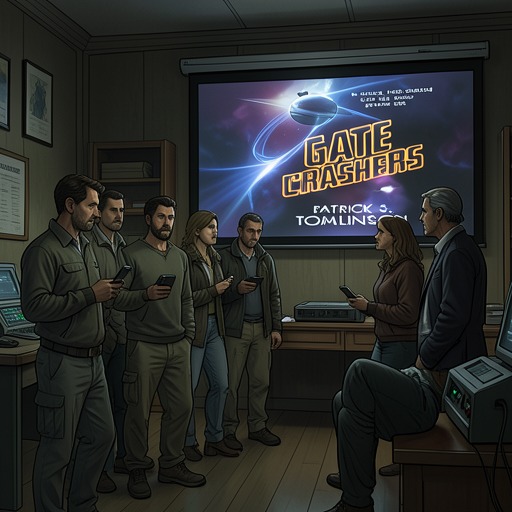
First contact between humans and D'armic
Gate CrashersThe first-contact conflict between humanity and D’armic is the decisive encounter in which a peaceful human expedition is reclassified as a criminal act by an alien official. Its immediate subject is the alleged geocide of Culpus-Alam, but its deeper force comes from the struggle to define what happened: humanity sees exploration and discovery, while D’armic sees a chain of evidence pointing to planetary murder. The encounter therefore makes first contact a legal and interpretive crisis before it becomes a military one.
Background: A Warning and a Misread Disaster
Humanity enters the encounter with inadequate knowledge of the civilizations beyond its frontier. The yellow-and-black handbook Allison Ridgeway consults identifies the situation as an encounter with an extraterrestrial space-faring race and congratulates the reader on surviving long enough to discover it. Its advice is deliberately reassuring: survival suggests that the aliens are not mindlessly violent. Yet the reassurance is undercut by the need for procedures intended to reduce the chance of catastrophe. The book frames first contact as a problem that can be managed through practical guidance, while the events that follow expose how little such guidance can anticipate.
The immediate misunderstanding arises from Culpus-Alam. D’armic has witnessed a fire worm in high-space, a titanic, boiling form that appears to be moving through the void toward his cutter. His lower brain interprets it as a monster from ancient Lividite superstition; his higher brain cannot supply a rational explanation quickly enough, and the cutter escapes through a portal. When D’armic later compares the worm’s estimated mass with the mass missing from the Culpus-Alam system, the figures match to six decimal places. The recognition links the apparent monster to a geocide and activates the historical memory of the Lividite war machine, whose campaigns once stretched against nearly everyone.
The history D’armic uncovers explains why the accusation is so grave. During the closing days of the Lividite war against the Pu’Lan and other peoples, the Lividite military sought to make an example of the Pu’Lan after suffering its first defeats. A ship could open a high-space portal through a world, creating a magma tunnel whose collapse would rupture the planet’s surface, trigger volcanoes at both entry and exit wounds, shatter tectonic plates, and disrupt its core and magnetic field. Culpus-Alam’s destruction is consequently not treated as an accident of exploration but as the signature of a weapon and a crime whose scale reaches beyond ordinary murder.
The Encounter and the Arrest Demand
D’armic’s cutter reaches the human vessels ahead of the intruders, but the maneuver drains its power reservoirs. While the reactor replenishes them, the cutter’s only weapon, an EM cannon, is nearly useless. D’armic therefore stalls for time while his ship recovers. He filters the humans’ encrypted video transmission and sees the familiar light-haired woman whose image had already been captured on Culpus-Alam.
Allison identifies herself plainly as captain of the AEUS Magellan and describes the expedition as peaceful exploration and discovery. Her voice is calm and friendly, a manner D’armic finds difficult to reconcile with the profile of a mass murderer. D’armic answers in measured English, identifying himself as D’armic Ytol ev Shamel, a frontier manager of the Bureau of Frontier Resources. His stated intention is not negotiation but custody: he will bring Allison and her crew in for judgment for the geocide of Culpus-Alam.
The demand carries an explicit deadline. D’armic gives the humans five minutes to explain the situation to their crew and prepare for surrender; if they refuse, he will fire on their vessels to force compliance. Allison and the bridge crew are left dumbstruck by the alien’s fluent English and by the sudden transformation of their expedition into a prosecution. Her immediate response is to ask him to hold, then to signal Prescott to cut the communication. The gesture captures the asymmetry of the moment: D’armic treats the encounter as a settled enforcement action, while the humans are still trying to understand the accusation.
Allison soon recognizes that the conflict may involve manipulation by forces neither side understands. She tells D’armic that both parties may be being played. D’armic does not dismiss the possibility, but he refuses to suspend the deadline. He counts down from three, and Allison orders the ship to brace for impact. D’armic fires.
The EM Pulse and the Turn from Combat to Diplomacy
The shot does not behave like a conventional attack. The EM pulse cannon is one of the most feared weapons in known space, but its initials refer not to electromagnetic force but to emotional maturity. It manipulates the bioelectrical fields of carbon-based beings with centralized nervous systems, causing those caught in its area of effect to recognize common ground with their opponents, abandon their weapons, and seek a constructive resolution. Its usual effects include hugging and off-key singing. The weapon is devastating to troop morale and outlawed across much of known space.
The cannon’s existence embodies a historical reversal. The Lividites invented it after their own intervention and rehabilitation, when neighboring systems retained huge military stockpiles built to resist another Lividite invasion. Once the Lividites abandoned violence, those arsenals did not disappear. Idle militaries revived old grievances and generated new conflicts, while the Lividites answered the problem with a device that made violence emotionally difficult rather than physically impossible. D’armic’s first attack thus carries the history of a formerly aggressive civilization that learned to impose peace through an unsettling form of coercion.
The weapon fails to resolve the encounter immediately. Allison asks Maximus Tiberius whether his people are willing to cooperate, while Maximus is already eating popcorn and discussing which musical his group might prefer. Allison then asks D’armic whether the pulse was his best shot. D’armic confirms that it was and calmly requests that a personal note be forwarded to his family before the humans destroy his vessel. His composure makes the threat feel both absurd and serious: he appears prepared for death, yet still accepts Allison’s proposal to try her method instead.
The resulting argument lasts more than an hour and shifts the conflict from weapons to protocol. Allison argues that D’armic should receive full diplomatic courtesies and an honor guard. Maximus instead wants guards who will escort the alien to the Bucephalus’s brig. Lieutenant Harris breaks the deadlock by volunteering to lead the honor guard and then follow D’armic to ensure that he does not get lost. The compromise does not erase suspicion, but it creates the first workable contact between the two sides.
Evidence, Jurisdiction, and the Reclassification of the Humans
The meeting proceeds through translation, records, and competing institutional authorities. D’armic explains that English functions as an unofficial bridge language even though the Assembly of Sentient Species preserves the official languages and cultures of its member races. His request to inspect the human sensor records is not casual curiosity. Geocide is especially grave among his people, and the records are the evidence on which the arrest demand rests.
The review reverses the initial presumption of guilt. D’armic announces that access to the records has conclusively eliminated both human vessels from suspicion in the geocide of Culpus-Alam. The reason is devastatingly simple: the AEUS Magellan and its companion vessel are too primitive to have carried out the attack physically. The humans are cleared not because their innocence has been morally established, but because their technology cannot produce the destruction under investigation. Their own tools, which they regard as advanced enough for a peaceful expedition, become proof of their incapacity.
D’armic also connects the case to a broader doctrine of noninterference and civilizational development. He describes the frozen world of Okim as a warning against advancement through outside intervention. An Assembly survey vessel suffered a catastrophic pressure loss in orbit, killing its crew and leaving the native population a visible new star. Once the Okim population recognized the vessel through telescopes, its technological development accelerated: a capsule reached the wreck within a century, a research team lived aboard it a decade later, and the society eventually landed it. Industry and population expanded rapidly, hydrocarbons were exploited, and huge cities arose, but pollution destabilized the environment, temperatures increased, and coastal regions flooded before the world became frozen solid. The example turns progress into a chain of unintended consequences and gives the encounter a second layer: the humans are being judged not only by what they did, but by what technologically powerful civilizations may do by intervening.
Consequences and the Larger Political Crisis
The first-contact conflict does not end when D’armic’s evidence review clears the human ships. The encounter leaves both sides trapped inside institutions whose narratives have already hardened. Later, Ruckk tells Allison that the Assembly’s deliberations concluded weeks earlier and that a ship had monitored the humans from the moment they entered its territory. From the Assembly’s perspective, the humans’ conduct forms a descending sequence of crimes: piracy of Assembly property, violation of its space, serial geocide, destruction of the Assembly vessel sent to contain them, and the killing of peace officers. Allison rejects the characterization by pointing out that those officers were firing weapons, but Ruckk treats the objection as impudence from convicted criminals. The earlier finding that the human ships were physically incapable of destroying Culpus-Alam cannot by itself dissolve the political case against them.
The conflict also reveals how quickly fear becomes self-confirming. D’armic first approaches as an official who intends to seize the humans for judgment. The humans interpret that intention as a threat and prepare for combat, while D’armic reads their evasive behavior and resistance through the established narrative of criminality. His weapon is designed to overcome precisely this cycle by forcing opponents to perceive common ground, yet even that intervention becomes another contested exercise of power. Diplomacy emerges only after the apparent attack fails and Allison deliberately chooses procedure over retaliation.
The consequences extend to Earth. While Eugene Graham attempts to prevent a retaliatory strike, he learns that the attack against Earth has already been launched and may arrive at any moment. The first-contact dispute has therefore expanded from one accusation around Culpus-Alam into an existential crisis for humanity’s home world. The prospect of planetary destruction echoes the earlier geocide that began the encounter, making the humans vulnerable to the same scale of violence they are accused of causing.
The later destruction of Xecoron intensifies that pattern. Renée Lemieux presses the Unicycle’s targeting control after its crew disables a dozen safeguards designed to prevent the action. The emitter assemblies release a 32.4-terawatt particle beam, reducing the target to an image of overwhelming physical devastation. In this wider sequence, the D’armic encounter functions as the threshold event: it introduces the civilization-wide legal and military order that can interpret human actions, condemn them, and answer planetary danger with planetary force. Its significance lies less in a clean resolution than in the exposure of a universe where exploration, enforcement, historical trauma, technological progress, and geocide can become indistinguishable before the facts are fully understood.