Gargoyle Track Overhead Platform
Gate CrashersGargoyle orbital overlook platforms—officially called orbital overlook platforms and informally known by military personnel as OOPs—are angular, bat-like machines designed to hang from ceiling rails and deploy through exterior hatches. Their decisive importance lies in their double identity: they are presented as observation and tracking instruments, yet they can be networked into fire control and deliver devastating antipersonnel fire from orbit. Their existence turns the apparently demilitarized space around humanity into a prepared weapons environment.
Appearance and Concealed Military Status
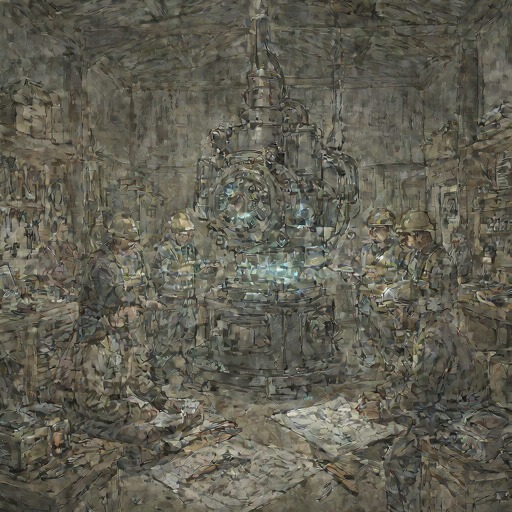
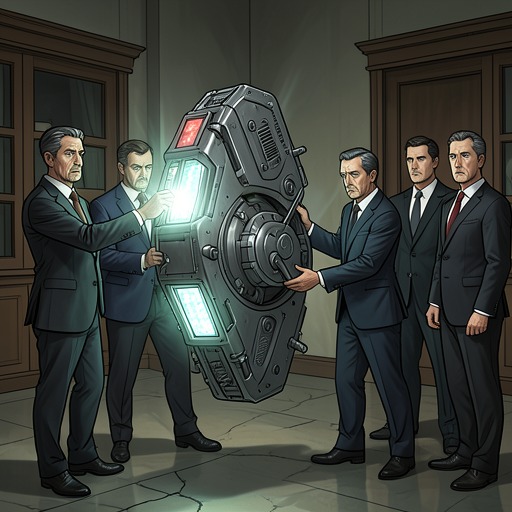
Gargoyles first appear as a dozen hostile-looking machines suspended in a large bay, their shapes compared to giant angular bats sleeping in a cave. The imagery makes the platforms seem both mechanical and predatory: they are dormant only in appearance, waiting in an enclosed chamber with rails leading toward hatches that open onto space. Their placement suggests that they were built for rapid deployment rather than ordinary maintenance or passive observation.
Their presence also exposes a legal distinction with serious consequences. Jeffery observes that space-based weapons have been illegal for four centuries, but Thomas Harris explains that the prohibition applies to deployment, not development. Gargoyles therefore embody a loophole in the space-weapons regime: a society can preserve the language of restraint while retaining the hardware necessary for war. The platforms are not merely weapons hidden from view; they are evidence that technical capacity can survive beneath a formally peaceful order.
Sensors, Networking, and Battlefield Control
The platforms function as a distributed surveillance and weapons network. During preparations for combat, commanders ask whether the Gargoyles are receiving a signal; the reply confirms that they are fully operational, after which their feeds and fire control are networked to a command link. In another engagement, the platforms detect an object making planet-fall and distinguish it from the principal hostile vessel, identifying it as a shuttle less than thirty meters long. Their value consequently begins before firing: they extend the fleet’s awareness, identify movement, and help classify threats approaching a planet.
This orbital perspective creates a sharp contrast with ground-level uncertainty. Personnel below must wait for targeting information and retreat under fire, while a platform hundreds of kilometers overhead can observe the battlefield and act across the distance almost instantaneously. The Gargoyles make the sky into an active military layer, joining surveillance, authentication, targeting, and attack in a single system.
The Antipersonnel Demonstration
The platforms’ most detailed combat use occurs when Thomas Harris takes cover inside a building and calls up the menu for the Gargoyles overhead. He selects platform seven, which is only five degrees from apogee, and chooses the antipersonnel ammunition mode. The platform authenticates the order in a millisecond, verifies that Harris is the officer who issued it, fires gas thrusters to refine its alignment, and spins up twelve barrels arranged in two counter-rotating bundles of six.
Once the barrels reach operating speed, the platform feeds them thirty-millimeter caseless rounds weighing almost a kilogram each. The rounds leave the muzzles at six thousand kilometers per hour, at a rate of nearly five thousand rounds per minute; the recoil is powerful enough to push the platform backward at nearly seventy kilometers per hour. The weapon’s guidance system is derived from the standard rifle bullets used by Harris’s troops, and the paint rounds fired during the retreat provide the aim points. Ground combat is therefore coupled directly to orbital machinery: the soldiers mark targets, the platform authenticates the command, and the Gargoyle converts those marks into massed kinetic fire.
The scene also gives the machines a disturbing autonomy without making them independent characters. The platform checks the identity of its commander, adjusts its own position, selects the firing geometry, and executes the attack, but it does so within a chain of human authorization. Its lethality comes from the combination of automated precision and human intention. Harris’s spoken command to fire is immediately translated into a barrage whose scale and speed exceed anything visible at ground level.
Surveillance, Preservation, and the Politics of the Gaze
The Gargoyles belong to a wider system in which observation and containment repeatedly overlap. Humanity is described by Gladstone Rockwell as being caged like zoo animals, while the network of buoys is defended as a buffer intended to keep outsiders away from Earth space. On Culpus-Alam, the Assembly of Sentient Species has placed human tribes in a controlled environment so that their cultures and future integration can be studied. An underground observation post similarly projects images of a Pirikura village, allowing unseen observers to watch women and children moving through their streets without knowing they are being viewed.
Within that pattern, the Gargoyles represent the militarized version of the same gaze. To observe from above is also to classify, anticipate, and control; the platform that detects a shuttle can also become the platform that fires on marked personnel. The protective language surrounding fences and preserves thus acquires an ominous ambiguity. Infrastructure said to defend a population may simultaneously define the population as an object of management, while weapons developed under a ban wait for circumstances that make their use permissible.
Narrative Significance
Gargoyles are important not because they are simply advanced guns, but because they make contradiction visible. They are illegal to deploy yet deliberately developed, visually dormant yet operationally aggressive, and associated with observation even when their defining action is destruction. Their name evokes watchfulness and menace at once, while the informal military abbreviation reduces an extraordinary orbital weapon to familiar service slang.
As an object, the Gargoyle marks the point where technological modernity abandons the comforting separation between seeing and acting. A sensor network can become a firing solution; a defensive envelope can become a killing zone; and a legal distinction can conceal a standing capacity for violence. The platforms’ recurring presence—from identifying a small shuttle during planet-fall to authenticating Harris’s order and unleashing thousands of rounds—shows how quickly a system built to watch can be made to decide.