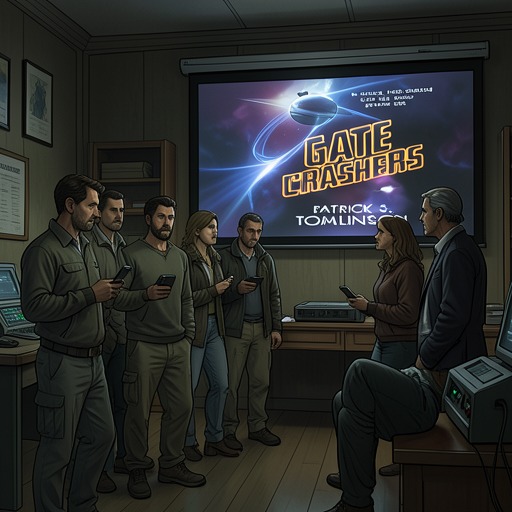
Guide to First Time Encounter for Dummies
Gate CrashersFirst Contact for Dummies is the book that turns an absurd joke into a survival instrument. An old paper-and-ink volume passed from Jacqueline Dorsett’s mother to Allison Ridgeway becomes, at the moment of humanity’s first dangerous contact, both a material link across generations and an improvised authority on how to speak to the unknown. Its advice does not solve the expedition’s crisis by itself, but it gives Allison a procedure when fear, incomplete information, and competing definitions of reality threaten to overwhelm command.
Physical Form and Family Inheritance
The book first appears as an object conspicuously out of place aboard a technologically advanced starship. Jacqueline Dorsett reaches into her cavernous backpack and produces not a page-reader screen but an actual paper-and-ink book. Allison reads its full title aloud, “First Contact for Dummies: The Complete Idiot’s Guide to the Most Important Moment in History,” and nearly laughs at the implication that the crew possesses so little confidence in its captain. The title’s comic condescension initially makes the gift look like a joke, yet the physical form immediately distinguishes it from the ship’s searchable digital systems.
Jacqueline’s explanation changes the object’s emotional status. The book belonged to her mother, who had worked with SETI and bought it as an antique, keeping it near her desk in case first contact ever became relevant. When Jacqueline joined Magellan’s crew, her mother gave it to her with the expectation that Jacqueline would be closer to the historic moment than she would ever be. Jacqueline then passes it to Allison because she believes the captain, rather than herself, may be the person who actually needs it.
The transfer is also an encounter with disrupted time. Jacqueline says that her mother died eight years earlier in ordinary years, but cryogenic travel has made the loss feel only two months old to her. The book therefore carries a family history that cryosleep has made temporally unstable: it is an heirloom from a dead parent, a relic of an earlier technological culture, and a gift aimed at a future that the giver never lived to see. Allison recognizes that she is holding a Dorsett family heirloom rather than merely a manual and presses it to her chest.
From Joke to Command Instrument
The book becomes operational when Magellan detects an unknown presence following the ship. The pursuer reacts to course changes with a delay that grows shorter on the second adjustment, suggesting not only pursuit but learning. Allison brings multiple sensor feeds onto the bridge display, but the void reveals nothing. Faced with an invisible and adaptive intelligence, she retrieves the yellow-and-black book from a storage compartment and challenges the others to make a joke. No one does.
Allison has never read a book without a search feature, so Jacqueline must previously have taught her how to use the index. That small detail makes the object an interface between two technological eras: Allison’s command culture expects instant retrieval, while the paper book requires physical orientation, page turning, and trust in an imperfect classification system. Allison flips to the relevant section, “SECTION 4: ENCOUNTERING E.T. IN SPACE,” and converts the heirloom into a checklist.
The section’s first reassurance is practical rather than heroic. It congratulates the reader for discovering another space-faring race and notes that survival is evidence that the aliens are not mindlessly violent. The book then advises the crew to reduce the chances of catastrophe rather than assume that the encounter is either friendly or hostile. Its tone is irreverent, but its method is cautious: surviving the opening moment is treated as information, not as proof of safety.
The manual’s communication guidance is particularly important. It reasons that a vessel still relatively close to Earth would remain inside the sphere of radio and television signals humanity had broadcast for decades. An alien civilization might therefore know something of human origins and expect communication through ordinary radio waves. The book specifically warns against using lasers or other directed-energy systems first, since such signals could be interpreted as active scanning or weapons range-finding. In a situation where every technical action may be assigned a hostile meaning, the manual supplies Allison with a vocabulary of restraint.
The Book Against Official Interpretations
The manual’s emphasis on communication becomes more significant as the encounter acquires competing legal and moral interpretations. Human linguists later translate the warning associated with the alien signal as “HUMAN WILDLIFE PRESERVE. KEEP OUT.” The phrase transforms humanity’s understanding of its position: the people encountered are not simply unknown neighbors but may regard Earth and its descendants as protected specimens, dangerous intruders, or both.
When Allison finally opens communication, she follows the book’s implied preference for a recognizable, non-aggressive channel. She identifies herself as the captain of AEUS Magellan, describes the expedition as peaceful exploration and discovery, and requests that the unidentified vessel state its intentions. D’armic Ytol ev Shamel answers that he intends to take Allison and her crew into custody while they await judgment for the alleged geocide of Culpus-Alam. The book has prepared Allison to initiate dialogue, but it cannot control the political meaning assigned to her arrival.
The encounter exposes the limits of procedural advice. D’armic’s civilization uses English as an unofficial bridge while officially preserving the languages of its member races. Translation enables communication without erasing the cultural and institutional differences behind it. The same human expedition can be understood by Allison as exploration, by D’armic as a criminal incursion, and by a larger Assembly as a sequence of violations including piracy, territorial intrusion, geocide, and the destruction of an enforcement vessel. The book helps open the channel, but the opposing authorities still struggle over who has the right to name what happened.
Material Continuity Amid Historical Rupture
The book’s survival through centuries of technological and biological discontinuity gives it a significance beyond its explicit instructions. The crew emerges from cryogenic sleep through painful, slow reanimation, while the expedition’s schedule stretches across generations and ordinary social time continues without them. Against that immense temporal machinery, the book is small, obsolete, and physically vulnerable. Yet its very obsolescence makes it legible as a keepsake and usable as a concrete object when digital systems cannot supply judgment.
Its journey from Jacqueline’s mother to Jacqueline and then to Allison parallels the expedition’s movement from anticipation to consequence. The mother kept it near her desk in case the impossible occurred. Jacqueline carried it into space because she believed the future might finally require it. Allison consults it when the future arrives in a form no briefing has made manageable. The inheritance thus passes not merely through a family but through successive definitions of first contact: a distant SETI possibility, a young crew member’s preparation, and a captain’s immediate responsibility for lives.
The book also establishes a quiet contrast with the ship’s artificial intelligence. Magellan can monitor radiation, calculate trajectories, vaporize dust, and address Allison by her first name as a developing social actor. Nevertheless, the ship’s systems cannot replace the humanly accumulated ritual of preparation represented by a physical manual. The book’s authority comes partly from its content and partly from the chain of care that placed it in Allison’s hands. It is an object whose usefulness depends on memory, trust, and embodied handling as much as on information.
Narrative and Thematic Significance
First Contact for Dummies embodies the novel’s recurring tension between comedy and danger. Its title mocks the grandiosity of first contact, and Allison’s first reaction is laughter, but the same object becomes indispensable when the crew confronts an unseen pursuer. The humor does not cancel the crisis; it gives the characters a way to remain mentally mobile inside it. The manual’s deliberately foolish tone makes caution memorable at the point when panic would make aggression feel easier.
As an object, the book moves from transparency to visibility. It begins as a gift that Allison can treat as a joke, becomes conspicuous when she pulls it from storage under the crew’s scrutiny, and finally acquires authority as she consults its index and follows its communication guidance. Its paper, title, inherited history, and physical pages all become part of the decision-making scene. The supposedly obsolete thing proves useful precisely because it cannot silently automate interpretation: it forces Allison to pause, locate advice, and choose how to apply it.
The book does not offer a prophecy or guarantee a peaceful outcome. It cannot prevent the accusations that follow, the alien authorities’ judgments, or the widening conflict between Earth and the Assembly of Sentient Species. Its decisive contribution is narrower and more human: it helps Allison take the first communicative step without presenting a weapon as an introduction. In that sense, the object preserves the possibility of dialogue even when the surrounding political systems have already begun converting contact into evidence, trespass, and trial.