Human crack alien buoy warning
Gate CrashersThe human deciphering of the alien buoy’s warning is the decisive interpretive reversal in the buoy investigation. What first appears to be a technical communications problem becomes evidence that humanity has not entered the galactic neighborhood as an equal participant, but has been identified by other intelligent species as a danger to be fenced off. The translation therefore changes the stakes of the ARTists project: knowledge promises protection, yet the same knowledge invites military exploitation and turns uncertainty into a countdown toward confrontation.
From Signals to Meaning
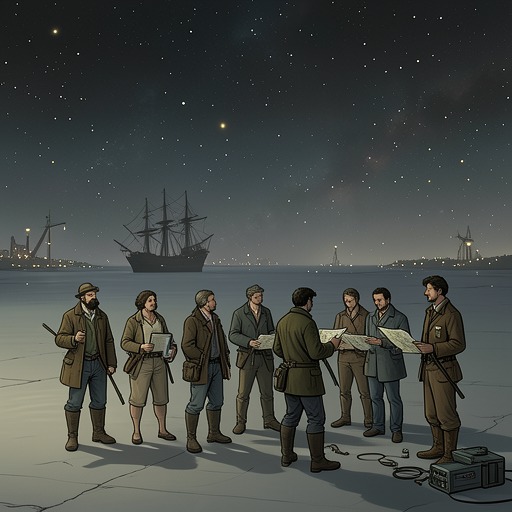
The breakthrough comes through collaboration among the linguists working on the buoy’s messages and the investigators directing the ARTists project. Jeffery reports that the messages have finally been cracked, explaining that the turning point occurred when Magellan’s crew found a readout inside the buoy that displayed the signals in written form. The second signal confirms the investigators’ earlier interpretation: it is a request for maintenance. That apparently practical message gives the buoy the character of a functioning device rather than a dead artifact, while also making the first signal more urgent. If the buoy can request service, its warning may represent an active communication system rather than an unintelligible remnant of the past.
Jeffery delays revealing the first translation because he knows its content will be unwelcome. He presents Eugene Graham with a linguist’s memo marked “Signal 1 Translation,” and the screen gives the message as “HUMAN WILDLIFE PRESERVE. KEEP OUT.” Eugene rereads it before asking whether the linguists are certain. Their confidence is greater than ninety-five percent in the overall meaning, despite disagreement over the exact phrasing caused by translation across seven languages. The small qualification about wording cannot soften the central fact: the message places humanity inside the vocabulary of wildlife management.
The Warning’s Political Shock
The warning immediately destabilizes the political assumptions surrounding the ARTists project. The politicians who know about the program respond with disbelief and indignation. Their reaction is not simply fear of extraterrestrial life; it is an injury to human self-importance. Discovering that as many as six intelligent alien species share the galactic neighborhood already forces humanity to reconsider its presumed centrality. Learning that those species are fencing humans off like elephants converts a scientific revelation into an accusation and a humiliation.
The phrase “Human Wildlife Preserve. Keep Out.” also reverses the direction of the human gaze. Humanity has treated the unknown as an object of investigation, but the warning implies that humans themselves have been observed, classified, and managed by a more powerful community. The preserve is not merely a boundary on a map. It is a political judgment: humans are considered sufficiently hazardous that separation is preferable to contact. The wording combines the language of conservation with the language of exclusion, making protection and imprisonment indistinguishable from the human point of view.
Gladstone Rockwell gives the most direct expression to the resulting security dilemma. He interprets the message as proof that humanity is being caged like zoo animals and asks whether the lack of a propulsion application means that it will still take decades to reach and confront the aliens. Eugene objects to the word “confront,” recognizing that it smuggles a military response into what remains an uncertain interpretation. The exchange shows how quickly a warning can become a strategic threat: once humans understand that they are being contained, the temptation is to treat the containment itself as an act of aggression.
Research, Funding, and Militarization
For Eugene Graham and his senior team, the translation initially produces an institutional advantage. Their budget expands dramatically because superiors now want every possible technology extracted from the buoy as quickly as possible. Allison Ridgeway and her team are preparing to resume work through the QER, and the research groups are operating smoothly. The warning therefore strengthens the scientific project even as it frightens the people responsible for it. A message that says to stay away becomes an argument for learning more, faster.
That acceleration also brings the military closer to the center of the investigation. Eugene’s team is uneasy about the growing influence of AESA defense collaboration, although its arrival is hardly surprising. The narrative presents militarization as an almost automatic institutional reflex: when a new technology appears, the first question is whether it can make killing easier. The buoy’s decipherment thus exposes a recurring contradiction. Humanity seeks knowledge in order to understand a possible quarantine, but its dominant institutions seek weapons in order to challenge the power that imposed it.
The warning is consequently not a self-executing peace message. It does not prevent escalation; it helps produce the conditions for escalation. The aliens’ attempt to establish distance is interpreted through human insecurity, wounded pride, and military calculation. The more clearly the message is understood, the less politically tolerable its implications become.
The Warning in the Larger Disaster Pattern
Later events make the buoy’s warning appear less like an isolated insult and more like a grim diagnosis of human risk. D’armic encounters a titanic fire worm in high-space, a phenomenon so far beyond his understanding that his cutter’s lower brain opens a portal and retreats before rational analysis can catch up. Sensor records then reveal that the worm’s mass matches, to six decimal places, the mass missing from Culpus-Alam. The discovery connects present danger to the Lividite war against the Pu’Lan and to a geocidal technology capable of boring a high-space tunnel through an entire world, collapsing magma, shattering tectonic plates, and destroying a planet’s surface, core, and magnetic field.
The same pattern appears in the history of Okim. An Assembly survey vessel’s orbital accident gives the native population access to a technological example that rapidly accelerates its development. Industrial expansion doubles the population in a generation, increases demand for energy and resources, and produces environmental instability. A reproductive fault in the engineered sun-weeds, untested under the combined conditions of low temperature, microgravity, and high radiation, then allows the plants to reproduce exponentially in orbit. Their modified photosynthesis eventually freezes the planet into a snowball world. These histories supply a material context for the preserve warning: outside observers may regard humanity not as innocent explorers but as another civilization whose technological growth could become ecologically or militarily catastrophic.
The warning’s logic also anticipates the later violence surrounding Earth. A red-hot inverted cone appears beyond the horizon above a quivering city, while the population watches in speechless horror. Allison Ridgeway later learns that the retaliatory strike against Earth has already been launched and may arrive at any moment. Finally, Renée Lemieux fires the Unicycle’s 32.4-terawatt particle beam after the crew disables its safeguards, destroying Xecoron with force that the narrative renders through an intentionally absurd household metaphor. The sequence turns the buoy’s short sentence into a recurring question of scale: what does a civilization do when its tools can cause planetary consequences before its institutions can develop the restraint to match them?
Consequences and Significance
The decipherment changes the narrative from discovery to responsibility. Before the translation, the buoy is chiefly an enigma whose signals require technical interpretation. Afterward, every technological advance connected to it carries diplomatic and existential consequences. The humans now know that alien societies have formed an opinion of them, but they do not know whether that opinion is based on current behavior, ancient history, or knowledge of dangers humanity has not yet revealed. The absence of that context leaves room for fear, resentment, and preemptive action.
The later political aftermath reinforces the warning’s central irony. After the failed attack on Earth, D’armic explains that official punishment for the Turemok is unlikely because much of the admissible evidence and many witnesses have disappeared; the Assembly would prefer the episode to fade from public scrutiny. Even without formal accountability, however, the Turemok are weakened by public loss of confidence, and their monopoly over military and police forces may be broken up. The pattern echoes the buoy incident itself: institutions respond to existential danger through partial investigation, delayed judgment, and contested control of security power.
As an event, the decipherment is therefore both revelation and trigger. Its sentence is short, nearly bureaucratic, and devastatingly clear. It strips away the comforting assumption that humanity is merely making first contact and replaces it with the image of a species standing outside a marked enclosure, discovering that the sign was written about humanity all along.