Humans discovered a lost human settlement on Solonis B
Gate CrashersThe discovery of lost human settlements on Solonis B, later identified as Culpus-Alam, is a decisive turning point in humanity’s first encounter with the galactic community. What begins as a military survey of an apparently uninhabited world reveals living human communities descended from people removed from Earth and placed there as part of a long-running anthropological experiment. The discovery therefore does more than expand the known map of human settlement: it exposes the political reality behind the Human Wildlife Preserve and turns an abstract warning about containment into evidence of an older, more intrusive system of observation and control.
The Settlement and the First Recognition
The revelation begins when a scout reports that the expedition has reached a settlement and encountered “people,” but immediately distinguishes these inhabitants from the expedition’s own personnel. A short woman emerges from the foliage twenty meters down the riverbank, carrying a blowgun, wearing little clothing, and marking her body with blue-and-white paint. Those visible differences initially make her appear radically foreign, yet the decisive observation follows: beneath the paint and loincloth, she is unmistakably human. The scene converts an archaeological or exploratory question into a crisis of identity. The expedition is not looking at an alien species that resembles humanity; it is looking at human beings whose history has been severed from Earth.
The settlement’s inhabitants are later identified as the Pirikura. Their culture has developed in isolation, with its own prohibitions, sacred geography, and account of threatening figures called phantoms or monsters. Communication is difficult because the expedition’s translation tools cannot immediately resolve the tribe’s compressed language. Even so, the investigators learn that the phantoms were once men who became cursed or fell, and that they sometimes take Pirikura people. One missing member of the tribe may have been taken in this way. The encounter consequently combines anthropological discovery with an urgent rescue problem: the expedition must understand the community’s rules without assuming that its own categories can explain them.
Evidence of a Displaced Human History
The existence of the settlement raises an immediate historical problem. Eugene Graham asks how the people could have reached Solonis B, noting that dozens of human ships have vanished over the decades. One possibility is that the inhabitants descended from a lost expedition, but the evidence rejects it. Felix Fletcher, Thomas Harris, and Allison Ridgeway remain at the first settlement while linguistic specialists examine audio transmitted through advanced quantum-entanglement radios. The inhabitants speak the dead language of an Amazonian tribe believed to have become extinct centuries earlier. Their speech has developed syntactic drift and absorbed some Spanish, but comparison with the Endangered Language Archive confirms the identification.
That linguistic evidence makes accidental survival or ordinary colonization implausible. The settlers are not descendants of marooned spacers, and the possibility that an extinct Amazonian tribe possessed an unnoticed space program is treated as absurd. Eugene concludes that the remaining explanation is abduction, and the conclusion changes the moral character of the expedition’s mission. The people on Solonis B are not merely isolated humans who established a distant branch of civilization; they are a population removed from Earth, relocated, and observed without consent. Their language preserves a fragment of terrestrial history that Earth itself had lost, turning the settlement into both a living archive and evidence of a crime.
The scale of the displacement is larger than the first settlement suggests. Orbital scans indicate eleven additional possible sites, while the survey team distinguishes abandoned settlements from those still active. Those sites represent only permanent communities; nomadic tribes may exist beyond them. The discovery thus reveals not a single anomalous village but a dispersed human population whose distribution has been deliberately engineered or at least systematically maintained. The uncertainty about how many communities remain intensifies the political danger: humanity cannot know how much of its own missing history has been taken beyond Earth’s reach.
The Sacred Landscape and the Hidden Observatory
The investigation leads the expedition toward the Cave of the Creators, a place the Pirikura regard as sacred and forbidden. The tribe describes it as the place where gods sleep and refuses to enter it. A mother explains that the phantoms or monsters live there and may have taken one of her people. When Allison Ridgeway asks to be shown the location, the woman refuses to guide the expedition, warning that the place is dangerous and forbidden. She instead summons Tolo, a teenager who escaped the phantoms. Tolo has no ears and reacts with violent refusal when asked to return, insisting that he will never go back.
Allison does not demand that Tolo lead the expedition. She asks only that he identify the location on a holographic map, a small but important adjustment from command to negotiation. His reaction makes clear that the sacred site is also a site of trauma, and the expedition’s pursuit of knowledge risks repeating the coercion already associated with the place. The team must therefore navigate two overlapping boundaries: the Pirikura prohibition against entering the cave and the investigators’ desire to recover a missing person and understand the settlement’s origins.
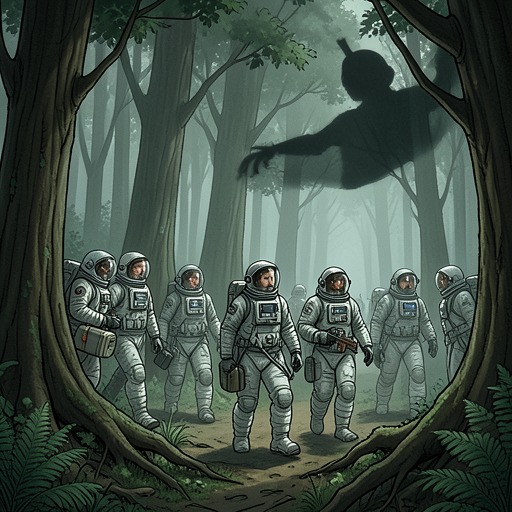
The cave ultimately proves to be an observation post rather than a supernatural dwelling. When the team enters a hidden room, organic webs of iridescent wires pulse along the smooth walls, resembling the interior of an alien buoy. The room activates as the cameraman crosses the threshold, displaying images of the Pirikura village from a dozen viewpoints. Women and children move along dirt roads and boulevards, unaware that observers beneath the ground are watching them. The discovery literalizes the politics of the settlement: the Pirikura have been converted into subjects of surveillance, their daily lives framed as data for an unseen observer.
The observation post also explains why the community’s myths contain phantoms and monsters. Its machinery, hidden beneath a forbidden sacred place, has been translated through generations of fear, memory, and cultural interpretation. The investigators recognize that the Pirikura are no threat to the observers, which makes the surveillance harder to justify. The post is not a defensive installation responding to imminent danger; it is an apparatus for watching a vulnerable human population.
Culpus-Alam as an Experiment
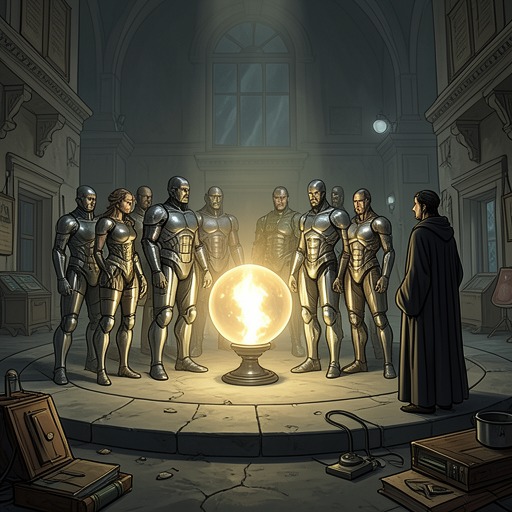
After the human vessels depart through a high-space portal, Vel Noric watches the world they have left behind. The civilized galaxy calls it Culpus-Alam, although the humans use another designation: Solonis B. Noric identifies it as a planet set aside many generations earlier to observe humans under controlled conditions. The experiment has continued unattended for many cycles while isolated tribes developed distinct cultures. Its intended next phase is to facilitate contact among those tribes and observe their interactions, in the hope of predicting how humanity might eventually integrate into the galactic community.
The later explanation to the human expedition makes the experiment’s origin explicit. The Assembly of Sentient Species projected that human expansion would eventually bring humanity into contact with the wider galaxy and established the Culpus-Alam research station to model human responses to unfamiliar cultures. The observers had already monitored human broadcasts, but those broadcasts contradicted one another. Some portrayed humans as cooperative and tolerant; others showed humans and aliens destroying each other. Because the observers could not determine which image represented the species accurately, they removed humans from Earth and placed selected populations in a controlled environment.
The human population used as experimental material came from Earth. Isolated tribes were preferred as the base stock, while random sampling was added to reduce the danger of inbreeding. This method gives the discovery its full colonial dimension. The Assembly did not merely watch a naturally occurring human diaspora. It selected bodies, severed communities from their historical setting, transported them across interstellar space, and treated their descendants as experimental subjects. The planet’s alternate names also reveal a struggle over authority: Solonis B is the human designation, while Culpus-Alam is the name imposed by the Assembly and later used to claim jurisdiction.
The experiment is presented by its administrators as cautious, expensive, and rational, but its procedure depends on a profound asymmetry. The observers possess the technology, the archives, the ability to move populations, and the power to define the world’s legal status. The Pirikura possess only inherited stories, endangered language, sacred prohibitions, and partial explanations for the machinery beneath their ground. Their apparent isolation is therefore not natural solitude but managed isolation, and their cultures are not untouched specimens but the products of displacement and long-term observation.
Political Consequences and Narrative Significance
The discovery directly intensifies the conflict surrounding the Human Wildlife Preserve. Gladstone Rockwell describes the network of buoys as a cage, while Eugene Graham objects that calling it a cage is an overly loaded characterization and suggests that it may mark territory reserved for humanity. The Solonis B settlement makes that distinction untenable. A civilization that relocates human populations to another world for observation has already demonstrated that “preservation” can include ownership, custody, and experimental control. The fence is no longer merely a warning around Earth; it belongs to a larger system in which humans are classified, bounded, and watched.
The Assembly later insists that the Human Wildlife Preserve was intended as a buffer zone, not a prison. Its warning was broadcast in Assembly languages because it was meant to deter outside powers from entering Earth space, not to bind humanity within the boundary. Yet the discovery of Culpus-Alam complicates this defense. Even if the Earth fence was designed as protection, the Assembly’s treatment of displaced humans reveals a broader habit of managing humanity from above. The same political order that claims to shield Earth also claims authority over a world populated by humans taken from Earth.
The legal consequences become explicit when Bloon asks what Solonis B is and D’armic explains that the humans call it Culpus-Alam. Bloon answers that Culpus-Alam was an Assembly world and therefore falls under Assembly jurisdiction, denying humans authority over the matter. This exchange transforms the settlement from a humanitarian discovery into a jurisdictional dispute. The humans regard the inhabitants as their lost people; the Assembly regards the planet as its property and the expedition as an unauthorized intrusion.
That dispute helps explain why the human mission is later described as piracy of Assembly property, violation of Assembly space, and serial geocide. Allison Ridgeway rejects the official framing, but the Assembly has already judged the humans and treats the destruction of Solonis B as a crime committed against an Assembly world. The initial discovery therefore contains the seed of the later indictment: by uncovering the settlement, entering its hidden observatory, and acting against the forces controlling it, the humans challenge not only a scientific experiment but the legal order that permits one civilization to define another civilization’s people, territory, and history.
The event’s deepest significance lies in its reversal of the gaze. Humanity begins by believing that it has discovered an abandoned or unknown human settlement. It then learns that the settlement has always been part of someone else’s experiment, that its inhabitants were taken from Earth, and that their sacred landscape conceals instruments of surveillance. The explorers become the observed, the preserved become the displaced, and the language of protection becomes inseparable from the language of possession. Solonis B is consequently not just a lost colony or archaeological curiosity. It is the moment when humanity discovers that its own history has been curated by an external power—and that the people conducting the curation consider the resulting world theirs to govern.