Jak'el
Gate CrashersJak'el is the concealed strategist behind the Turemok escalation toward war with humanity. His decisive significance lies in the contradiction between his body and his authority: he is described as the smallest adult Turemok anyone has ever seen, yet he operates publicly through the immense persona of the Kumer-Vel. By converting that disguise into political power, he makes spectacle, xenophobia, and manufactured emergency serve a coup against the Assembly of Sentient Species.
Identity and the Kumer-Vel Persona
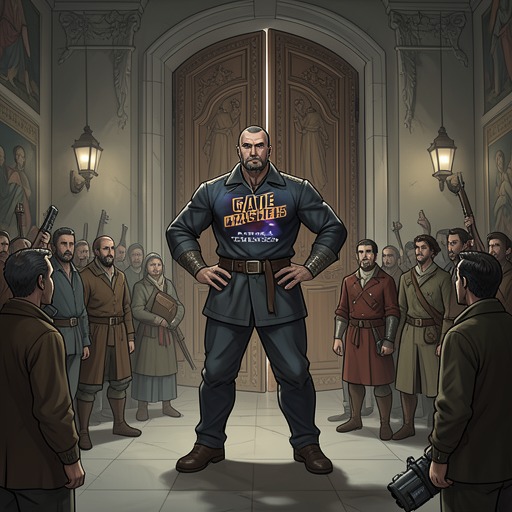
Jak'el belongs to a trio of brothers whose physical bodies make them unsuited to the Turemok warrior society. Neither Jak'el nor Grote possesses the stature that society treats as a prerequisite for success; their younger brother J'quol is somewhat larger, but still part of the same marginal family. Instead of accepting obscurity, the brothers construct a single intimidating public identity. Grote carries Jak'el in a rig, while Jak'el's robe and enormous prosthetic crest complete the illusion of a gigantic warrior ruler. The performance is so convincing that even Turemok who have lived with it for years continue to be overawed by the supposed Kumer-Vel.
The deception is not merely theatrical but administrative and military. When Vel Noric encounters the Kumer-Vel, he sees twin red points above a figure towering a full head and crest over him, and suppresses an instinct to flee. The physical scale of the imposture gives Jak'el access to the obedience normally reserved for noble birth or martial greatness. Later, when an aide announces the approach to Earth, Jak'el again stands atop Grote's shoulders and answers with rehearsed disdain, while the aide bows deeply before retreating. The persona has become an institution: a body assembled from two allegedly powerful brothers, a costume, a title, and the automatic submission of everyone around it.
Engineering a Pretext for War
Jak'el's political method is to transform uncertainty into panic. The discovery that humanity has opened a high-space portal changes the strategic situation, but Jak'el does not treat it as a matter for cautious investigation. He tells Grote that the humans must be used to create a “healthy panic,” because a coup becomes simpler when the population itself demands extraordinary protection. Humanity is therefore valuable to him less as a real opponent than as a threat-image that can persuade the public to surrender authority.
His first major instrument is Vel Noric. Jak'el identifies Noric as reflexively xenophobic, incompetent, and too unintelligent to understand that he will eventually be discarded. The Kumer-Vel offers Noric a route to command the Xecoron, the flagship of the Turemok fleet and the most prestigious command in Assembly space. In exchange, Noric must supply an excuse or pretense for action against humanity while the Assembly still restrains the Turemok from attacking a threat in its nest. The offer exploits ambition and fear simultaneously: Noric believes he is being rehabilitated, while Jak'el expects him to overreach and become the expendable branch of the operation.
J'quol is assigned the subtler role of pushing Noric toward that overreach. Jak'el relies on the younger brother's persuasive position to guide Noric toward the failure the conspiracy requires. The arrangement reveals the brothers' division of labor. Grote provides the visible bulk of the Kumer-Vel, J'quol applies pressure at the operational level, and Jak'el interprets the resulting disorder as a ladder toward power. The Turemok military and police monopoly weakened by Assembly restraints becomes, in Jak'el's hands, an argument for replacing the existing hierarchy rather than merely defending it.
The Brothers' Alliance and J'quol's Death
Jak'el's relationship with Grote combines intimacy, manipulation, and practical dependence. After J'quol is killed, Grote paces their shared office and struggles to lift their solid bertel-wood desk, asking how their brother could have been killed. Jak'el answers that J'quol died a hero to their people and insists that he merely failed to survive after completing his part of the operation. The distinction is cold but strategically precise: death is not allowed to interrupt the plan because, in Jak'el's interpretation, J'quol has already fulfilled his function.
Their argument exposes the brothers' complementary temperaments. Jak'el tells Grote that he acts on impulse while Jak'el tidies up the mess, using the overturned office as a metaphor for their relationship. The line is enacted physically: Grote's anger scatters the files, and Jak'el wipes his hands on his cloak before reorganizing the debris. Yet the practical role does not make him emotionally detached from the family. He acknowledges that J'quol's death deserves more than bickering, then immediately converts remembrance into a renewed political objective.
That objective is an Assembly order authorizing action against Earth and its colonies. Once the document is found, Jak'el declares that the Kumer-Vel will lead the attack from the bridge of the Xecoron. He frames Earth's destruction as revenge for J'quol, promising that Earth itself will become the brother's funeral pyre. The image fuses private grief with mass violence: J'quol's death is both mourned and weaponized, while the planet's thirty billion inhabitants are reduced to material for a familial and authoritarian myth.
The Coup's Escalation and Approach to Earth
Jak'el understands that the conspiracy could have been allowed to grow more slowly. On the approach to Earth, he wonders whether the ruse has been advanced too quickly, imagining a broader campaign in which several inhabited planets would experience panic over supposed human terrorists. Sufficient fear might have led the Assembly to beg the Turemok to impose martial law, making a coup against the Assembly hierarchy easier. This counterfactual reveals that the attack is not simply a reaction to events; it is one stage in a larger plan for Turemok ascension.
He nevertheless concludes that delay would create additional opportunities for failure. More time and more planets would mean more variables, whereas immediate action removes one more obstacle to Turemok supremacy. Jak'el therefore accepts a smaller operation because it is more controllable. His strategy resembles a choice to carry smaller boulders along a longer path: gradual accumulation is preferable in theory, but the immediate destruction of a major threat may be safer in practice.
The approach itself is enabled by knowledge gathered through espionage. Jak'el knows that human defenses are effectively absent because humanity, paranoid about internal spies, has hidden its warship yard in its own asteroid belt, where Turemok-built espionage platforms are also located. The same secrecy meant to protect Earth thus leaves it exposed to the conspirators. Jak'el's power comes not only from the Kumer-Vel disguise but from information asymmetry: he can see the weakness created by human suspicion while the humans remain unaware of the surveillance around them.
The Attack on Earth and Narrative Role
On the bridge of the Xecoron, Jak'el and Grote preside over the warship like a wrathful deity. The crew oscillates between worshipful awe and fear, settling into the uneasy behavior of people who bow to the persona while stealing glances at the figure they cannot fully understand. The scene makes the brothers' false body politically real. Whether the Kumer-Vel is one giant warrior or two hidden, inadequate bodies matters less than the obedience produced by the image.
Jak'el commands the vessel to sheath itself, open the high-space portal, and return to lower-space. When the portal opens, Earth appears as a blue-green jewel, and he calls it beautiful before declaring that the assembled crew is witnessing it for the last time. His appreciation does not restrain destruction; aesthetic recognition intensifies the cruelty of his decision. Earth can be admired precisely as it is marked for annihilation.
As a character, Jak'el is therefore the shadow behind the book's chain of misread threats. Human fear of the Human Wildlife Preserve warning, Turemok fear of human technological growth, accusations of geocide, forced surrender demands, and the punitive expedition all become stages in a security spiral that he actively engineers. His role reverses the familiar heroic journey: instead of crossing a threshold to return with knowledge, he crosses into power by manufacturing ignorance, disguising weakness as supremacy, and turning the promise of contact into a pretext for conquest. His ending position is not redemption or exposure but command at the moment the attack portal opens, with the fate of Earth placed beneath the authority of a persona that is physically false and politically devastating.