Jeffery
Gate CrashersJeffery is Eugene Graham’s assistant and one of the book’s most persistent human links between bureaucratic authority, scientific urgency, and personal loyalty. His importance is not defined by a single heroic act but by continuity: he carries messages, tracks the political and publicity dimensions of the mission, recognizes danger before others do, and remains present when the scattered expeditionary relationships are gathered back into a household. His comedy makes him memorable, but his real narrative function is connective. He turns institutions into conversations and helps the story move between technical crisis and domestic fellowship.
Identity and Introduction
Jeffery is introduced as the assistant responsible for waking Eugene Graham when an urgent summons arrives from the Fleet Com QER Center. He apologizes for disturbing Eugene but makes clear that the professor is needed immediately, placing him at the point where private sleep gives way to public emergency. The title “Professor” reflects Eugene’s earlier career as dean of Cornell University, while Jeffery’s role belongs to Eugene’s newer life as head of the American/European Space Administration. Jeffery therefore serves an authority figure whose old academic identity has been absorbed into a much larger administrative and scientific system.
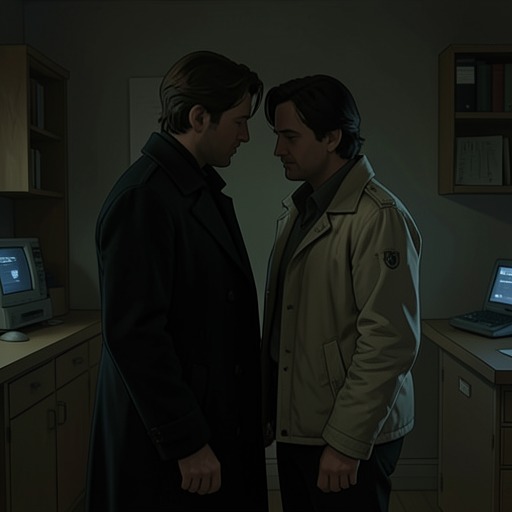
His appearance is marked by a striking physical incongruity. The lightly muscled body carrying him lags roughly a second behind his movements, so that Jeffery always seems several steps ahead of himself. The delay makes him an awkward assistant, but not an ineffective one. The same description also emphasizes his unnaturally resolute hair, a small visual detail that turns his polished appearance into a recurring comic emblem. Jeffery’s competence is thus presented through a mismatch between speed and embodiment: his mind and manner are brisk, while his body appears to receive the instructions late.
Work, Competence, and Comic Timing
At the QER Center, Jeffery participates in the institutional response to the artifact discovered by the expedition. Eugene asks him specifically about the unwanted-publicity front, and Jeffery reports that the feared leak has not yet occurred. His assignment is not merely clerical. He monitors how information about the artifact may escape into the public sphere, placing him within the political and reputational machinery surrounding the research project. When Thomas Harris then mentions that he has spotted a tail while shopping, Jeffery answers with dry astonishment, helping expose the absurdity of trying to contain mission-critical information once powerful interests have begun to circle it.
Jeffery’s humor is usually brief, observational, and socially precise. After Captain Maximus Tiberius delivers a baffling lesson about faith and leaves the bridge, Jeffery explains that Felix Fletcher has effectively been put in his place by a Jack Russell terrier. The comparison punctures Maximus’s military self-importance without requiring a formal argument. Jeffery understands the emotional and theatrical dimensions of a room, and his jokes often identify what the others have just experienced but cannot yet articulate.
That quality becomes especially visible when Felix enters the bridge of Bucephalus. The space is crowded with holographic displays, pulsing sounds, and busy crew members, more like a Berlin discothèque than the quiet environment in which Felix had previously worked. Jeffery belongs to this new atmosphere as both participant and commentator. He helps make the transformation legible: the expedition has become faster, louder, more socially complicated, and more dangerous, and Jeffery’s quick verbal reactions give that change a human scale.
Relationships and Loyalty
Jeffery’s closest explicit professional relationship is with Eugene. He is the person who wakes Eugene for the QER emergency, accompanies the administration’s response, and remains part of the professor’s trusted circle long after the original mission has expanded into an interplanetary crisis. Their relationship is practical rather than sentimental in its first appearances, but its durability suggests confidence built through shared responsibility. Jeffery knows how to interrupt Eugene, how to report bad news, and how to keep the conversation moving when Eugene would rather remain in bed.
He also becomes part of the close friendship network around Felix Fletcher and Thomas Harris. His comments often mediate between them, especially when Maximus’s charisma or authority unsettles Felix. At the eventual homecoming, Jeffery and Harris sit together holding hands, while Felix sits close to Jacqueline Dorsett. The arrangement confirms that Jeffery is not merely an observer of the expedition’s personal bonds: he belongs to the surviving emotional community created by them. His welcome at Eugene’s dinner is marked by hugs and kisses, transforming the assistant who once delivered urgent summonses into a member of the household.
Jeffery’s connection to Jacqueline is likewise shown through this communal setting rather than through a separate dramatic confrontation. He and Jacqueline stand to greet the returning men, and their gestures help establish the dinner as a reunion of people who have endured danger together. The scene distributes affection across the group, making survival collective rather than solitary. Jeffery’s place in that pattern matters because his work has often positioned him behind the scenes, yet the ending gives him equal physical and emotional presence among the survivors.
Crisis, Time, and the Return Home
Jeffery’s importance increases as communication becomes a matter of life and death. During the threat to Earth, Jacqueline Dorsett insists that the nearest ship must be reached so that Jeffery or Eugene can be contacted as quickly as possible. The purpose is to warn them before the attack falls and to give civilians time to evacuate. Jeffery is therefore one of the people whose access to information may determine whether Earth can respond at all. He is not presented as the person firing a weapon; he is part of the communication network on which preparation, warning, and survival depend.
His story also unfolds against the book’s fractured experience of time. Cryogenic sleep makes years pass externally while the sleepers experience only brief intervals, and the personal consequences of that division are visible throughout the expedition. Jeffery’s work belongs to a society in which messages can arrive instantly across distances that once made news slow, while bodies and relationships remain subject to long delays. His role as assistant is consequently more than administrative: he helps maintain continuity across technological and temporal breaks.
The epilogue completes that continuity with a domestic reunion at Eugene’s penthouse. Eugene welcomes Felix and Harris with an enormous bear hug and relief that everyone is safe, while Jeffery and Jacqueline greet them alongside the other guests. Jeffery then sits at the table holding Harris’s hand. The gesture is quiet, but it is the clearest confirmation of his place in the post-crisis community. The assistant who first appeared as a holographic interruption in the middle of the night is now physically present in a room where the expedition’s survivors can eat, drink, conceal small secrets, and belong to one another.
Narrative Role and Significance
Jeffery is a rounded supporting character because his defining trait—speed—does not exhaust him. He is physically delayed yet verbally ahead; professionally subordinate yet socially perceptive; comic without being frivolous; and embedded in institutional systems while remaining capable of intimate loyalty. His awkward lag makes technology visible as lived experience, while his jokes prevent the command structure from becoming solemn or impersonal.
He also helps the novel test the boundary between function and personhood. Magellan’s developing self-awareness raises the question of whether a useful entity can be treated as a person, while Jeffery’s own characterization reverses the problem: a person whose body appears mechanically out of sync is still recognized through wit, responsibility, affection, and sustained relationships. The contrast does not make Jeffery a symbol of disability or machinery; instead, it gives the story a comic way to show that embodiment is never perfectly transparent, even in a technologically advanced future.
By the end, Jeffery has helped carry the narrative from emergency communication to shared survival. He is not the expedition’s commander or its principal discoverer, but he makes its institutions responsive and its friendships legible. His final presence at the dinner table gives emotional form to the book’s larger movement: people separated by distance, danger, altered bodies, and disrupted time can still assemble again, provided someone keeps the lines open.