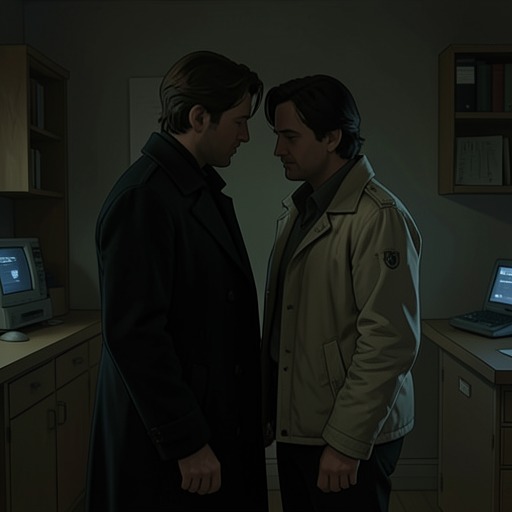
Jeffery–Thomas Harris relationship
Gate CrashersThe Jeffery–Thomas Harris relationship is a concealed but increasingly secure romance between Jeffery and Thomas Harris. It begins in the social margins of their workplace, becomes visible through small physical and verbal intimacies, and gains emotional weight when Thomas Harris is reassigned to a dangerous mission. Their relationship consequently joins private love to public duty: Jeffery wants Thomas Harris safe, while Thomas Harris accepts the risks of service without treating that acceptance as a reason to withdraw from him.
Recognition and Early Intimacy
The relationship first becomes legible during an evening at Captain’s Mast. Jeffery invites Felix Fletcher to join him in meeting Thomas Harris for a drink, and the three arrive at a crowded nautical bar filled with young service members, spinning radar and radio antennas, and sailors singing lewd sea shanties. Thomas Harris sits quietly beside the noisier Royal Navy group, but his greeting makes clear that Jeffery is already a familiar and welcome presence. The gathering provides a public setting in which the relationship can exist without being announced.
Later, after several hours of drinking, Jeffery leans his head on Thomas Harris’s shoulder, and Thomas Harris does not object. Felix Fletcher notices the gesture and wonders whether the two men are on a date, although he has not recognized any obvious signs of romance at work. The moment is important precisely because it is casual: physical ease, rather than a declaration, exposes a bond that the workplace has not yet named.
The intimacy becomes still more unmistakable when Thomas Harris absently twirls a finger through Jeffery’s hair while they watch Maximus Tiberius pursue another romantic conquest. Jeffery jokes about Maximus Tiberius being too comfortable with other people’s skin, while Thomas Harris’s touch quietly establishes a different kind of closeness beside the loud, performative heterosexuality of the bar. The contrast gives their relationship its particular texture. Maximus Tiberius turns romance into spectacle; Jeffery and Thomas Harris communicate through familiarity and touch.
Privacy and Mutual Disclosure
Jeffery does not immediately present the relationship as settled. When Felix Fletcher cautiously asks whether he and Thomas Harris are “a … thing,” Jeffery answers that he would not say so yet. He explains that they are enjoying each other’s company and asks Felix Fletcher to keep the matter private because the office does not need to know. The request indicates both affection and caution. Their intimacy is real, but it has not been converted into a public identity, and Jeffery remains aware of the institutional consequences of workplace knowledge.
The secrecy is not framed as shame between the two men. Jeffery speaks openly enough to Felix Fletcher to seek his discretion, and Felix Fletcher responds that he is happy for them. The exchange creates a small circle of trust around the couple. Their relationship therefore grows through selective disclosure: private at work, acknowledged to a friend, and protected by mutual understanding rather than by a dramatic declaration.
The relationship also appears as part of Thomas Harris’s longer pattern of conduct. Eugene Graham later tells him that he has seen Thomas Harris and Jeffery “sneaking around like kids trying to find the Christmas presents for a year now.” Eugene Graham has recognized the relationship before Thomas Harris discusses its implications directly with him. The remark confirms that the romance is not a sudden attachment formed at the bar; it has already endured a year of concealed meetings and recognizable signs of mutual attraction.
Duty, Reassignment, and Separation
The relationship is placed under pressure when Thomas Harris is reassigned. Thomas Harris believes Eugene Graham failed to speak out on his behalf, because Eugene Graham made the reassignment sound final. Eugene Graham explains that he would like to keep Thomas Harris nearby, and specifically acknowledges that the transfer will take him away from Jeffery. This recognition matters because it places their private relationship inside the command structure. The romance is no longer merely a personal secret; it is one of the human costs of military deployment.
Eugene Graham nevertheless chooses the reassignment because he considers Thomas Harris one of the best people available to represent them if fighting begins. He refuses to retain Thomas Harris for selfish reasons when another, less suitable marine might lead the detachment. In this decision, Thomas Harris’s competence and his relationship with Jeffery pull in opposite directions. The same qualities that make Thomas Harris valuable to the mission make his absence painful at home.
The couple’s private conversation before the separation makes that cost explicit. Jeffery admits that knowing military life is dangerous differs from experiencing the danger. Thomas Harris answers by embracing him and reassuring him that he has been in bad situations before and knows what he is doing. Jeffery then asks him to keep Felix Fletcher alive as well, describing Felix Fletcher as someone he really likes. Thomas Harris answers that he likes Felix Fletcher too. The exchange broadens their intimacy beyond the couple: Jeffery’s concern for Thomas Harris includes the people who will share his danger, and Thomas Harris accepts that concern rather than dismissing it.
Emotional Function and Significance
The relationship supplies a counterpoint to the novel’s technological and military scale. While Magellan can regard a crew of 157 people as children under her care and struggle with the possibility of becoming obsolete, Jeffery and Thomas Harris experience vulnerability in immediate human terms: a shoulder offered in a crowded bar, a head resting against a lover’s neck, and the knowledge that reassignment can carry someone into combat. Their romance makes separation a personal fact rather than an administrative consequence.
Its gradual presentation also gives the relationship a distinctive narrative form. The reader first sees companionship in a public drinking scene, then notices physical familiarity, then receives an explicit request for privacy, and finally learns that the attachment has existed for approximately a year. The chronology of revelation lags behind the chronology of the relationship. That delayed recognition mirrors the couple’s own guardedness and lets ordinary gestures carry the force of disclosure.
The relationship is neither reduced to a workplace secret nor completed by a single public announcement. It remains defined by a balance between discretion and commitment. Jeffery protects the relationship’s privacy, yet he openly worries about Thomas Harris’s safety; Thomas Harris accepts military responsibility, yet he answers fear with physical reassurance. Their bond therefore represents a form of romance compatible with duty but not untouched by it: love does not remove danger, and duty does not erase love.