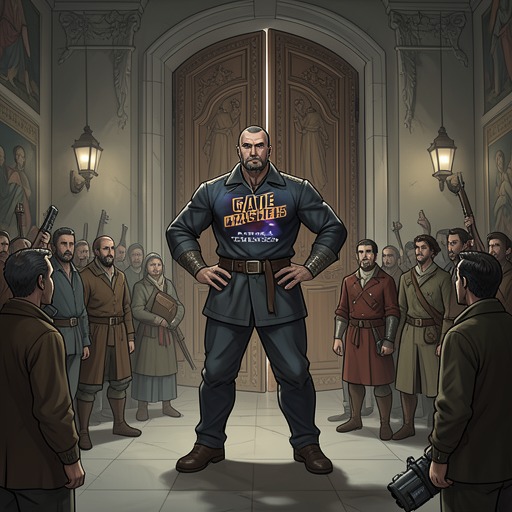
Kotal
Gate CrashersKotal is a Turemok officer whose importance emerges during the human prisoners’ escape from a patrol cruiser. He is not presented as the architect of the crisis or as an ideological champion of the Turemok military system. Instead, his role is that of a technically capable subordinate caught between formal authority and the rapidly expanding danger posed by J’quol. His perceptiveness allows him to understand what has happened, but his fear prevents that understanding from becoming resistance. Through Kotal, the narrative shows how a violent institution can absorb an ordinary officer and make him useful to a more dangerous superior.
Position and Introduction
Kotal first appears in a command environment dominated by rank, surveillance, and the language of security. After Vel Noric is killed and the humans escape, he reports the facts to J’quol: security has confirmed Noric’s death, the prisoners have broken free, and the humans have already killed a hand of guards. Kotal’s report is direct and operational, but the circumstances make it politically explosive. The humans have recovered the weapons confiscated when they arrived, and the failure has occurred inside a facility that should have held them securely.
The immediate explanation is institutional rather than accidental. Kotal identifies that the security grid is maintained at the Hedfer-Vel’s station, while duty shifts are also controlled there; the guards on duty were Noric’s loyalists. His answer exposes the weakness created by Noric’s command structure, but it also places Kotal in danger because he has identified the mechanism of the failure too clearly. J’quol responds with an icy mixture of approval and menace, calling Kotal perceptive and suggesting that a soldier with such insights might have uses. Kotal shakes his head vigorously when asked whether he intends to oppose J’quol. His body answers before his words do: survival requires immediate submission.
Promotion Under Pressure
J’quol’s seizure of authority changes Kotal’s title and position without making him secure. J’quol takes the ship’s command station and instructs Kotal to stop addressing him as Hedfer-Vel. Kotal adopts the new form of address, calling him Vel, but J’quol pointedly continues to call him Hedfer-Vel Kotal. The exchange creates a hierarchy built on controlled humiliation: Kotal has been promoted into proximity with power, yet the old title remains a reminder that his authority depends entirely on J’quol’s recognition.
J’quol assigns Kotal a new station and orders him to observe carefully. Kotal therefore becomes both subordinate and witness. He is close enough to see the decisions being made, but not strong enough to challenge them. His new position also gives him access to the operational picture when the humans neutralize the hangar guard and escape in their small craft. Kotal reports the development to J’quol, who answers with deliberate calm. The escape is treated as unsurprising, even though it represents another collapse of Turemok control.
Kotal then checks the weapons-readiness screen and confirms that the cruiser’s short-range autocannons have been disabled. His confusion is genuine: if the weapons cannot fire, he cannot understand why the humans are being allowed to escape. J’quol denies that the situation reflects a conspiracy, accusing Kotal of wild accusations and implying that such talk is unbecoming in an officer of his rank. Kotal retreats once more into obedience, answering, “Of course, Vel.” His technical competence produces knowledge, but knowledge does not yet produce agency.
Witness to J’quol’s Machinations
Kotal’s decisive narrative function is to recognize the logic behind J’quol’s apparent incompetence. J’quol explains that the disabled weapons will force him to destroy both human vessels, regretting that the ships cannot be preserved for the Assembly’s inquiry. Only then does Kotal grasp the full design. If prisoners under Turemok custody die, their deaths will invite suspicion; if the captured human ships survive, they remain physical evidence that could contradict the official account. But if the prisoners escape and attack a patrol cruiser whose weapons have been sabotaged, J’quol can present the destruction as necessary self-defense.
Kotal understands the additional consequence that makes the scheme so deadly: the counterattack can leave no survivors and no material evidence capable of challenging J’quol’s version of events. The realization changes his assessment of the officer beside him. J’quol is no longer merely a superior exploiting a security failure; he is, in Kotal’s judgment, the most dangerous Turemok he has ever encountered. Kotal’s perception gives the reader access to the moral structure of the plot without turning him into its hero. He sees the trap because he is stationed close enough to its controls, but he remains trapped by the same chain of command that lets him see it.
Kotal’s exchange with J’quol over Cuna reinforces this characterization. Kotal asks whether J’quol is a Cuna player, recognizing that the operation resembles a game in which the visible move conceals the real objective. J’quol confirms that he has played since leaving the nest and invites Kotal to join him. Kotal refuses with the bleak response, “Not on your life.” The line is not a public denunciation, and it does not interrupt the plan. It is instead a private boundary: Kotal can identify the game and decline its language even while continuing to serve the player who controls the board.
Fear, Knowledge, and Complicity
Kotal’s relationship with J’quol is defined by asymmetry. J’quol tests him, praises the very perceptiveness that makes him dangerous, and then incorporates him into the new command structure. Kotal’s vigorous denial of opposition demonstrates fear, while his later observations demonstrate that fear has not erased his judgment. He remains capable of distinguishing an operational failure from a deliberate fabrication and of calculating the political consequences of destroying evidence. The narrative thus separates moral understanding from moral action.
That separation matters within the wider conflict between the Turemok military apparatus, the human expedition, and the Assembly. Humans have already been treated as suspects in the geocides of Culpus-Alam and Okim, and the Turemok response depends on custody, weapons, and controlled testimony. Against that background, Kotal’s station is not neutral administration. His reports help sustain a system that turns accusation into military procedure. Yet the same reports reveal how unstable that procedure is: the prisoners’ escape, the loss of guards, the recovery of confiscated weapons, and the disabling of the autocannons all threaten the official narrative. Kotal becomes the officer who can see the gap between the law’s stated purpose and the violence being prepared in its name.
His conduct also contrasts with the broader rhetoric of emergency that drives the novel’s interspecies conflict. Human leaders speak of needing a deterrent in case first contact goes badly; distant authorities interpret human technological progress as a future threat; and the Turemok issue commands under suspicion of geocide. Kotal does not create these threat narratives, but he operates inside their machinery. His fear shows how security language affects not only enemies and prisoners but also the officers charged with enforcing it. The system demands obedience first and interpretation second, even when interpretation reveals that the command is designed to erase accountability.
Narrative Role and Significance
Kotal is a threshold figure between institutional routine and deliberate atrocity. He begins as an interpreter of events, identifying where the security system failed, and becomes an observer of a coup-like transfer of authority. His promotion is therefore an inversion of advancement: a higher station gives him a clearer view while binding him more tightly to the person who has taken control. He is rewarded for insight but not permitted to convert insight into dissent.
His significance lies in the precision of his recognition. Kotal understands that J’quol’s plan depends on manufacturing a defensible story from a sabotaged situation. The humans must appear to have escaped violently; the patrol cruiser must appear to have acted in self-defense; and the destruction of the ships must remove the evidence that could expose the lie. Kotal sees all three parts at once. That knowledge makes him a witness to the political manufacture of truth, even though the narrative does not present him as capable of stopping it.
Kotal’s final refusal to play Cuna with J’quol gives the character a narrow but meaningful form of resistance. He cannot oppose J’quol openly, cannot restore Noric’s command, and cannot prevent the destruction being prepared. What he can do is name the danger privately and reject the invitation to treat calculated murder as sport. The refusal does not redeem him from complicity, but it preserves a distinction between understanding power and admiring it. Kotal remains a frightened subordinate, yet his frightened perception is precisely what exposes J’quol as the most dangerous figure in the room.