Kulla
Gate CrashersKulla is a Chimanis world whose ruined surface first appears empty, recreational, and harmless, but whose hidden history makes it one of the most consequential locations in the expedition’s widening interstellar crisis. The planet embodies a recurring danger in the novel: a landscape can be read incorrectly when its visible remains are treated as the whole truth. What the human explorers initially identify as a dead resort world is in fact a misleading outer layer of a civilization whose cities and industry lie underground, and Kulla’s destruction later becomes part of the evidence in a political struggle over geocide, jurisdiction, and responsibility.
Definition and Setting
Kulla is the fourth planet in the system associated with the Chimanis. Vel Noric initially reacts with disbelief when his sensors locate the human vessels there, because, in his understanding, Kulla contains little beyond empty vacation homes and rotting resorts. The Chimanis’ principal cities and industrial facilities are on the third planet, so Kulla is not where an informed observer would expect a human expedition to concentrate its attention.
The apparent vacancy of Kulla is deceptive rather than absolute. J’quol explains that Chimani cities and infrastructure were built almost exclusively underground in order to preserve moisture in the desert environment. A cursory scan could therefore miss the civilization entirely. Kulla’s geography thus produces a layered form of concealment: the surface records leisure, abandonment, and decay, while the functional life of the Chimanis remains below ground and elsewhere in the system.
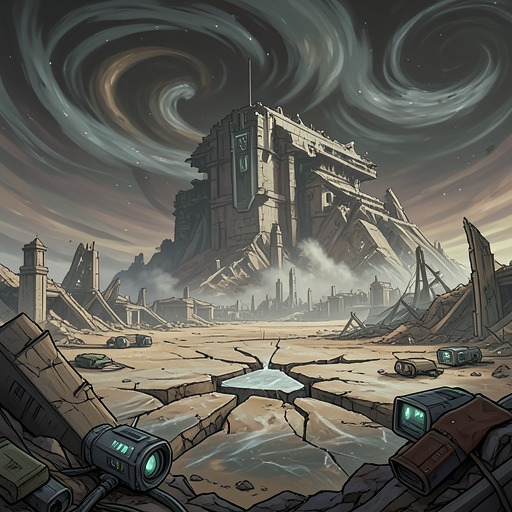
The human team’s visual encounter with the planet reinforces the error. Through a break in the foliage, the explorers see a city abandoned for generations. Its roads are unpaved, and purple grass rises waist-high across the boulevards, thick as carpeting and giving the place an almost carnival appearance. The architecture is extravagant and heterogeneous, combining tall geometric structures with fluid organic forms rather than following one coherent style. Buildings compete for prominence as isolated centerpieces, creating a skyline without a single governing aesthetic.
Time and vegetation have nevertheless imposed their own unity on the city. Sapling-sized trees grow from rooftops, sending roots down grimy walls; windows are cracked or missing; and vivid paint has faded into pastels. Close inspection reveals peeling surfaces, spiderweb cracks, and mold-like growths ranging from orange to blue. The city’s former human or alien design has been overtaken by the twin pressures of nature and time, so that decay becomes the only common style left.
The Expedition’s Misreading
Allison Ridgeway’s ground team initially assumes that the abandoned city is the destination it has been seeking. The explorers move through it with scouts ahead, packs on their shoulders, and Allison and Harris leading the advance. The setting appears to offer exactly the kind of evidence an expedition expects from a lost settlement: monumental buildings, traces of infrastructure, and a landscape rich in unfamiliar flora.
The interpretation begins to fail when Felix notices that the planet’s physical conditions do not fit the people associated with the city. The other habitable planet is arid and has lower gravity, a combination that would better explain the height of the Chimanis. Once he articulates the possibility, Allison recognizes that the answer is obvious: the expedition is on the wrong planet, and the supposed destination is merely a tourist trap.
The correction is handled with practical restraint rather than drama. Allison learns that Magellan and Bucephalus will be overhead in less than ten minutes and that the teams could be evacuated by shuttle on the current orbit. Instead, she decides there is no emergency and orders the personnel to walk back, conserving shuttle fuel while collecting additional flora samples. The decision turns a costly navigational and interpretive mistake into a manageable field reversal, but it does not erase what the error reveals about the limits of remote observation.
Kulla therefore functions as a counterpoint to the expedition’s confidence in scanning, naming, and classification. A brief survey identifies a resort landscape, yet fails to disclose the underground civilization that gives the system its real significance. The planet is not simply an abandoned backdrop; it is a test of whether observers can distinguish visible ruins from the social and ecological systems that produced them.
Connection to Culpus-Alam and Human Observation
Kulla belongs to the wider network of worlds shaped by the Assembly’s treatment of humanity as an object of study. The human tribes encountered elsewhere are not native accidents of galactic history. The Assembly established Culpus-Alam, known to humans as Solonis B, as an anthropological experiment intended to model how humans would respond to unfamiliar cultures. Human populations were taken from Earth, with isolated tribes preferred as the base stock and random sampling added to reduce the risks of inbreeding.
That experimental framework gives Kulla an important contextual role. The human expedition is not merely exploring an unknown planet; it is moving through a galaxy in which human beings, their history, and their possible future integration have already been organized by other powers. The Assembly’s observers hoped to resolve contradictory impressions of humanity—broadcasts showed humans cooperating with other races in some accounts and acting as irrational, violent, or bigoted destroyers in others. Kulla’s ruined surface and hidden infrastructure extend that problem of partial knowledge into the physical environment itself.
The planet also reverses the direction of the gaze. The Assembly watched humanity as a controlled population, while the human explorers now examine alien remains and infer a civilization from incomplete evidence. Yet the explorers’ mistake demonstrates that observation is never neutral or automatically comprehensive. The surface city is visible, legible, and narratively tempting; the underground Chimanis world is harder to detect and therefore easier to exclude from the first account.
Destruction and Political Consequences
Kulla is ultimately grouped with Culpus-Alam and Okim among the planets destroyed through high-space technology. D’armic argues before the Assembly that Bucephalus was physically incapable of creating portals large enough to destroy those worlds. By contrast, the patrol cruiser commanded by the deceased Vel Noric possessed the relevant capability. This technical distinction becomes a central part of the case against the official version of events and against the attempt to blame humanity.
The stakes are not limited to identifying the weapon. D’armic warns that the antagonists may have acted independently or under clandestine orders, while sending altered reports back to the Assembly. Human sensor logs and Bucephalus’s high-space generator are therefore presented as the best remaining means of proving the mutual innocence of the humans and D’armic. Kulla’s destruction is evidence in a conspiracy whose consequences extend far beyond the planet itself.
The political danger is catastrophic. If the evidence fails, a Turemok fleet will enter the Human Wildlife Preserve, destroy Earth, and impose a generation-long sequestration on each human colony world. Kulla is consequently transformed from an apparently empty tourist planet into one of the factual foundations of a threatened species’ defense. Its destruction supplies both the material scale of the crime and the technological comparison needed to challenge the accusation against the human vessels.
By the time the matter reaches the Assembly, the jurisdictional dispute has become inseparable from the question of naming. When Bloon asks what Solonis B is, D’armic explains that it is the human name for Culpus-Alam. Bloon then insists that Culpus-Alam was an Assembly world and therefore fell under Assembly authority, denying humans the right to decide the matter. Kulla participates in the same larger struggle over who may define a world, claim authority over its inhabitants, and determine which testimony counts.
Narrative Significance and Aftermath
Kulla’s significance lies in the collision between surface appearance, hidden structure, and institutional power. Its abandoned city is visually memorable because decay has not erased grandeur; it has made grandeur unreliable. The roads, purple grass, competing architectural forms, and invasive trees invite the explorers to treat the planet as a dead museum, but the underground Chimanis infrastructure shows that absence of visible activity is not proof of civilizational absence.
The planet also sharpens the novel’s ecological and colonial dimensions. The Chimanis adapted their settlements to a desert by placing cities underground to conserve moisture, while later observers reduce the world to vacation properties and ruins. The Assembly, meanwhile, classifies inhabited or formerly inhabited worlds according to its own jurisdictional and experimental categories. Kulla is thus subjected to several forms of external reading: as resort, as research object, as strategic target, and finally as evidence in a legal and military dispute.
The official investigation into Culpus-Alam and the other destroyed planets eventually stalls because much of the admissible evidence and many witnesses are gone. D’armic expects the Assembly to prefer that the episode disappear from public scrutiny, even though the Turemok are weakened by repeated defeats and the public’s loss of confidence. Kulla remains part of that unresolved record. Its ruins are not restored, its dead are not fully accounted for, and its destruction does not produce a clean institutional punishment; instead, it leaves behind an evidentiary trace that exposes how easily powerful organizations can convert planetary catastrophe into jurisdictional argument and administrative silence.