Lockheed-Boeing-Raytheon
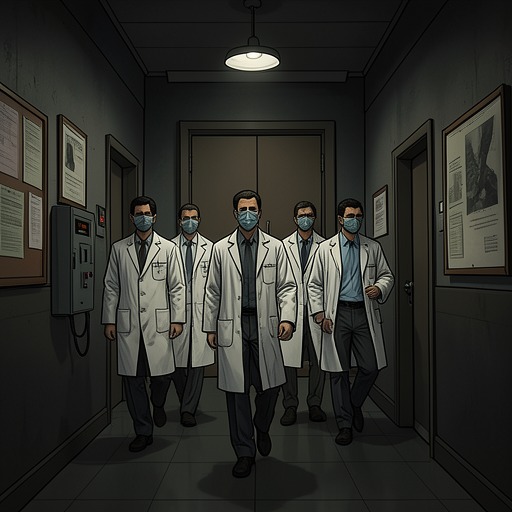
Gate CrashersLockheed-Boeing-Raytheon is presented as the largest defense contractor on Earth and as the industrial power most eager to convert humanity’s encounter with alien technology into military advantage. Its influence reaches directly into the American/European Union Parliament, where Gladstone Rockwell serves less as an independent representative than as the company’s political instrument. The organization therefore embodies the danger that a scientific breakthrough, discovered under conditions of uncertainty, will be governed by procurement, deterrence, and strategic fear rather than by exploration alone.
Political Influence and Corporate Constituency
Gladstone Rockwell officially represents the Chicago-Milwaukee metropolitan area, but the narrative treats that designation as a polite fiction. His real constituency is Lockheed-Boeing-Raytheon, whose position as the planet’s largest defense contractor gives it extraordinary leverage over public policy and appropriations. Rockwell has acquired the nickname “Gladhand” because of his unrivaled ability to secure government funding for his home district, making his genial political persona a surface expression of the company’s reach rather than evidence of disinterested public service.
The company’s scale is emphasized through its global customer base: it supplies arms to everyone from Warsaw to Walmart. That deliberately comic range makes the underlying fact more disturbing. Lockheed-Boeing-Raytheon is not merely one contractor among many, but an institution capable of treating the entire political world as a market for weaponry. Its interest in space is consequently not abstract curiosity. Space represents an expansion of the defense frontier, and the company sees the newly discovered boundary around humanity as an opportunity for contracts worth untold trillions.
The Space Arms Race
Humanity’s established rules had kept space largely free of weapons since the earliest period of spaceflight. The Outer Space Treaty formally prohibited nuclear weapons in space and the construction of military bases beyond Earth, while an informal international understanding broadened that restriction to include offensive weapons generally. The discovery of an extraterrestrial “fence” threatens to unsettle that arrangement. Once humanity learns that it is being contained or observed, the distinction between exploration and strategic vulnerability becomes politically unstable.
Lockheed-Boeing-Raytheon benefits directly from that instability. The possibility of contact with an unknown civilization is recast as a security emergency, with the potential to trigger an arms race comparable to the paranoia of the Cold War. Rockwell’s early presence at the ARTists briefing is therefore ominous to Eugene Graham: it signals that the military-industrial sector has entered the project before the scientific and diplomatic implications are understood. The company does not need to prove that war is inevitable. It only needs uncertainty to make weapons appear prudent.
Rockwell’s questions expose the organization’s preferred vocabulary. When he hears that the alien technology does not appear to offer a propulsion system, he immediately asks whether it will still take decades to reach and confront the aliens. Eugene Graham objects to “confront” as a loaded word, but Rockwell answers that humanity has discovered it is being caged like zoo animals. The exchange shows how Lockheed-Boeing-Raytheon transforms an ambiguous discovery into a narrative of confinement and impending conflict, creating the political audience for a military response.
Influence on the Bucephalus Program
The company’s influence is most consequential in the decision to develop the warship Bucephalus alongside the ARTists hyperspace program. Eugene Graham had believed that the president’s military project was suspended until the hyperspace generator became available. That belief was deliberately cultivated. In reality, the administration chose to run the two programs in parallel, and construction on Bucephalus resumed the week after the research team opened its first hyperspace window.
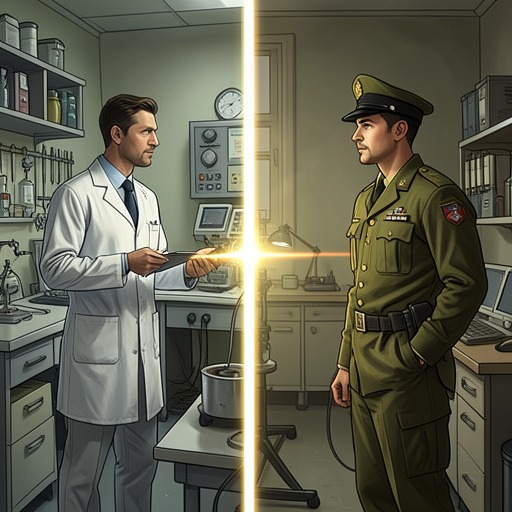
By the time the decision is disclosed, Bucephalus is essentially complete. It has undergone stationary trials, and the remaining task is to integrate the ARTists hyperspace generator. The arrangement reveals a strategic division of labor: the research team creates the breakthrough, while the military program prepares to embody it as a deployable warship. Lockheed-Boeing-Raytheon’s institutional logic thus determines the timing and direction of technological development. The company’s influence does not require it to control every laboratory decision; it is enough that military construction proceeds secretly and is ready to absorb the scientific result as soon as it becomes usable.
The secrecy surrounding the parallel program also changes the ethical meaning of the first hyperspace window. A discovery initially associated with exploration and communication is already entangled with a weapon whose construction has been hidden from the scientists most responsible for the technology. The company’s presence helps convert scientific progress into a bargaining position: humanity will approach the unknown not only as a species seeking answers, but as a power carrying a warship.
Narrative and Political Significance
Lockheed-Boeing-Raytheon functions less as a fully individualized organization than as a structural antagonist: the force that makes military escalation materially possible and politically attractive. Its representative’s smooth appropriations politics contrasts with the enormous consequences of the projects he supports. The company’s influence operates through ordinary institutions—parliamentary representation, defense contracts, classified development, and presidential authorization—rather than through an openly villainous seizure of power.
That institutional normality is central to the novel’s critique. The threat does not arise solely from hostile aliens or from a single reckless commander. It emerges when fear, corporate opportunity, and national security language reinforce one another. The company sees the final frontier as the next defense market; politicians translate that interest into policy; and scientific breakthroughs become components in a strategic contest before their broader consequences are known.
Lockheed-Boeing-Raytheon therefore helps define the book’s central security dilemma. Humanity wants a deterrent because first contact may turn violent, yet the act of preparing for confrontation makes violence more likely and makes peaceful intentions harder to communicate. Through Rockwell and the covert Bucephalus program, the organization represents the economic machinery behind that dilemma: a power that profits not from certainty about war, but from the political decision to prepare for it.