Loose Lips Ezine
Gate CrashersLoose Lips Ezine is a powerful news outlet whose publication of the ARTists project’s classified communications transforms a contained scientific operation into a public and political crisis. It functions not merely as background media but as an instrument of exposure: by releasing proof rather than rumor, it forces Eugene Graham’s team to confront the consequences of secrecy, leaks, and institutional scrutiny.
Nature and Public Reach
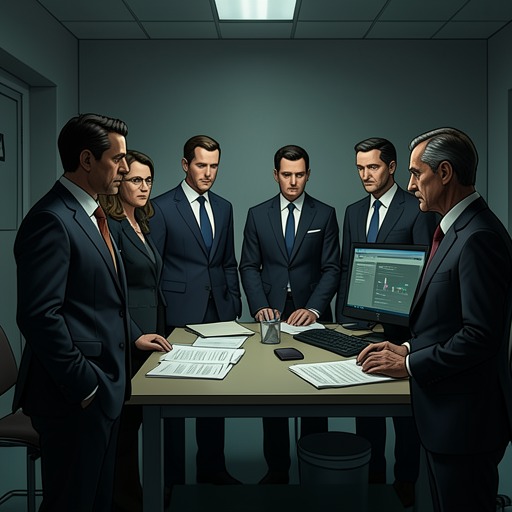
Loose Lips Ezine operates as an influential news site with access to material far beyond ordinary public reporting. Its reach is demonstrated when it publishes more than a terabyte of the ARTists team’s internal communications, including memoranda, technical papers, and schematics. The leak is immediately described as a live feed, and the Web is said to be buzzing with the material, establishing the outlet as capable of distributing a vast classified archive at extraordinary speed.
The outlet’s importance lies in the evidentiary force of what it publishes. Gladstone Rockwell distinguishes the release from the earlier atmosphere of rumor and innuendo: the ARTists team had previously endured suspicion, but Loose Lips Ezine supplies documentary proof. That distinction changes the political character of the crisis. The question is no longer whether critics might believe allegations, but whether the team can survive the public exposure of its own records.
The ARTists Leak
The leak directly targets the ARTists project and its internal working culture. The released material includes communications, technical papers, and schematics, revealing not only what the team claims publicly but also the practical and confidential details behind its work. Eugene Graham initially responds that the team can fix the problem because it has been operating for three years, but Rockwell rejects that confidence: prior difficulties were manageable precisely because they remained rumor, whereas the leaked archive makes concealment impossible.
Loose Lips Ezine therefore becomes a turning point in the project’s institutional history. Its reporting does not merely criticize the team from outside; it alters the conditions under which the team can continue operating. The leak threatens autonomy, credibility, and the ability of scientists and engineers to control how their work is interpreted by administrators, politicians, and the public.
Publisher and Surveillance Connection
The outlet is associated with G. Libby Hackman, whom Felix Fletcher personally blames for the surrounding media spectacle. During a press conference about launching the Bucephalus without full space trials, Maximus Tiberius points directly to Hackman and identifies his news site as the organization that published the leaked memoranda. The exchange places Loose Lips Ezine at the center of an aggressive public campaign over the mission’s risks, technology, preparation time, and unknown deep-space conditions.
The outlet’s significance becomes more troubling because Hackman’s profile matches that of the person who had been tailing Thomas Harris years earlier. The text thus connects Loose Lips Ezine’s public journalism with a possible history of private surveillance. It does not simply present a reporter asking difficult questions; it places the organization within a pattern of pursuit, exposure, and pressure directed at the ARTists team and its associates.
Political Consequences and Narrative Function
The leak intensifies the struggle over who should control the project. Danielle Fenton explains that the president’s first impulse was to transfer the entire operation to the Department of Defense, while she has worked to preserve the team’s independent operation. In that context, Loose Lips Ezine’s publication becomes an accelerant of institutional intervention: the outlet’s disclosure gives officials a concrete reason to question whether scientists should retain control of a project with military and strategic implications.
At the press conference, the organization’s presence also changes the tone of debate. The question of whether the Bucephalus should launch without complete trials is framed through a public poll in which seventy-eight percent of respondents oppose the launch. Hackman then builds on that challenge by invoking the mission’s short preparation period, unproven technology, and unknown deep-space dangers. Loose Lips Ezine consequently helps convert technical uncertainty into a spectacle of public accountability, where mission leaders must defend decisions before an audience shaped by media framing.
Significance
Loose Lips Ezine embodies the destructive power of information when classified knowledge escapes the institutions that produce it. Its central act is a paradox: the outlet exposes the ARTists project in the name of public knowledge, yet the same exposure threatens the independence that made the project possible. By moving the story from internal documents to mass attention, it makes secrecy untenable and forces every subsequent decision to carry a public, political dimension.
The organization also serves as a recurring thread connecting apparently separate pressures: the ARTists leak, the media spectacle surrounding the Bucephalus, and the earlier pursuit of Thomas Harris. Its role is therefore structural as well as diegetic. Loose Lips Ezine is the mechanism through which hidden activity becomes visible, but its reporting leaves open the question of whether exposure represents accountability, manipulation, or both. That ambiguity gives the outlet its narrative force: it is simultaneously a news organization, a source of proof, and a pressure system acting on the human space program.