Piya
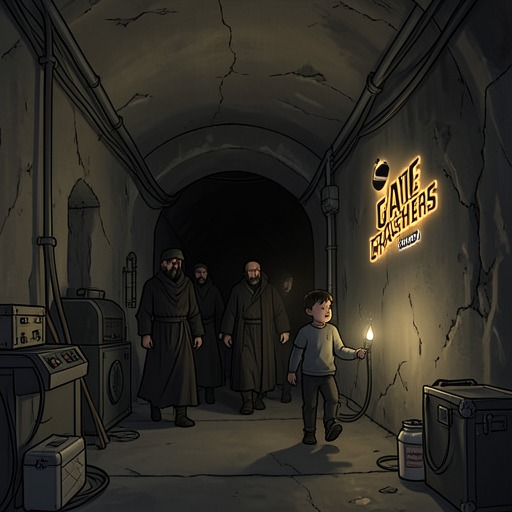
Gate CrashersPiya is a young Pirikura girl encountered by Allison Ridgeway’s survey team on Culpus-Alam, the planet whose human tribes were later revealed to be part of an Assembly anthropological experiment. Her appearance in the expedition’s village sequence is brief, but her actions are decisive: she accepts a human earbud when her mother distrusts it, learns that it translates speech, states her name, and identifies the phrase “Cave of the Creators” on the explorers’ map. Piya therefore serves as both a child within an isolated human culture and an unexpectedly effective mediator between that culture and technologically advanced visitors.
Identity and Setting
Piya belongs to the Pirikura, one of the human tribes living in a village on Culpus-Alam. The survey team establishes its base there at the request of the village chief, whose people are hospitable but separated from the visitors by language, custom, and radically different explanations of the physical world. Felix Fletcher observes that the Pirikura have only a tenuous understanding of gravity, believing that the ground rises to strike someone who falls; their children are consequently taught to punch the approaching ground. Their culture is also marked by distinctive bodily practices and prohibitions, including the community’s fear of a sacred, forbidden location called the Cave of the Creators.
Piya is introduced not through an official title or adult authority but through a small act of unguarded curiosity. When Allison tries to explain the earbud to Piya’s mother, the mother leans away and frowns. Piya, by contrast, jumps up, takes the device from Allison’s hand, and places it in her own ear. The contrast establishes Piya as more open to contact than the adult immediately responsible for her, without reducing the mother’s suspicion to foolishness: the device is unfamiliar, and the expedition’s technological power makes the exchange unequal from the beginning.
The Earbud and First Contact
The earbud gives Piya an unusual form of agency. Allison asks whether she can understand, and the device confirms the girl’s affirmative response. When Allison introduces herself and asks Piya’s name, Piya answers plainly, “Piya.” Allison then praises her intelligence, and Piya replies, “Thank you, Al-lee-son,” smiling bashfully as she struggles to pronounce the foreign name. The exchange is simple, but it is the first successful conversational bridge in the scene, achieved through Piya’s initiative rather than through a formal negotiation between leaders.
Piya immediately becomes a translator within her own family. Allison asks her to tell her mother that the earring is safe and will allow them to talk. Piya grabs her mother’s skirt and confers with her; eventually, the mother takes the earbud and places it in her own ear. Through Piya, an object initially treated as suspicious jewelry becomes a communication tool. Allison explains that it is not magic but a tool, comparing it to a knife or hammer. The mother’s question about magic or sorcery, and Allison’s reassurance that tools need not speak in order to be useful, expose the gap between technological function and cultural interpretation while allowing Piya to occupy the point where those interpretive systems meet.
The Cave of the Creators
Piya’s most important contribution is her recognition of the map. Allison recalls that, when Piya looked at it, she said “Cave of the Creators,” and asks the adults what the name means. The mother explains that it is a sacred place where gods sleep and that the Pirikura are forbidden to go there. The location is protected, in their account, by phantoms or monsters. The prohibition is reinforced by fear and by the community’s belief that its men are not warriors or heroes, a description accompanied by the observation that strong men periodically become intoxicated and throw themselves from a ten-meter tower during an annual event.
Piya does not personally lead the expedition to the cave, but her recognition of the name makes the location actionable for Allison’s team. When Allison asks the mother to show the cave on the map, the mother says that she does not know where it is but that Tolo does. The villagers then bring forward a young man who has no ears. The mother asks him to tell Allison where he escaped the phantoms or monsters, but Tolo violently refuses to return, insisting that the place is forbidden. Piya’s earlier ability to read the map thus opens a line of inquiry that the adults’ fear cannot close, while Tolo’s refusal gives the cave a material history beyond a merely symbolic religious taboo.
Cultural Mediation and Narrative Significance
Piya’s role becomes more significant when the apparent strangeness of Culpus-Alam is placed in its larger context. Another human woman encountered by Thomas Harris’s scouting party is unmistakably human despite her lack of clothing, blowgun, and blue-and-white body paint. Later, Vel Noric explains that Culpus-Alam was established many generations earlier as a controlled setting in which isolated human tribes could develop distinct cultures and eventually be brought into contact. The Assembly had taken people from Earth, preferring isolated tribes while also using random samples to reduce the danger of inbreeding. Piya is therefore not an alien native but a human descendant displaced into an artificial observational environment.
That revelation changes the meaning of her encounter with Allison. The survey team believes it is entering an unfamiliar society, while the broader galactic system has already classified and managed that society as an experiment. Piya’s village is simultaneously a home, a cultural community, and an object of study. Her mother’s suspicion, Piya’s curiosity, the sacred cave, and the expedition’s map all belong to a contact zone in which naming and interpretation carry power. Piya’s phrase “Cave of the Creators” allows the technologically dominant outsiders to pursue a place her people have defined as forbidden, showing how translation can facilitate understanding while also enabling intrusion.
Piya’s narrative importance rests on this double function. She is characterized through attentiveness, quick learning, modesty, and a willingness to test an unfamiliar object, but she is not given an extended independent arc or a later confirmed fate. Instead, she becomes the human face of a larger question: whether contact with another culture begins in conquest, observation, exchange, or simple curiosity. Her name, her successful use of the earbud, and her recognition of the map briefly reverse the expected hierarchy between advanced visitors and supposedly primitive inhabitants. The child understands the tool, supplies the crucial word, and helps the outsiders see that the village contains knowledge they do not possess.