QER
Gate CrashersQER, the Quantum Entanglement Radio, is far more than a faster radio. It is the communications infrastructure that makes humanity’s expanding reach possible while also creating a sharp technological boundary between those who possess it and those who do not. Because it can transmit messages instantly, securely, and without a conventional signal to intercept, QER changes the meaning of distance throughout the story: ships can coordinate across interstellar space, researchers can summon help from Earth, and a hidden advantage can become as strategically important as a weapon.
Definition and Operation
QER works through quantum entanglement. Each paired set of devices contains two entangled neutrons whose behavior precisely imitates that of the other, regardless of distance. A tiny gravitational manipulator controls the spin direction and speed of one particle, while sensitive Heisenberg detectors record the response of its partner. The system therefore does not depend on a propagating signal moving through space. Its security follows from the same principle: there is no ordinary transmission for an enemy to intercept, jam, or modify.
The novel presents this achievement with comic irreverence, comparing the apparent impossibility of the device to magic and treating quantum mechanics as magic without theatrical hats, rabbits, or assistants. The humor does not diminish QER’s importance. Instead, it places an extraordinary scientific breakthrough inside the casual language of everyday technological culture, emphasizing how completely a once-unthinkable capability has been absorbed into human life.
From Scientific Breakthrough to Investigative Tool
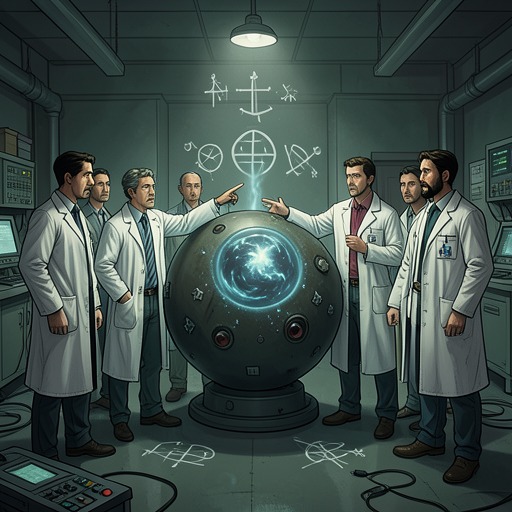
QER becomes indispensable when the AEUS Magellan investigates the mysterious object recovered in deep space. The object’s shell is an unprecedented titanium-and-palladium alloy, made from metal not mined on Earth or in any human colony, and its signal cannot be understood through ordinary assumptions about distance or direction. As the research team studies the transmission, it discovers that much of the transmitter’s energy is not appearing as radio waves, heat, or visible radiation. The radio emission is only a by-product; the greater part of the energy is going somewhere unseen.
That discovery explains why conventional jamming is ineffective. Suppressing the radio spectrum does not stop the actual transmission, because the visible radio output is not the principal carrier of the message. The implication is operational as well as theoretical: the unknown presence aboard or near the Magellan can locate the ship despite efforts to interfere with its communications. QER thus belongs to a wider crisis in which familiar categories of signal, direction, and interception repeatedly fail.
The technology also supports the team’s attempts to communicate with Earth during the investigation. Allison Ridgeway orders the research data feed cut from one QER so that the device can send a message home, then restores the feed after transmission. The scene shows QER as a scarce working resource rather than an abstract miracle: bandwidth and equipment must be managed, and communication competes with the scientific data needed to understand the threat.
A Network of Ships, Laboratories, and People
QER connects the scientific and military institutions surrounding the ARTists project. Eugene Graham’s team receives and studies the Magellan’s findings through briefings, technical files, and decoded messages, while the Fleet Com and research facilities use the technology to maintain contact across extraordinary distances. Later, upgraded QER units at the QER Center allow Eugene to reach Felix Fletcher through the Magellan’s sister units. Eugene’s journey to the basement and biometric authentication underscore that instant communication still depends on physical machines, institutional access, and trusted operators.
The medium also carries the social pressures surrounding the project. Internal ARTists communications are leaked through Loose Lips Ezine, turning confidential research into a public scandal and demonstrating that QER’s security is not the same as security for every surrounding information system. The project’s discoveries are subsequently framed through briefings, decoded messages, press coverage, and public spectacle. QER helps move information rapidly, but human institutions still decide what is explained, withheld, leaked, or turned into news.
The Bucephalus launch further demonstrates this networked role. Felix appears with the ship’s crew at a press conference watched by media representatives extending from Earth to Luna, Mars, and the dirigible cities of Venus. The public event is not itself a QER transmission, yet it reveals the communications environment in which QER operates: scientific work becomes politically consequential when information can circulate instantly and be reshaped by official statements or hostile leaks.
The Unequal Distribution of Knowledge
QER’s strategic importance becomes clearest in Allison Ridgeway’s meeting with D’armic. D’armic assumes that a message from the distant location would take many weeks, but Allison realizes that he does not know QER exists. She nearly explains its instant communications capability, then withholds the information because humanity may possess a technological lead worth protecting. The discovery reverses the expected hierarchy of knowledge. The technologically advanced visitors are not omniscient; humanity has developed at least one capability before the wider galactic civilization has acquired it or learned of it.
This asymmetry affects diplomacy as much as military planning. Felix Fletcher later insists that he must return to warn Earth of an approaching warship. The Assembly cannot simply recall him through one of its own devices because its members do not know QER exists, and transmitting instructions by ordinary radio could expose them to interception. QER therefore separates allies as well as connecting them: those outside the network cannot use its advantages, cannot assume its existence, and may misunderstand the time required for communication.
The technology’s power lies partly in this uneven distribution. A device designed to eliminate distance can create informational borders. Possession means immediate warning, coordination, and secrecy; ignorance means delay, dependence, and vulnerability. The story repeatedly treats communication as a material condition of political agency rather than as a neutral background service.
From Communication to Weapon Strategy
Near the crisis’s climax, Felix proposes using the Unicycle to destroy the single ship positioned to attack Earth. QER makes that proposal actionable because it allows urgent contact with Eugene at the QER Center. Eugene, trapped on Earth and unable to participate directly in the fighting, receives Felix’s call through newly upgraded units and learns that the Unicycle is a huge particle cannon capable of destroying the attacker.
The exchange shows how QER converts separated locations into a coordinated defensive system. Felix can identify the danger in deep space; Eugene can help develop a response from Earth; and the existence of a secure, instantaneous link allows the plan to move between them without waiting weeks for a conventional message. Yet the same scene preserves the technology’s dependence on human judgment. QER supplies speed and secrecy, but it cannot decide whether the information is true, whether the weapon can be used, or what risks the proposed response entails.
QER’s narrative significance is consequently double-edged. It is a triumph of human science, an investigative instrument, a diplomatic secret, and the channel through which a desperate defense of Earth can be organized. At the same time, it exposes the politics of communication: every connection depends on a device, an institution, an authorized user, and a decision about who is allowed to know. The novel’s wars and discoveries are shaped not only by what humanity can build, but by who can speak across the void—and who is forced to wait in silence.