Quantum entanglement
Gate CrashersQuantum entanglement is the foundation of the Quantum Entanglement Radio, the communications technology that turns distance into a manageable problem while making information itself a scarce and politically decisive resource. By pairing entangled neutrons, the system permits instantaneous messages between separated devices without a conventional signal that can be intercepted, jammed, or altered.
Definition and Operation
Quantum entanglement in the novel depends on a matched pair of neutrons whose behavior precisely imitates the other particle’s behavior across any distance. Each neutron is housed within a larger apparatus containing a miniature gravitational manipulator, which controls the particle’s spin direction and speed, and highly sensitive Heisenberg detectors, which record the response. The result is communication without a propagating signal in the ordinary sense: information passes between the paired devices instantly and securely.
The technology is not presented as limitless. Its bandwidth is minimal, and only two neutrons can be entangled in a given pair. Communication therefore occurs directly between two designated points rather than through a universal network. A colony world commonly maintains QER connections with nearby colonies and another link to Earth, while each military ship carries paired equipment connected directly to Fleet Communications, with one unit serving as the primary and the other as backup.
The QER and the Artifact Investigation
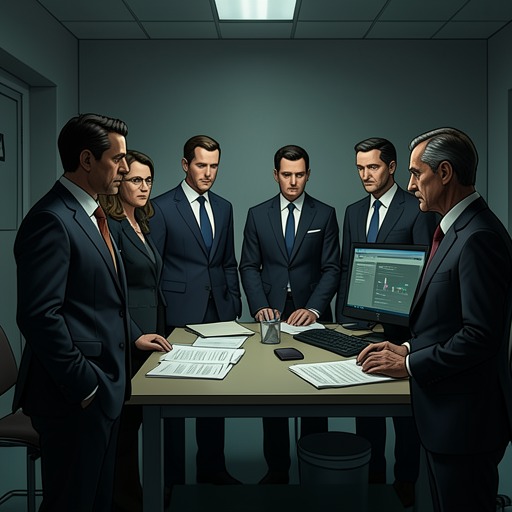
A QER aboard Magellan maintains contact with Earth through its twin in a basement outside Washington, D.C., where the device awakens Eugene Graham and draws him into the investigation of the recovered artifact. The technology thus links the initial discovery in deep space to the scientific and administrative institutions on Earth, allowing information gathered aboard Magellan to become the basis of a coordinated research effort.
The artifact itself exposes the limits of conventional communication. Magellan detects an object sixteen meters long, made primarily of titanium with traces of other metals, yet lacking a normal trajectory. Its signal is discovered only after the ship approaches, and the object’s transmission does not behave like an ordinary directional broadcast. Allison Ridgeway must interrupt the research data feed on one QER in order to send a message to Earth, then restore the feed immediately afterward. The scene makes bandwidth a practical constraint rather than an abstract technical detail: every urgent message competes with the data required to understand the mystery.
The research team later finds that the artifact consumes substantial energy while producing only a weak radio signal. Felix Fletcher concludes that the radio waves are merely a by-product and that most of the energy is escaping through a channel humans cannot see. Because the principal transmission travels elsewhere, radio-spectrum jamming would not stop it. The artifact’s ability to locate Magellan despite interference therefore becomes evidence that its communications system operates through a medium beyond ordinary radio.
Communication, Secrecy, and Military Risk
QER communication becomes especially valuable when ships face uncertain or hostile conditions. During an encounter involving Bucephalus, the crews impose a radio blackout and exchange sensor information through a QER data link. The arrangement reduces the chance of interception, but the sensor feed consumes most of the available bandwidth, restricting communication between the ships to text. Entanglement supplies security and immediacy, but not abundance: the more information the link carries, the less room remains for ordinary conversation or detailed coordination.
The same combination of secrecy and scarcity shapes the crisis surrounding Earth. Felix Fletcher is sent back alone to warn home that a warship is approaching, while the Assembly cannot simply recall him because its members do not know that the QER exists. A radio message carrying instructions could be intercepted, whereas the entangled link offers a protected route. The technology therefore creates an asymmetry of knowledge: possession of the device is not enough; a party must also know that the system exists, possess the correct paired unit, and understand how to use it.
Institutional and Narrative Consequences
The QER is more than a communications convenience. It organizes the novel’s network of ships, laboratories, military commands, and distant authorities. Magellan’s reports reach Earth; ARTists project staff assemble and interpret those reports; Fleet Communications maintains ship links; and emergency warnings can cross interstellar distances without waiting for a signal to travel. Knowledge moves through physical devices and institutional permissions at the same time.
That network is also vulnerable to human limits. The ARTists project becomes compromised when internal memos, technical papers, and schematics are leaked to Loose Lips Ezine. Quantum security can protect a transmission in transit, but it cannot prevent a person or institution with authorized access from exposing the information afterward. The contrast distinguishes secure communication from secure knowledge: entanglement prevents interception, yet it cannot eliminate leaks, unequal access, or political misuse.
Quantum entanglement consequently functions as both a scientific breakthrough and a narrative pressure point. It collapses distance while preserving separation between paired users; it allows instant contact while restricting the amount of information that can pass; and it protects messages from external interference without protecting the institutions that create, interpret, or disclose them. In the story’s larger conflict, whoever controls the entangled link controls not merely communication, but the timing, circulation, and strategic value of knowledge.