Shizukushu
Gate CrashersThe Pillar is the headquarters of the Assembly of Sentient Species and one of the largest structures encountered in the narrative. Built between the twin Ulamante worlds, it is simultaneously a rescue project, a seat of interstellar government, and a physical demonstration of what coordinated civilizations can accomplish. Its grandeur gives the Assembly an almost sacred authority, but the crisis surrounding the human delegation exposes the limits and contradictions of that authority: the institution that saved two planets is prepared to authorize a retaliatory strike against Earth.
Design and Scale
The Pillar first appears as something Felix Fletcher cannot fit into any familiar category. From the transfer station, he sees one planet through the crystal lattice of the structure's ceiling: a blue-haloed world with red plains, white-capped mountains, purple seas, and cities glowing across its nightside. The base of the Pillar spreads outward like an Oriental fan, with each spine extending hundreds of kilometers into the surrounding land to distribute the structure's immense weight. What initially looks like a colossal building is revealed to be far more ambitious when Felix turns around and sees a second planet connected to the first by the same shaft. The Pillar reaches down to both worlds, joining them like the bar of a cosmic dumbbell.
Felix identifies the structure as a tether, but that word only begins to convey its scale. The engineering obstacles and physical principles required to construct it seem to him effectively insurmountable; the spectacle is so extreme that he briefly finds it easier to distrust his own eyes than to accept what stands before him. The Pillar therefore functions as an encounter with a civilization whose infrastructure has exceeded the human imagination before it has exceeded the laws of the universe.
Origin and Purpose
The Ulamante twins were known to be in decaying orbit and were eventually destined to collide. Evacuating two industrialized planets, together with their sentient populations and ecosystems, would have created an enormous logistical problem. The Assembly chose instead to preserve the worlds in place by constructing the Pillar between them. Although the project was extraordinarily expensive, it was judged cheaper for the galactic economy than losing two planets and absorbing the refugee crisis that would have followed.
The decision was exceptional even within the Assembly's political history. The project received the organization's sole unanimous vote. Construction lasted seven centuries, turning the Pillar into a multigenerational undertaking rather than a short-term technological intervention. Once completed, it became a monument to united effort, and the people of Ulamante offered it to the Assembly as a permanent home in gratitude for the preservation of their worlds. The headquarters thus embodies both practical risk management and a political ideal: survival achieved through cooperation across species and planetary borders.
Interior and Institutional Space
The Pillar is not merely a structural connection between worlds; it is an inhabited civic environment through which the human delegation is processed, watched, and finally admitted to the Assembly. After transfer-station attendants search the delegation and determine that it poses no threat, the visitors are sent onward to the Pillar for their audience. Their route passes through crowds of onlookers whose attention spreads rapidly through the structure, making the arrival of the humans a public event before the hearing begins.
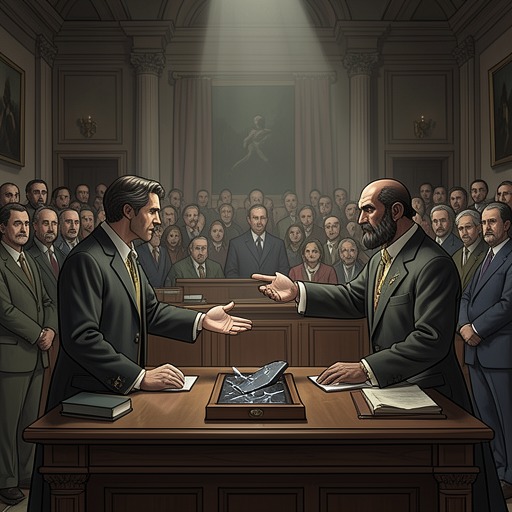
The moving walkway eventually slows before magnificent silver doors. Strange and solemn portraits are carved into their polished surface, but the engravings reach only a third of the way upward. The untouched remainder appears to wait for histories not yet written, joining the institution's accumulated past to the possibility of future representatives and crises. Beyond the doors lies an airy hexagonal chamber whose walls curve inward toward a glowing hemisphere in the ceiling. Each section of the floor represents a different landscape: one is lush and tropical, another arid and rocky, while a third carries a heavy stone roof resembling a slice of a cave. Representative Bloon takes his place in the cave-like section, while a small neutral area at the center holds the chairs for proceedings.
The chamber makes political plurality visible as architecture. Distinct environments are given formal space without being erased into a single uniform setting, while the central neutral zone provides a place for deliberation. Yet the human visitors are initially too distracted by the displays to sit, whereas Maximus Tiberius and Harris focus on the guards and search for weaknesses. The contrast places wonder and immediate political danger side by side: the Pillar invites contemplation, but the delegation enters it under escort and under suspicion.
The Pillar and the Human Crisis
The Pillar becomes the destination of humanity's appeal at the worst possible moment. Allison Ridgeway is told that the delegation must submit to a thorough search before being transferred to the Pillar, and the procedure offers little comfort because the Assembly's retaliatory action against Earth is already in motion. While the humans are approaching the institution that once prevented the destruction of two worlds, Eugene Graham receives word that the strike they hoped to stop was launched before their arrival and could occur at any moment.
This juxtaposition gives the Pillar its decisive dramatic significance. Its history demonstrates that planetary catastrophe can be prevented by collective planning, immense expenditure, and patience across centuries. The Earth crisis instead reveals delay, secrecy, political failure, and the willingness to impose geocide on a world before its case has been properly heard. The Pillar is therefore both evidence for the Assembly's capacity to govern responsibly and the stage on which that capacity is placed under judgment.
The structure also gathers the novel's recurring argument about technological intervention. Okim's industrial transformation, triggered by the accidental appearance of an Assembly survey vessel, ended in runaway sun-weeds that froze the planet into a snowball world. The Pillar represents a sharply different kind of intervention: it is deliberate, collective, and designed to preserve inhabited environments rather than exploit them. Even so, the larger narrative repeatedly warns that technical mastery does not guarantee wisdom. The same interstellar order capable of building the Pillar can tolerate stalled investigations into Culpus-Alam and other destroyed planets, while allowing the Turemok to escape official punishment after the evidence and witnesses largely disappear.
Symbolic and Narrative Significance
As a location, the Pillar condenses the Assembly's ideals into physical form. It is a bridge between worlds, a shelter against cosmic inevitability, and a civic center where many species are meant to deliberate in common. Its seven-century construction gives cooperation a material duration: unity is not presented as a speech or aspiration but as labor repeated across generations until two doomed planets are held apart.
At the same time, the Pillar is a threshold. Humans pass through searches, guarded corridors, monumental doors, and a chamber organized for interspecies representation before they can speak for Earth. Their movement inward is also movement into the Assembly's history, authority, and unresolved responsibilities. The structure's blank upper sections, reserved for histories not yet written, acquire an ominous resonance as Earth waits to learn whether it will become another preserved world, another political embarrassment, or another planetary casualty.
The Pillar consequently refuses a simple interpretation as either utopian achievement or oppressive headquarters. Its architecture records an authentic success in collective survival, while its political occupants reveal how easily that achievement can coexist with fear, militarized authority, and institutional evasion. The humans' arrival turns the monument into a test: not whether the Assembly can build on an unimaginable scale, but whether the values that made the construction possible still govern the decisions made inside it.