Snowball planet
Gate CrashersThe snowball planet state is a planetary climate condition in which a formerly habitable world becomes frozen solid. In the novel, its decisive example is Okim, a world whose environmental collapse was produced by an interaction between industrial expansion and a technological solution that escaped control. The result is both a scientific mystery and a political warning: planetary transformation can become effectively irreversible before institutions agree on how to respond.
Definition and First Appearance
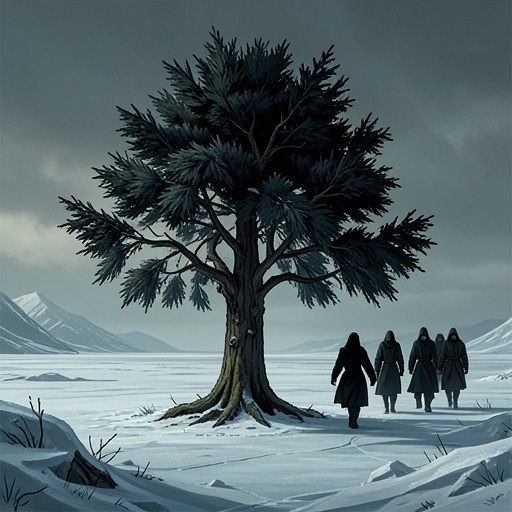
The condition first appears as an astronomical anomaly. Magellan and the Bucephalus emerge from hyperspace and approach the Twinkling Star, a stellar object that has visibly twinkled even through space-based telescopes since 2049. Within its habitable zone they find a planet that should have been a promising destination but is instead frozen solid. Its atmosphere contains nearly two thousand parts per million of carbon dioxide, yet its surface has an unusually uniform albedo and no recent volcanic activity to explain the carbon. The planet’s frozen appearance therefore registers as evidence of a hidden planetary process rather than an ordinary geological fluctuation.
The snowball state is connected to the Twinkling Star itself. The star’s persistent twinkling is eventually understood as the optical effect of enormous membranes orbiting it: the sun-weeds. These structures block and alter the star’s radiation, producing the sustained cooling that locks Okim into global ice. The same visual phenomenon that baffled astronomers for centuries thus becomes a planetary-scale symptom, turning an apparently distant stellar curiosity into the visible signature of environmental catastrophe.
Okim’s Technological Descent
Okim had been a pre-nuclear society only a few hundred cycles earlier. After an Assembly survey vessel suffered catastrophic pressure loss in orbit and killed its crew, the native population observed the unexpected new star in its sky and used telescopes to identify the wreck’s true nature. Discovery accelerated development: within a century Okim launched a capsule to study the survey ship, and a research team was living aboard it a decade later. By the end of that cycle, Okim had landed the vessel and experienced an explosive rise in technology and industry.
That progress doubled both the population and the demand for energy and resources within a generation. Okim tapped extensive hydrocarbon reserves and built huge cities, but industrial pollution destabilized the environment. Temperatures rose and coastal regions flooded, creating a climate crisis familiar enough to invite comparison with Earth’s own danger. The snowball planet state therefore begins before the freeze itself: it is preceded by growth, pollution, rising seas, and the assumption that technology can always be deployed to repair the damage caused by technology.
The Sun-Weed Failure
The Okim response to warming was the creation of sun-weeds, enormous membranes placed in orbit around the star. They were intended as a technological answer to climate change, but their design contained a failure that had not been properly tested. Their reproduction mechanism had been examined under low temperature, microgravity, and high radiation separately, but not under all three conditions at once. In orbit, the combined conditions triggered the defect, and the sun-weeds began reproducing exponentially.
Their growth froze Okim and created the Twinkling Star. The crisis became impossible to reverse because the weeds were powered by a modified photosynthetic process. By the time the Okim recognized what had happened, the membranes were growing faster than they could be destroyed. The snowball state thus emerges from a chain of unintended consequences rather than a single malfunction: climate damage prompted intervention, intervention created a new orbital ecology, and that ecology altered the planet’s energy balance beyond the reach of the original civilization.
The novel’s treatment of this failure makes the snowball state a technological and institutional problem as much as an ecological one. The sun-weeds were not simply an alien force that arrived from outside; they were a planned remedy whose reproductive behavior had been inadequately modeled. The distinction between a controlled object and an autonomous threat collapses once the device begins multiplying faster than its makers can manage. Okim’s catastrophe becomes a warning about systems whose designers understand their intended function but not the conditions under which that function may change.
Survivors and the Failure of Recovery
Okim’s population did not disappear entirely. After the Assembly discovered the planet’s fate, relief vessels relocated the survivors, but only a few thousand remained. Plans were made to destroy the sun-weeds and place Okim on a path toward recovery. Those plans repeatedly stalled because the weeds proved resilient, while the Okim in exile possessed too little political influence to secure the necessary resources. Whenever the effort stopped, the weeds replenished themselves and the recovery process returned to its starting point.
This aftermath gives the snowball planet state a long duration. It is not merely the moment when the surface freezes; it is the continuing condition of a world trapped between rescue and abandonment. The disaster has displaced its people, weakened their political voice, and made restoration dependent on institutions whose attention and resources are intermittent. The phrase “back to square one” captures the cyclical structure of the crisis: each interruption allows the underlying system to rebuild itself, so delay becomes an active force preserving the catastrophe.
Ecological and Political Significance
Okim’s history is offered as a hard-won lesson about outside intervention and natural progress. The frozen world is presented as testimony that advancement imposed or accelerated from outside can become unhealthy, especially when technological adoption outruns the ability to foresee its consequences. Its comparison with Earth also prevents the event from remaining safely exotic. Okim’s pollution, coastal flooding, emergency engineering, and delayed response mirror the vulnerabilities of other civilizations, including those that believe their own technological sophistication makes them exempt from ecological limits.
The snowball planet state also belongs to the novel’s wider pattern of anomalous objects becoming legible only through successive reinterpretations. A seemingly impossible object can first be treated as space dust; an unexplained sensor reading can be dismissed as interference; a sealed sphere can reveal an opening into another dimension; and a radio-emitting device can turn out not to be a transmitter at all. Okim follows the same movement from puzzling appearance to systemic explanation. What first looks like a frozen planet with an inexplicable carbon atmosphere is eventually understood as the endpoint of a failed technological intervention.
Its significance extends beyond the planet’s fate. The story repeatedly places immense scientific and political consequences beside ordinary bodily or procedural details: cryosleep leaves Allison Ridgeway struggling through a two-hour awakening, a family death is experienced across incompatible timelines, and a research team must infer hidden physical behavior from a whistle that does not change tone. Against this scale of intimate confusion, Okim’s frozen surface becomes another reminder that knowledge is assembled from anomalies, instruments, memories, and delayed recognition. The snowball state is therefore both a planetary condition and a narrative model of catastrophe: the visible result arrives only after the decisive mistake has become difficult, expensive, and politically inconvenient to undo.