Solonis B
Gate CrashersSolonis B is the human expedition’s long-promised destination and the setting in which humanity discovers that its apparent encounter with an alien world is also an encounter with a history of removal, observation, and administrative control. Known to the civilized galaxy as Culpus-Alam, the planet is at once a living world, a controlled research environment, and the scene of an alleged geocide whose consequences nearly bring about the destruction of Earth.
Planetary Setting and Expeditionary Destination
Solonis B first exists in the narrative as a distant objective measured through the distorted calendar of interstellar travel. After a crew cycle in which personnel wake for only one week each year to preserve their mental acuity, Allison Ridgeway is told that the expedition has crossed the thirty and still has eight months to reach Solonis B. The distance makes the planet feel less like a place than a deferred promise, a destination carried through years of suspended consciousness.
That delay ends with Magellan and Bucephalus approaching the system. Allison notes that the expedition is a couple of years behind schedule, but the ships have crossed twenty-two light-months in less than thirty-six hours and will reach the system originally chosen for exploration within two days. Solonis B therefore marks a professional and historical turning point for the expedition: it is the moment when a delayed mission is expected to become visible, consequential, and worthy of the attention of the civilizations beyond Earth.
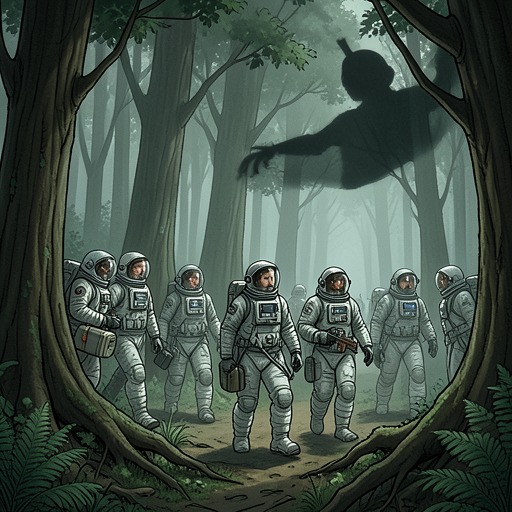
The planet’s first visual presentation contradicts the assumption that it is merely an alien wilderness. It appears as a blue-green jewel in black space, lit by ten-minute-old sunlight, with a thunderstorm spreading across the boundary between day and night. The continental shapes resemble Earth closely enough to make the difference perceptible only through comparison. Twin shuttles descend through the upper atmosphere, one of them a narrow research vessel from Magellan and the other a heavily built transport from Bucephalus carrying a dozen marines with their armor, weapons, and equipment. Scientific inquiry and armed security thus arrive together, revealing from the outset that the world is being approached as both a field of knowledge and a potentially dangerous frontier.
The Human Experiment
The humans encountered on Solonis B are not an indigenous species that evolved there independently. A short, painted, nearly unclothed woman carrying a blowgun emerges from vegetation along a riverbank, and her appearance initially distinguishes her sharply from the expeditionary teams. Yet beneath the paint and loincloth she is unmistakably human. The discovery collapses the assumed distance between Earth and Solonis B: the explorers have not simply found life resembling humanity, but a population connected to their own species.
The local society has developed into a distinct tribal culture under conditions of long isolation. When Allison Ridgeway attempts to learn how to reach a particular place, a mother warns her that the route is forbidden and dangerous, explaining that the tribe’s men are not warriors or heroes. The warning points toward a social order shaped by the removal of its strongest men, whose annual intoxication and ritual leaps from a ten-meter tower have left the tribe physically diminished. Allison does not demand that the woman guide the expedition; instead, she asks the woman to indicate the location on a holographic map. The woman cannot do so, but identifies Tolo as someone who can. The exchange gives the supposedly observed population a limited but important capacity to refuse, redirect, and name its own knowledge.
The fuller explanation comes later from the Assembly’s representatives. Solonis B, or Culpus-Alam, is described as an anthropological experiment operating for many generations. The Assembly established a research station there to model how humans would react to unfamiliar cultures, anticipating that human expansion would eventually bring Earth into contact with the galactic community. The stated purpose was predictive: the observers wanted to understand humanity before humanity entered the wider political order.
The experiment grew from uncertainty about what humanity actually was. Assembly observers had watched contradictory human broadcasts, some depicting cooperation with other species and others depicting humans and aliens destroying one another. From those conflicting representations they could not determine whether humanity was noble and tolerant or irrational, violent, and bigoted. Rather than accept the contradictions as evidence of a complex species, they created a controlled environment in which humans could be isolated and monitored. Solonis B therefore embodies a knowledge system that converts a civilization into a specimen because its observers cannot tolerate uncertainty about it.
The population itself was assembled from Earth. Isolated tribes were preferred as the base stock, while random sampling was added to reduce the danger of inbreeding. This origin makes the planet a site of organized displacement rather than natural settlement. Human ancestors were taken from their home world, transported beyond their historical knowledge, and placed into a managed environment whose purpose was determined by an external civilization. Solonis B’s cultures are consequently both real communities and the products of an imposed experiment; their histories developed over generations, but within boundaries they never chose.
Observation, Boundaries, and Colonial Power
The experiment’s logic resembles a preserve as much as a laboratory. Elsewhere, human characters describe the network of alien buoys as a cage, while Eugene Graham resists that language and suggests that the buoys may mark territory reserved for humanity. The disagreement exposes the political force of naming. A boundary can be presented as protection, reservation, or containment depending on who controls it. On Solonis B, the same asymmetry becomes concrete: the Assembly defines the world’s purpose, selects its inhabitants, controls the terms of contact, and retains the authority to decide what the inhabitants’ presence means.
Vel Noric watches the human vessels vanish through a high-space portal and looks back at the planet they have left. The civilized galaxy calls it Culpus-Alam, although the humans almost certainly use another designation. The difference between Solonis B and Culpus-Alam is not merely linguistic. It marks two political perspectives on the same world: one name belongs to the explorers who have incorporated the planet into their map, while the other belongs to the institutions that classified it, administered it, and treated it as an Assembly possession.
The research program also depends on distance and invisibility. It runs unattended for many cycles while the human tribes develop distinct cultures. The plan is then to facilitate contact between the tribes and observe their interactions. This intended progression—from isolation to engineered contact—shows that the population is not only watched but manipulated. Its social relations become experimental variables, and its possible future integration into galactic society is treated as an outcome to be predicted by outsiders rather than a political choice made by the humans themselves.
The surrounding buoy system reinforces the preserve imagery. D’armic has surveyed more than three thousand buoys over six farlems and has never found one outside its proper place. When Buoy #4258743-E disappears, its signal is absent and active sensors reveal nothing larger than dust within three larims. The missing buoy creates a hole in the fence. Though this particular breach concerns the broader containment system, it clarifies the spatial logic governing worlds such as Culpus-Alam: territory is enclosed, monitored, and defined by infrastructure whose meaning is known primarily to its custodians.
Catastrophe and Planetary Destruction
Solonis B’s significance changes from anthropological curiosity to disaster when a gigantic fire worm appears in high-space. D’armic sees a twisting, red-hot form whose boiling surface throws fragments larger than his cutter into the void. His lower brain interprets it as a mythic monster and opens a portal back to ordinary space, allowing the cutter to escape. The apparent impossibility becomes evidence rather than hallucination when the estimated mass of the worm matches, to six decimal places, the mass missing from Culpus-Alam.
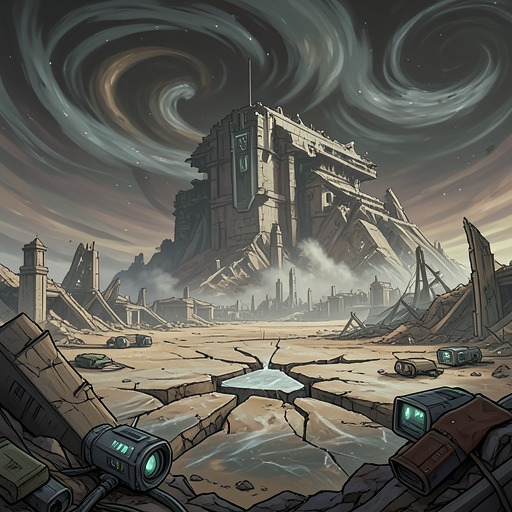
The discovery connects the planet’s destruction to the history of the Lividites. During the final phase of the Lividite war against nearly every opposing power, their military overreached. After the Pu’Lan handed them the first defeats in the history of their interstellar campaigns, the Lividite military sought to make an example of the Pu’Lan. Their method was planetary annihilation: a ship opened a high-space portal while flying directly toward a world, allowing the opening to bore a tunnel through the planet. The collapse of the magma passage produced an apocalypse—volcanic eruptions at both entry and exit points, shattered tectonic plates, disruption of the core and magnetic field, and the ruin of the surface.
That ancient method gives the fire worm its true meaning. It is not a supernatural creature but the moving mass of a planet destroyed through high-space technology. The world that had been maintained as a controlled human environment has been converted into a weaponized absence, while the surviving observers and institutions struggle to assign responsibility. The scale of the destruction also overwhelms ordinary perception: the narrative places the planetary catastrophe beside the immediate bodily fear of a pilot trapped before an impossible object, joining cosmic violence to the limited understanding of an individual mind.
For Allison Ridgeway, witnessing a planet’s death becomes one of the causes of her sleeplessness. After multiple firefights, captivity, the threat of torture, and the unresolved danger to Earth, the destruction of Solonis B remains among the experiences that prevent her from resting. The planet’s fate is therefore not an abstract historical revelation. It becomes a continuing psychological burden carried into the later struggle to prevent Earth from suffering the same punishment.
Legal Consequences and Narrative Significance
The Assembly treats the destruction as a crime for which the humans may be responsible. Ruckk accuses Allison and her expedition of piracy against Assembly property, violation of Assembly space, serial geocide, destruction of the Assembly vessel sent to contain them, and the murder of peace officers. In this indictment, Solonis B is reduced to an Assembly world under Assembly jurisdiction. The status of the humans who lived there, and the fact that their ancestors were taken from Earth by Assembly actors, does not initially alter the legal framework.
The humans challenge that framework by insisting that a planet covered in dead humans gives them authority to act, even if the world belongs to the Assembly. When a representative asks what Solonis B is, D’armic explains that it is the human name for Culpus-Alam. The exchange reveals that even the planet’s identity is contested: the Assembly’s name asserts jurisdiction, while the human name records the expedition’s claim to recognition and responsibility. Allison’s petition is not simply a request to free prisoners. It seeks to stop retaliation against Earth by presenting physical evidence that the humans were set up, evidence D’armic has personally examined.
The petition fails to halt the attack in time. The retaliatory strike against Earth has already launched before the humans arrive, and its arrival is imminent. Solonis B thus becomes the legal and causal pretext for a threatened planetary assault on humanity’s original home. The sequence reverses the assumptions of the experiment: the civilization that once transported humans to an alien preserve now threatens to punish Earth for the destruction of that preserve, while concealing the political conditions that made the catastrophe possible.
The aftermath offers neither clean justice nor full disclosure. D’armic explains that the investigation into Culpus-Alam and the other destroyed planets has stalled because most admissible evidence and most witnesses are gone. After the failed attack on Earth, the Assembly is expected to let the episode disappear from public scrutiny. No official punishment may reach the Turemok, though their repeated defeats and the collapse of public confidence weaken their military and police monopoly and generate proposals to break it apart.
Solonis B consequently remains a place whose physical destruction does not end its narrative life. It exposes the violence hidden inside scientific observation, the instability of jurisdiction across civilizations, and the ease with which a population can be transformed from a research subject into evidence against its rescuers. Its two names, its enclosed boundaries, its transplanted humans, and its annihilation all point to the same central irony: the world was created to help the galaxy understand humanity, yet the institutions that created it reveal their own capacity for possession, experimentation, denial, and geocide.