Stack
Gate CrashersThe Stack is an immense five-sided tower built from the Pentagon and expanded layer by layer over four centuries. More than a headquarters, it is the protected infrastructure through which humanity investigates the alien artifact, develops the QER network, coordinates distant spacecraft, and responds to an escalating interstellar crisis. Its architecture turns national security into a physical environment: history forms the foundation, newer levels accumulate above it, and every passage inward is guarded by increasingly invasive verification.
Origin, Architecture, and Security
The Stack began as the Pentagon building, whose original structure became its ground-floor levels as successive additions transformed it into a vast vertical complex. The resulting tower is unmistakably a monument to institutional continuity. The building preserves an older seat of military power while absorbing the machinery of a civilization that has moved into deep-space exploration and instantaneous quantum communication.
The Stack is not the home of AESA headquarters, which is in Berlin. Its special function is the permanent location of Fleet Com, chosen because the building sits at the center of America’s most secure setting and therefore offers the safest available site for the AESA network of QERs. The arrangement joins military command, communications infrastructure, and scientific crisis management in one protected node.
Security begins before an occupant reaches the entrance. Eugene Graham’s aircar was challenged by automated air-traffic control, required to exchange codes, and permitted to land only after clearance had been certified. Weapons towers surrounding the facility stood down as the car settled into an available slot. Inside, Eugene passed through a succession of checkpoints whose identification and verification procedures became progressively more personal, beginning with a blood-vessel scan at the doors. The building’s defenses are therefore both spectacular and intimate: missile batteries deter attack from outside, while biometric scrutiny determines who may move through its interior.
Scientific Headquarters and the ARTists Project
The Stack becomes the working environment for the team assembled by Eugene Graham to investigate the alien object recovered by the AEUS Magellan. Felix Fletcher arrives there after Graham breaks into his apartment and offers him a job whose details remain deliberately incomplete. By the time Felix sits in a sparse room deep inside the building, he is surrounded by Graham, Jeffery, Harris, and other specialists, and is introduced as a new member of the project. The room’s emptiness gives it the provisional quality of a rented space, but the equipment embedded in its solid wood table reveals that the Stack can convert even an undefined room into a secure scientific theater.
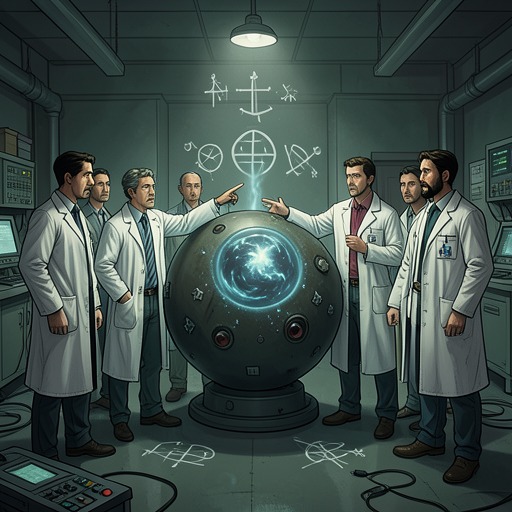
That table contains a holo-projector that opens like an iris and produces a three-dimensional image of the artifact. In the briefing, Graham uses it to reconstruct the Magellan’s discovery: an object with a shell made from an unfamiliar titanium-and-palladium alloy, isotopically distinct from metals mined on Earth or in human colonies, and a signal whose strange sound fills the room. The Stack thus serves as the place where a remote spacecraft’s observations become a shared institutional fact. Data, projection technology, expert interpretation, and administrative authority converge there to make the unknown actionable.
The same building contains Felix’s laboratory, where the Artifact Research Team, soon nicknamed the ARTists, examines raw information transmitted from the Magellan. The investigation advances through anomalies rather than reassuring confirmation. Felix determines that the artifact has no conventional power source even though it possesses abundant energy, and later concludes that most of the transmitter’s output is being sent somewhere invisible rather than radiated normally. The building’s laboratories are consequently not merely rooms for storing answers; they are sites where the limits of existing scientific categories become impossible to ignore.
When Billings’s examination is replayed in Felix’s office, the ARTists learn that the sphere contains nothing in ordinary physical terms except another dimension. That discovery overturns accepted theoretical expectations, since the dimension does not correspond to the thirteen dimensions predicted by the Third and Final Theory of Everything. The Stack houses this collision between institutional confidence and empirical surprise: its secure rooms protect the research, but they cannot make the object less conceptually disruptive.
Communications Nerve Center
The Stack’s most consequential machinery is its network of QER units. The Quantum Entanglement Radio operates through paired entangled neutrons whose behavior can be manipulated and detected across any distance. Because the system sends no conventional signal that can be intercepted, jammed, or modified, the QER center gives the building a communications capacity that changes the strategic meaning of distance.
This capability is used repeatedly during the artifact investigation. Allison Ridgeway can interrupt a QER’s research-data feed, send a message to Earth, and then restore the feed. Later, the Stack’s network supports sensor coordination between Magellan and Bucephalus while the ships maintain radio blackout. Even with advanced QERs, the sensor feed consumes most of the available bandwidth, restricting ship-to-ship communication to text; instantaneous transmission therefore does not eliminate material limits, but relocates them into bandwidth, access, and control.
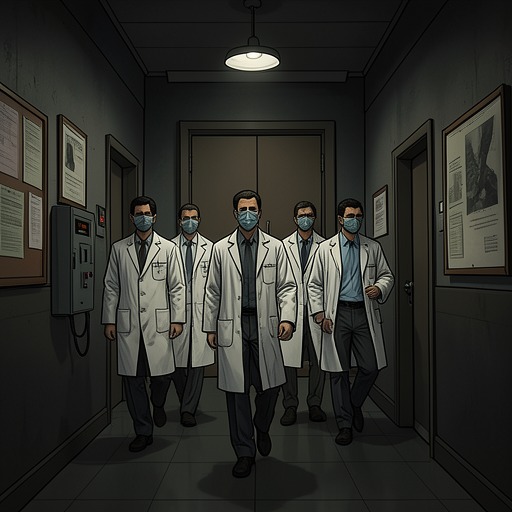
The QER center also becomes a protected route for warnings. When Eugene reaches the basement after Felix requests a private conversation, he moves through a white corridor toward Magellan’s sister QER units, which are among the newest machines installed in the center. Biometric scanners confirm that he is not an impostor before he connects the call. Felix then warns him that a warship is about to strike Earth and that Eugene must reach a QER to alert people at home. The Stack is the only place from which that warning can be sent securely: the Assembly does not know that the QER exists, and ordinary radio instructions might be intercepted.
This makes the building a communications bottleneck as well as a refuge. Knowledge of the crisis has already leaked, but the means of transmitting a decisive warning remain restricted to a small circle. The Stack’s power lies not only in possessing information but in deciding who can send it, which channel may be trusted, and whether a message will arrive before violence begins.
Crisis, Breach, and Aftermath
The Stack’s apparent control is repeatedly undermined by the political and informational consequences of the ARTists project. Gladstone Rockwell confronts Eugene with a live feed from Loose Lips Ezine containing more than a terabyte of the team’s internal communications, including memos, technical papers, and schematics. The leak exposes the limits of the Stack’s secrecy: a building designed to contain sensitive knowledge cannot prevent that knowledge from becoming public once its communications network has been compromised.
The crisis becomes physical in the QER center basement. After Eugene finishes Felix’s call and turns toward the sister machine of the Unicycle, he is struck by a taser and falls paralyzed. A previously covered table now holds a candlelit buoy idol, suggesting that the center has been seized or infiltrated by people whose reverence for the artifact has become cultic. The Stack’s technological sanctum is transformed into a ritual space, and the object that once appeared in scientific holograms is reintroduced as an idol within the institution itself.
The breach continues into the building’s security response. Balog, monitoring sentry systems while piloting four battle androids, notices a man armed with a candelabra fighting an Mk VII in the Stack basement. He abandons his game and switches his virtual environment into the sentry unit, bringing the android’s oversized shotgun to bear. The scene exposes the building’s layered absurdity: advanced military automation, exhausted human operators, improvised ritual violence, and bureaucratic communications all occupy the same defensive system.
After Kiefer and his associates are secured under Balog and the angry robot’s supervision, Eugene connects with the Unicycle and immediately encounters another communications obstacle. He demands that Lemieux be brought to the phone, because the Stack remains dependent on human operators and external contacts even at the height of its automation. Its machines can provide instantaneous links and its defenses can deploy armed androids, but its decisive actions still depend on people recognizing the emergency, trusting one another, and moving through the building in time.
Narrative Significance
The Stack concentrates the novel’s central tension between knowledge and power. It is where the alien artifact is rendered into data, where data becomes theory, where theory becomes a strategic program, and where that program becomes vulnerable to leaks, interception, panic, and sabotage. The building’s five-sided form and Pentagon ancestry make that process visible: scientific discovery does not occur outside institutions but inside a militarized structure that assigns value, controls access, and prepares knowledge for action.
Its repeated connection to QER communication gives the Stack a second symbolic function. The building is a node in a network extending from Earth to Magellan, Bucephalus, and the wider interstellar crisis, yet the node is never fully sovereign. Messages require bandwidth, authorization, trusted recipients, and protection from interception. The Stack can collapse distance, but it cannot abolish uncertainty or guarantee that the right person will be free to speak.
The building’s final reversals sharpen that irony. Its missiles, scanners, checkpoints, androids, and secure QER machines create the image of an impregnable command center, while leaks and an internal buoy cult reveal how porous it is to information and belief. The Stack therefore stands simultaneously for humanity’s greatest concentration of organized intelligence and for the fragility of the systems built to contain the unknown.