Tolo
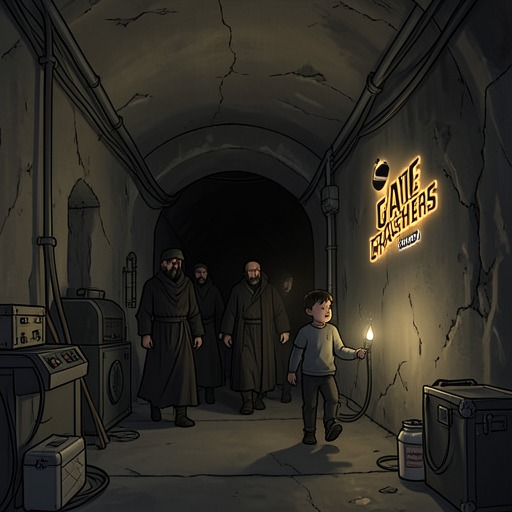
Gate CrashersTolo is a teenage member of the Pirikura tribe on Culpus-Alam, remembered chiefly as the survivor who can locate the forbidden Cave of the Creators. His importance lies not in authority or technical knowledge but in the bodily memory of having escaped the site: when the tribe’s stories, taboos, and fear prevent everyone else from identifying it, Tolo points Allison Ridgeway toward the hidden installation and thereby helps expose the machinery behind the supposed supernatural danger.
Identity and Introduction
Tolo appears within a Pirikura village where Allison Ridgeway’s survey team has established a base camp at the request of the local chief. The tribe possesses only a partial understanding of the humans’ language, and Allison relies on a translating earbud to communicate. When she asks about the Cave of the Creators, the villagers explain that it is a sacred place where gods sleep, protected by phantoms or monsters and forbidden to the Pirikura. The mother first says that she does not know its location but that Tolo does.
The villagers then part around Tolo, who is described as no more than a teenager. His physical difference is immediately striking: he has no ears, so his mother must lean close to his face while speaking loudly enough for him to understand. The detail makes his body part of the scene’s meaning before he says anything. Tolo is not introduced through a biography or an abstract characterization, but through the visible evidence of a life shaped by the dangerous place the tribe refuses to approach.
The Survivor Who Knows the Forbidden Place
Tolo’s mother orders him to tell Allison where he escaped the phantoms and monsters. He responds with violent refusal, throwing up his hands and shaking his head, insisting that he will not go back and that the place is forbidden. His resistance is not presented as empty superstition. He has apparently been there and escaped, so the tribal language of monsters is attached to a concrete experience that remains inaccessible to the rest of the village.
Allison changes the demand rather than forcing a journey. She tells the mother to explain that Tolo need only point to the location on the map. This distinction allows him to contribute knowledge without physically returning to the forbidden site. Tolo studies the display, which shows the village and the river, and works out the position with visible concentration. He finally jabs a finger at a point roughly three kilometers west of the place where Felix Fletcher’s trail had disappeared. His gesture supplies the first precise lead to the Cave of the Creators.
Tolo’s knowledge therefore functions as a form of embodied testimony. He cannot or will not narrate the experience in detail, and the language available between the Pirikura and the survey team is imperfect. Yet his recognition of the map is enough to transform fear into geographical information. The body that marks him as different from the villagers also becomes the medium through which a hidden history is recovered.
From Monsters to Observation Technology
The site Tolo identifies overturns the Pirikura explanation without making their fear meaningless. When the survey team enters the underground room, the chamber lights in response. Iridescent organic webs of wire pulse along the smooth walls, resembling the interior of an alien buoy. Images then appear from multiple viewpoints, showing the Pirikura village in detail: women and children move along the dirt roads while unseen observers watch them from beneath the ground.
The installation is recognized as an observation post. Its purpose is not immediate attack, and the investigators question why anyone would spy on people who appear to pose no threat. The discovery reveals that the Pirikura have been placed inside a larger system of surveillance and controlled observation. What they experience as sacred danger is connected to technology built by an advanced civilization, while what the technologically equipped humans initially read as primitive superstition becomes evidence of a real intrusion into the tribe’s world.
Tolo’s role is consequently a threshold function in the investigation. His warning belongs to the tribe’s supernatural vocabulary, but it leads directly to a material explanation. The scene moves from phantoms and forbidden gods to wires, sensors, and recorded images without treating the transition as a simple victory of enlightened outsiders over ignorant natives. The villagers were correct that the place was dangerous and protected; they merely named its danger through the concepts available to them.
Culpus-Alam and the Politics of Being Watched
The broader revelation is that Culpus-Alam is not an ordinary human settlement. Vel Noric observes the planet after the human vessels depart and explains that the civilized galaxy has designated it as a controlled setting for observing humans. The experiment has continued for many generations, allowing distinct human cultures to develop before a later stage of facilitated contact between the tribes. The intended purpose is to learn enough to predict humanity’s eventual integration into galactic society.
Seen against this background, Tolo’s encounter with the Cave of the Creators becomes part of a colonial and zoological arrangement rather than an isolated supernatural episode. The Pirikura are watched, classified, and managed without informed consent, just as humanity itself is enclosed within a network of buoys understood by Gladstone Rockwell as a cage. The later explanation of the Human Wildlife Preserve claims that the fence was meant as a buffer to keep outsiders away while humanity developed, not as a device to imprison humans. Yet the distinction between protection and confinement remains unstable: the people being protected are also being observed, interpreted, and assigned a place within someone else’s plan.
Tolo is central to this tension because his small act of pointing breaks the preserve’s concealment. He does not command the investigation, understand the wider galactic institutions, or deliberately challenge the observers. Nevertheless, his refusal to return and his ability to identify the site expose the distance between the tribe’s lived reality and the official language of research. The observation post may belong to a supposedly rational experiment, but for Tolo and the Pirikura its presence is experienced as violation, taboo, and terror.
Narrative Significance
Tolo is a minor character with a decisive narrative function. He is the reluctant guide who converts a frightened community’s fragmented knowledge into a usable direction, enabling Allison Ridgeway’s team to reach the hidden station and discover that the gods’ cave is an alien surveillance facility. His scene also reverses the expected hierarchy of expertise: the technologically sophisticated explorers possess the equipment, maps, and translation tools, but the supposedly unsophisticated teenager possesses the one knowledge that matters most.
His characterization remains deliberately limited, and the evidence does not establish a later career, a fuller account of his escape, or a direct confrontation with the observers. What remains is a concentrated image of refusal and recognition. Tolo will not go back, will not accept the tribe’s command to revisit the danger, and yet will point to it. That combination gives his brief appearance its force: survival does not require him to become fearless, only to decide that a memory too painful to revisit can still be used to make the hidden visible.