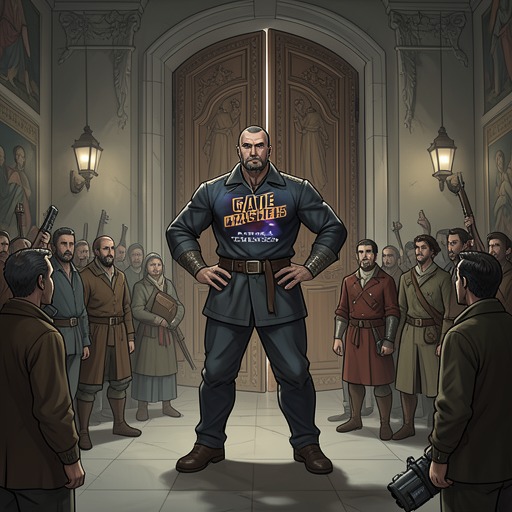
Turemok attack on the human fleet at Kulla
Gate CrashersThe Turemok attack on the human fleet at Kulla transforms a dispute over exploration, jurisdiction, and geocide into a direct interstellar assault. The attack is not presented as an isolated act of aggression. It grows from a chain of warnings, mistranslations, technological fear, and competing claims to lawful protection, until the Turemok military treats the human expedition as an imminent strategic threat and moves to capture it by force.
Causes and Strategic Background
The political atmosphere had already been poisoned by the message translated as “HUMAN WILDLIFE PRESERVE. KEEP OUT.” Humanity understood the warning as evidence that Earth had been placed inside a cosmic enclosure, a judgment reinforced by the discovery that the alien buoy was associated with a power capable of controlling access to space. Rockwell described the situation as being “caged like zoo animals,” while the human leadership concluded that diplomacy without a deterrent would leave Earth helpless. Danielle Fenton explained that the cabinet wanted humanity to possess “some teeth to bare” if first contact deteriorated, and that the planned outreach would combine diplomacy with a show of strength.
The danger intensified when the humans opened their own high-space portal on Earth. Vel Noric had already warned that returning humans might use the marker to accelerate their technology and become a genuine threat within one or two of their centuries. The revelation that the portal had been detected on Earth itself changed the strategic calculation. Turemok observers no longer had to imagine a distant possibility: human access to high-space appeared to be developing independently and rapidly.
The human side, meanwhile, framed its expedition as peaceful exploration. Allison Ridgeway identified herself as captain of the AEUS Magellan and described the mission as an expedition of “exploration and discovery.” Turemok officials heard the same encounter through a radically different legal and moral vocabulary. D’armic Ytol ev Shamel declared that his intention was to bring the humans into custody pending judgment for the geocide of Culpus-Alam. The human claim to peaceful discovery therefore collided with an alien accusation of mass murder, while Turemok’s claimed law enforcement appeared to the humans as an armed attempt to imprison them.
The Turemok Interception
Vel Noric ordered the Turemok vessel to remain under its stealth sheath and intercept the human ships. The instructions were explicit: activate the main cannons, warm the screening portals, assemble four hands of shock troops, board both vessels, take the crews prisoner, and throw them below with their Lividite collaborator. A further troop detachment was assigned to descend to the planet and retrieve the human prisoners after the two ships and their surface teams had gathered on the same side of Kulla. When Noric was asked what should happen if the humans resisted, he answered that their deaths would save the Assembly the cost of imprisonment.
The plan depended on surprise and positional control. Turemok forces waited until the human ships and their ground party were aligned, then intended to jump through high-space to the opposite side and strike while the targets were divided between orbit and the surface. The assault was therefore both a boarding operation and a coordinated planetary interception. It sought to remove the human crews as prisoners, but it also authorized lethal force as an economical alternative to detention.
The first visible sign of the ground assault was a small object making planet-fall. The human sensors identified it as a shuttle less than thirty meters long, and Marcel Gruber immediately recognized its purpose: the Turemok were going after the teams on the ground. The fleet had already passed its launch window for the orbit, so the human commanders could not send reinforcements from space. The surface teams had to prepare with what they already possessed.
Harris’s people checked their weapons and armor while Allison’s team struggled to keep fear from overwhelming them. Felix helped the marines construct a makeshift firebase in front of the bar. After eight tense minutes, Harris ordered the fire team to activate its active camouflage, turning the soldiers into mirages as the drop-ship descended. The black craft, shaped like an armored fish, circled once before settling into the courtyard. Its troops emerged rapidly, spread out, and took positions without the careful mutual cover expected of a trained squad. Their speed and apparent carelessness suggested either overwhelming confidence or serious tactical sloppiness.
The Ultimatum and Opening of Battle
The Turemok finally revealed their presence through a monstrous figure standing in the boulevard. Zek’nel was enormous, with a body compared to a bipedal ox coated in razor blades and crimson cybernetic eyes that glowed like freshly spilled blood. He identified himself as a member of the Turemok Pacification Force and accused the humans of the geocides of Culpus-Alam and Okim. The order was immediate: surrender their weapons, walk forward with their appendages visible, and obey within twenty rakims or be forcibly subdued.
The ultimatum exposed the central contradiction of the encounter. Turemok forces called the operation pacification and restraint, yet arrived cloaked, heavily armed, and prepared to seize prisoners on both a ship and a planet. The humans, already convinced that alien powers regarded them as managed wildlife, encountered the language of law as the outer shell of military coercion. Their resistance was not simply a refusal to submit; it was a rejection of the Turemok right to define the humans as criminals before any shared investigation had taken place.
Tillman reported a clear shot and requested permission to fire. Harris initially ordered him to hold, then requested authorization from Bucephalus and directed Allison’s team back inside the building. Once permission was granted, he ordered the rifle team to go weapons-free. The concealed human soldiers answered the Turemok demand for surrender with an ambush, making the ground confrontation the first open exchange in the attack.
The orbital engagement escalated in parallel. Three hundred kilometers above Kulla, the Turemok cruiser dropped its sheath and exposed a design intended to inspire terror. Vel Noric issued the familiar surrender ultimatum to the human ships, but Maximus Tiberius listened with growing boredom rather than submission. Instead of accepting restraint for the alleged geocides, the human command prepared its own response. Maximus ordered missiles one through five to receive telemetry and launch in a ripple. Each SSM-1 weighed nearly fifty metric tons; magnetic rails expelled the weapons from their tubes at three hundred kilometers per hour before their motors ignited. When Maximus gave the order to fire, the deck shuddered under the recoil, and the missiles began a seven-to-eight-second run toward impact.
Consequences and Political Aftermath
The attack made violence the governing language of contact. Turemok’s stated objective was to capture the crews and place them before judgment, but the operation included active cannons, screening portals, shock troops, a surface retrieval team, and permission to kill resisting prisoners. The humans answered with camouflage, fortified positions, weapons fire, and ship-launched missiles. Each side claimed necessity: Turemok invoked geocide, public safety, and the danger of human technological growth; humanity invoked self-defense against a power that had already categorized Earth as a preserve and now sought to impose custody.
The clash also became part of the Assembly’s later case against the humans. At the hearing, Ruckk listed what he described as a progressive criminal spiral: piracy of Assembly property, violation of Assembly space, serial geocide, destruction of the Assembly vessel sent to contain the humans, and the deaths of peace officers. From the human perspective, those “peace officers” had fired on them and attempted to board their ships. Allison Ridgeway answered that they had been discharging their weapons, exposing the reciprocal structure of the indictment: the same battle could be narrated as lawful containment or as an unprovoked attack.
The political consequences extended beyond Kulla. Even when new evidence cast doubt on the human responsibility for the earlier destruction, Bloon stated that the punitive expedition against Earth could not be halted. It had been authorized and dispatched weeks earlier, after the destruction of Kulla was reported. Thus the Kulla assault did more than endanger the expeditionary crews. It supplied the institutional momentum for a planet-wide punishment, showing how a local engagement could become evidence in an administrative process already moving toward planetary annihilation.
Narrative and Thematic Significance
The attack dramatizes a security dilemma in which defensive preparations become proof of offensive intent. Humanity’s effort to acquire a deterrent, its independent high-space portal, and its armed expedition appear to Turemok as signs of dangerous acceleration. Turemok’s stealth sheath, military interception, and boarding force appear to humanity as confirmation that peaceful contact is impossible. Neither side possesses a stable common framework for distinguishing exploration from intrusion, protection from imprisonment, or enforcement from conquest.
The event also reverses the language of the preserve. Humans first learned that they were being watched and enclosed like animals; at Kulla, they are tracked, surrounded, ordered to expose their limbs, and pursued by a force whose mission is explicitly pacification. The Turemok attack makes the metaphor physical. It places the humans inside the scene of capture while allowing them, through active camouflage and missiles, to resist becoming passive specimens.
Finally, the assault reveals how the story’s largest disasters are assembled from ordinary decisions under incomplete information. A translated warning, a detected portal, an accusation of geocide, a hidden cruiser, a planet-fall shuttle, a missed launch window, and a seven-second missile countdown each narrow the available alternatives. By the time the Turemok and human commanders exchange ultimatums, war has become the accumulated consequence of competing interpretations that each side treats as self-evident. Kulla is therefore not merely the site of a battle; it is the moment when uncertainty acquires weapons, legal language acquires troops, and first contact becomes an interstellar conflict.