Turemok cruiser escape
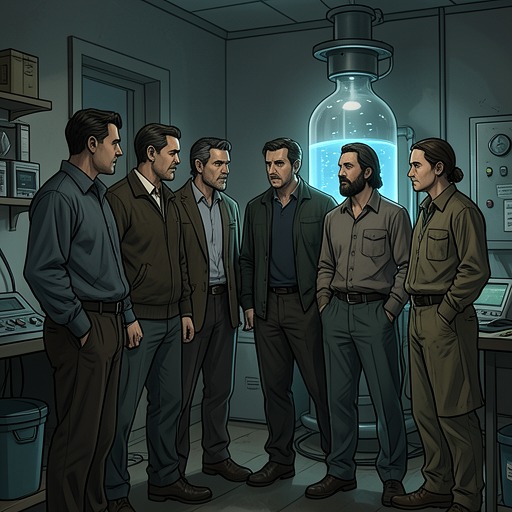
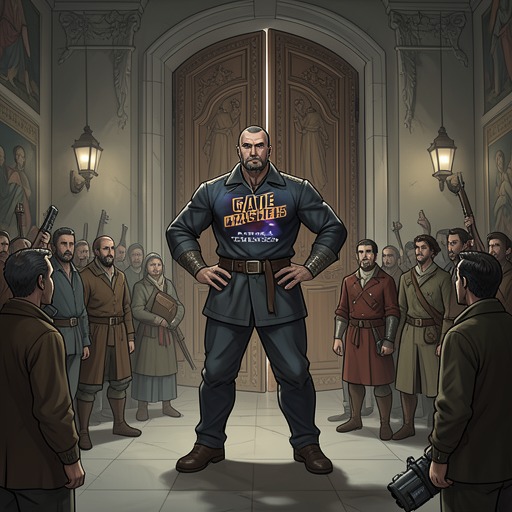
Gate CrashersThe Turemok cruiser escape is the prisoners’ decisive break from alien custody and the turning point that makes resistance possible. It converts the humans’ position from restrained suspects awaiting judgment into fugitives capable of recovering their ships, rescuing a crucial witness, and challenging the story being used to justify military action against Earth.
Causes and Stakes
The escape grows out of a conflict over who has the authority to define human actions. The humans have discovered that a network of buoys marks off a supposed preserve around Earth, a revelation that Rockwell describes as being caged like zoo animals. The Assembly’s officials, by contrast, maintain that the fence is a buffer intended to keep outsiders away while humanity develops. The same system that humans experience as confinement is therefore presented by their custodians as protection.
That disagreement becomes lethal when D’armic identifies the human expedition as responsible for the geocide of Culpus-Alam. Culpus-Alam is not an abandoned world but a controlled environment in which the Assembly has observed human tribes for generations, hoping to study their cultures and eventual integration into galactic society. The accusation against the humans thus carries the weight of an interstellar legal and political system, even though the humans do not yet understand the events for which they are being blamed.
The crisis is intensified by mutual securitization. Human officials already want a diplomatic mission accompanied by a show of strength after the discovery of the buoy and the warning identifying a Human Wildlife Preserve. At the same time, Vel Noric learns that Earth has opened its own high-space portal, a technological development he regards as potentially dangerous. When the humans are later detained, the Turemok Pacification Force announces that they are suspected of the geocides of Culpus-Alam and Okim. The escape therefore takes place inside a rapidly expanding security panic, where each side treats the other’s defensive preparations as evidence of an approaching threat.
Breakout and Rescue of D’armic
The immediate escape sequence combines force, improvisation, and the prisoners’ need to preserve testimony. A firefight ends in victory, but Simmons is killed by a pulse to the neck, leaving the assault shuttle without a pilot. The surviving humans then find D’armic barricaded behind a door. Maximus argues that there is no time to retrieve him, but Allison rejects that calculation: D’armic is the only witness to what happened at Okim and an officer of the Assembly. Keeping him alive is essential if the humans are to clear their names.
D’armic is not rescued through trust. He is frightened, and an attempt to overcome that fear with reassurance fails. Allison instead exploits it, warning him that the Turemok are coming and will feed him to the Fungus Harvester. The tactic is coercive, but it succeeds where persuasion does not; D’armic cries for help and is moved out with the humans. His presence changes the escape from a simple prisoner revolt into an operation to secure evidence and an official witness.
The episode’s moral pressure lies in that contradiction. The humans are trying to prove that they are not indiscriminate destroyers, yet their survival requires threats, armed action, and the manipulation of a terrified alien. The rescue does not erase the violence surrounding the escape; it demonstrates how the humans’ claim to innocence must be pursued within the same coercive conditions that have made them appear guilty.
Retaking Magellan
The escape from custody leads directly to the recovery of the AEUS Magellan. Allison cuts through Magellan’s hull with the shuttle’s emergency docking laser and drops into the ship, while Harris and his squad secure the corridor ahead of her. The plan had been formed during the escape: Harris and his team would accompany Allison, while Bucephalus carried the rest of the marine platoon and a full armory.
The operation also requires a rearrangement of personnel. Jacqueline is transferred to Maximus to replace his fallen pilot, a practical consequence of the earlier firefight that makes the assault possible. Harris expects Magellan’s crew to have been confined in the shuttle bays, where the enemy could monitor them and, if necessary, flush them into space. He therefore begins the sweep from the engineering section and advances forward, treating the ship itself as both battlefield and prison.
This movement through Magellan reverses the logic of captivity. The Turemok have attempted to convert the vessel into a controlled holding environment, but the humans use their knowledge of its design, its access points, and their own chain of command to turn it back into an instrument of escape. Allison’s passage through the newly cut hull is consequently more than a tactical entrance: it marks the recovery of human initiative and the beginning of the effort to reunite the fleet.
Consequences and Aftermath
The escape secures three immediate gains. The humans survive detention, recover access to Magellan, and retain D’armic as a witness whose official position may challenge the accusations against them. It also allows the human crews to continue acting rather than waiting passively for an Assembly judgment based on incomplete or distorted information.
Yet the breakout does not end the larger danger. The Assembly’s officials have already interpreted the humans’ actions as a chain of escalating crimes: piracy of Assembly property, violation of alien territory, serial geocide, destruction of an Assembly vessel, and the killing of peace officers. Later, Ruckk declares that the humans have already been judged and that an Assembly ship has tracked their movements from the moment they entered its territory. From that perspective, the cruiser escape is not exoneration but another item in a record of criminality.
The political consequences extend beyond the prisoners. Even when new evidence is presented, the Assembly states that it cannot halt the punitive expedition against Earth because the armada was dispatched weeks earlier, after the destruction of Kulla was reported. The escape therefore occurs under a cruel temporal imbalance: the humans are only beginning to assemble proof while military decisions based on earlier reports are already in motion. Their flight preserves the possibility of an appeal, but it cannot undo the momentum of retaliation.
Narrative Significance
As an escape plot, the episode follows a recognizable progression from confinement through revolt to recovery, but it complicates the usual triumph. Freedom is won through casualties, coercion, and the seizure of a witness; it is not a clean release from danger. Simmons’s death gives the breakout a permanent cost, while D’armic’s forced rescue ensures that the humans’ moral and legal problems remain physically present within their group.
The event also crystallizes the book’s recurring animalization motif. Humans resist being enclosed behind a network of buoys like specimens in a preserve, while the Assembly regards Culpus-Alam as a managed experiment and observes developing human cultures from a position of institutional authority. During the escape, the humans become both the watched subjects of an interstellar system and armed actors attempting to escape its enclosure. The cruiser is thus simultaneously prison, evidence chamber, and contested territory.
Most importantly, the escape changes the value at stake from mere survival to the possibility of being believed. The humans do not simply flee the Turemok; they carry D’armic, reclaim Magellan, and pursue the means to contest the accusation of geocide. Their breakout cannot immediately stop the punitive expedition against Earth, but it creates the only remaining path toward testimony, counterevidence, and a different interpretation of humanity’s place in the galactic community.