Turemok military
Gate CrashersThe Turemok military is the armed hierarchy that makes the Turemok the Assembly of Sentient Species’ principal instrument of force. It is defined not only by ships, weapons, and command authority, but by a culture in which rank is physically and politically enforced, military readiness is treated as a condition of survival, and technological uncertainty is rapidly translated into a case for intervention. Its confrontation with humanity shows how an institution organized to preserve security can manufacture the very war it claims to prevent.
Nature and Internal Hierarchy
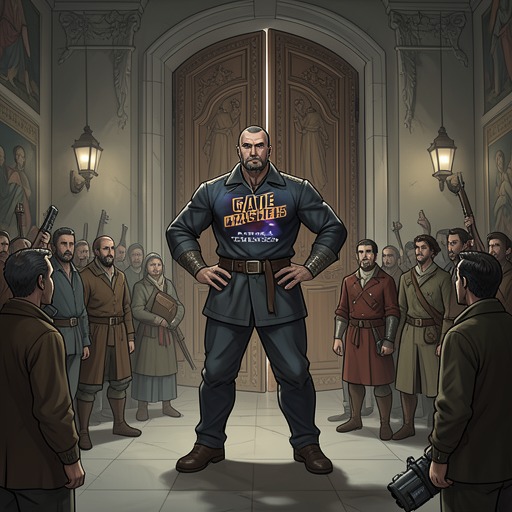
The military’s command structure is headed by figures such as the Vel, supported by subordinate officers including the Hedfer-Vel. Vel Noric’s authority is immediately legible aboard his ship: he stands nearly a full crest taller than the rest of his crew and outweighs his closest competitor by twenty percent. His size is partly natural, but his unusually favorable personnel assignments are also the result of cultivated favors within the hierarchy. He arranged for his first crew to be unusually small, making his physical dominance a practical survival strategy while he remained an untested Vel.
That survival strategy reflects the military’s internal brutality. Since Noric’s appointment, there has been only one Pal’kuar dominance rite, and its finality is presented as insurance against another challenge during his tour. Command is therefore not merely administrative; it is embodied, contested, and potentially lethal. Noric selected J’quol as his Hedfer-Vel because the younger officer was deferential, lacked ambition, and was too slight to act on that ambition even if it arose. The choice exposes an institution in which subordinates are assessed partly according to whether they can threaten the commander, and in which commanders do not expect to retire safely from power.
Security Doctrine and Strategic Anxiety
The military’s larger history explains its persistent readiness to use force. The Turemok were once technologically dependent on their home world, but centuries of Lividite aggression drove neighboring societies into desperation. The Turemok were released from that stagnation and forged into a spear aimed at the Lividite enemy. When the original purpose of that mobilization ended, the institution could not simply be demobilized. Millennia later, the Turemok remained the Assembly’s talons, committed to preserving the position created by their military role.
This history produces a security doctrine that treats technological change as an approaching threat. When the military learns that humanity has opened a high-space portal on Earth itself, the discovery overturns its assumptions. Noric initially believes the humans could only have adapted technology from the alien buoy, but the portal was detected on Earth almost half a cycle earlier, before signals from the human expedition could have arrived. The alternatives are alarming: humanity has independently produced the technology, or it possesses a means of instantaneous communication that leading Lividite scientists consider impossible. Either possibility suggests that human development is accelerating beyond military prediction.
The reaction is explicitly preemptive. Noric warns that the humans could use the buoy’s marker to accelerate their technology and become a genuine threat within one or two of their centuries. The Kumer-Vel then offers Noric a path to rehabilitation and possibly command of the Xecoron, the flagship of the Turemok fleet, if he can provide an excuse to act before humanity becomes dangerous. The military’s logic is consequently circular: the humans’ capacity for future advancement is treated as evidence of present danger, while an invented pretext for intervention is treated as defensive necessity.
Contact, Deterrence, and Escalation
Humanity’s own institutions respond to the same uncertainty through militarization. On Earth, Steven Billings Rockwell argues that without propulsion the human ships will still take decades to reach the aliens, while Eugene Graham objects to describing a future encounter as a confrontation. Rockwell nonetheless interprets the discovery of the “wildlife preserve” warning as proof that humanity is being caged like zoo animals. Danielle Fenton reports that the cabinet wants enough military strength to provide teeth if first contact turns hostile, and she persuades the president and most advisers to combine diplomacy with a show of force.
The Turemok military reads this posture through its own strategic fears. What human leaders describe as deterrence can appear to an established military power as preparation for an assault. The result is a classic security dilemma: each side arms itself in response to the other’s imagined future action, and every defensive measure becomes evidence supporting the opponent’s suspicion. The Turemok military’s history makes this dilemma especially dangerous because it has institutional reasons to preserve its role as the Assembly’s spear rather than accept technological parity with a newly emerging power.
Its public-facing method is coercive custody. D’armic Ytol ev Shamel, identified as a frontier manager of the Bureau of Frontier Resources, tells the crew of the AEUS Magellan that his intention is to take them into custody pending judgment for the geocide of Culpus-Alam. Later, Zek’nel of the Turemok Pacification Force orders human forces to surrender under suspicion of the geocides of Culpus-Alam and Okim, giving them twenty rakims to comply before force is used. These announcements present military action as legal enforcement, but the accusations also function as the language through which organized violence becomes permissible.
Authority, Force, and the Punitive Expedition
The military operates within a larger Assembly system, yet its operational momentum can outrun political correction. When new evidence raises the possibility that humanity was not responsible for the alleged destruction, the Assembly acknowledges an obligation to investigate. Even so, Bloon Representative states that the punitive expedition already authorized against Earth cannot be halted because the armada was dispatched weeks earlier, after the destruction of Kulla was reported.
This sequence reveals the danger of delegated force. Once the military has been authorized and deployed, later uncertainty cannot easily reverse the decision. The expedition acquires its own inertia, turning an allegation into an irreversible strategic fact. Allison Ridgeway emphasizes that thirty billion people live on Earth, but the military machine is no longer governed solely by the evidentiary question of guilt. Authorization, mobilization, and distance have made the consequences exceed the original claim.
The Turemok military therefore occupies an unstable position between Assembly authority and institutional autonomy. It is powerful enough to threaten a planet, yet its leaders remain constrained by formal rules against attacking humanity while the supposed threat is still inside its nest. That constraint does not eliminate aggression; it redirects it toward the manufacture of a pretext. Noric is asked to supply the excuse that will transform prohibited attack into authorized action, demonstrating how military institutions can preserve the appearance of legality while preparing to evade its substance.
Cultural Contrast and Narrative Significance
The military’s coercive worldview is sharpened by the book’s contrasts with the human survey teams. Felix Fletcher sits in a thatch hut, eating the indigenous food called kuluk, while trying to understand the Pirikura with no anthropology training and little experience of other cultures. The survey team’s base has been established at the request of the local chief, and the Pirikura’s explanations of gravity, hospitality, and forbidden places are treated as cultural encounters rather than immediate grounds for conquest. Allison Ridgeway likewise uses a translation tool to communicate with the villagers, learns that the Cave of the Creators is sacred and forbidden, and confronts the consequences of that prohibition when Tolo, a teenager without ears, refuses to reveal how he escaped the supposed phantoms or monsters.
These scenes do not make human exploration innocent: the surveyors misunderstand the Pirikura, and Felix’s sudden attention to a refined copper cauldron exposes the possibility that the community’s apparent stone-working culture conceals an older technological history. Yet the human teams are at least capable of curiosity, negotiation, and revised interpretation. The Turemok military, by contrast, repeatedly converts incomplete knowledge into custody orders, accusations, and expeditionary force. The contrast is not between a purely peaceful humanity and a purely violent alien institution, but between different responses to the unknown: ethnographic inquiry on one side, securitized command on the other.
The Turemok military’s decisive narrative function is to embody the politics of the “wildlife preserve” revelation. Humanity discovers that it has been categorized and managed from outside, while the Turemok military sees itself as the guardian of a wider order threatened by a rapidly changing species. Both positions depend on acts of classification: someone is named a preserve, a geocide perpetrator, a future threat, or a population requiring control. The institution’s tragedy is that its inherited identity as the Assembly’s weapon leaves it unable to encounter humanity without asking whether humanity must be contained, punished, or destroyed.