Twinkling Star
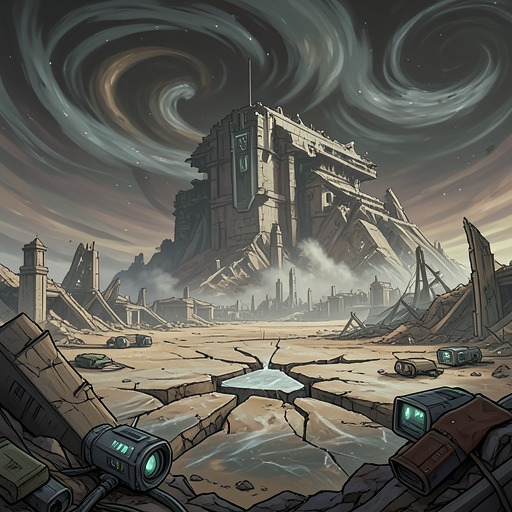
Gate CrashersTwinkling Star is both a celestial enigma and a threshold in humanity’s expanding world. For centuries it appeared as an impossible star that flickered even when observed through space-based telescopes; when Magellan and Bucephalus finally approached it, the mystery resolved into an immense engineered structure, making the sky itself a site of concealed infrastructure, surveillance, and contact.
An Astronomical Anomaly
The mystery began when Twinkling Star started twinkling in 2049. Ordinary stars could shimmer when viewed through a turbulent atmosphere, but this object continued to do so when seen from space. The anomaly resisted sustained scientific explanation for generations. Proposed answers included the debris of a disintegrating planet, an unstable accretion disk, and even a star with a malfunctioning thermostat. None survived testing, and by 2073 the astrophysical community had temporarily abandoned explanation in favor of calling the object a miracle.
That unresolved history gives Twinkling Star a distinctive place in the narrative’s treatment of knowledge. It is not initially presented as a destination or a known machine, but as a stubborn remainder that frustrates established categories. The object’s name preserves the language of observation rather than understanding: humanity can describe what it seems to do long before it knows what it is.
The Approach from Solonis B
When Magellan launched toward Solonis B in 2285, the relatively short distance of six light-years offered an opportunity to study Twinkling Star with the vessel’s powerful multispectrum telescope. The expedition therefore carries an explicitly scientific hope even as it moves toward the broader mystery of alien civilization. The object is approached as data before it becomes an encounter.
Two days and six light-years later, Magellan and Bucephalus reemerged from hyperspace and moved into formation. At a distance of barely six light-minutes, the ships no longer needed a telescope. Between them and the system’s primary floated a field of gargantuan, opaque membranes. Each membrane had streamers kilometers long, projecting toward the outer system like wind socks, while the broadly circular canopies were marked by an asymmetrical divot. Their appearance was so recognizable that Ensign Prescott identified them as giant lily pads, and Allison Ridgeway answered with an image of the bullfrogs that might accompany them. The exchange converts an abstract astronomical puzzle into an immense, disconcertingly familiar physical landscape.
The Hidden Galactic Infrastructure
The visible membranes reveal that Twinkling Star is not a conventional star at all, but a constructed installation or system of structures whose scale had concealed its function. Its apparent astronomical behavior was the surface effect of technology far beyond humanity’s prior understanding. The encounter therefore performs a classic reversal: the object first appears to be a remote natural body, then becomes evidence of deliberate engineering and an inhabited political order.
That reversal belongs to the same pattern as the wider discovery of the Human Wildlife Preserve. Humanity initially interprets the network of alien buoys as a cage, while Eugene Graham argues that it may instead mark territory reserved for humans; Gladstone Rockwell rejects that distinction as paternalistic because the Assembly of Sentient Species has still decided what humanity’s territory should be. The absent Buoy #4258743-E later exposes a hole in the fence, and the observation post beneath the Pirikura village shows that the surrounding system is also an apparatus of watching. Twinkling Star extends this pattern from the local object to the cosmic environment: what looks like nature may be infrastructure, and what looks like a boundary may be an instrument of management.
A Threshold to Contact and Judgment
Twinkling Star’s decisive narrative function is to bring humanity close to the civilization that has been observing, classifying, and regulating it. Culpus-Alam is described as a controlled setting in which human tribes were allowed to develop distinct cultures before contact between them was facilitated for study. The Assembly’s preserve is similarly defended as a buffer zone intended to warn outsiders away from Earth space while humanity developed, rather than as a barrier meant to imprison humanity. Yet the language of protection remains inseparable from the power to define, survey, and judge.
This tension culminates in the later judgment of Allison Ridgeway and her companions. Ruckk declares that the Assembly has already judged humanity and lists the charges associated with its expansion: piracy of Assembly property, violation of alien space, serial geocide, destruction of the vessel sent to contain the crisis, and the killing of peace officers. Twinkling Star thus stands at the beginning of a chain that leads from wonder to institutional scrutiny. It is a threshold, but not a neutral one: crossing into the wider galaxy means entering a system whose machines, borders, research projects, and tribunals have already assigned humanity a place.
Narrative Significance
Twinkling Star embodies the book’s movement from scientific uncertainty to political estrangement. Its flicker first produces hypotheses, irritation, and failed explanation; its membranes then provide an image of enormous, opaque design. The revelation does not merely answer an old astronomical question. It teaches that humanity’s apparent isolation has been structured by powers it could not see, and that the boundary between a natural cosmos and a managed preserve is politically consequential.
The location’s importance therefore lies less in its physical description than in the change of scale it imposes. A mystery once measured by centuries of astronomy becomes a nearby field of artificial canopies, linked to the same civilization that maintains buoys, observes human populations, and claims authority to judge Earth’s actions. Twinkling Star is the moment when the distant universe ceases to be background and becomes an organized, watchful environment.