Vel Noric
Gate CrashersVel Noric is a Turemok military officer whose imposing body, cultivated authority, and alarm over humanity make him one of the story’s most persistent external antagonistic forces. He is not merely a hostile commander: he is an officer who recognizes a genuine danger in human technological advancement, yet repeatedly converts that insight into surveillance, intimidation, violence, and demands for confession. His trajectory gives the wider conflict a face—large, disciplined, impatient, and convinced that the Assembly of Sentient Species is dangerously slow to act.
Identity and Military Authority
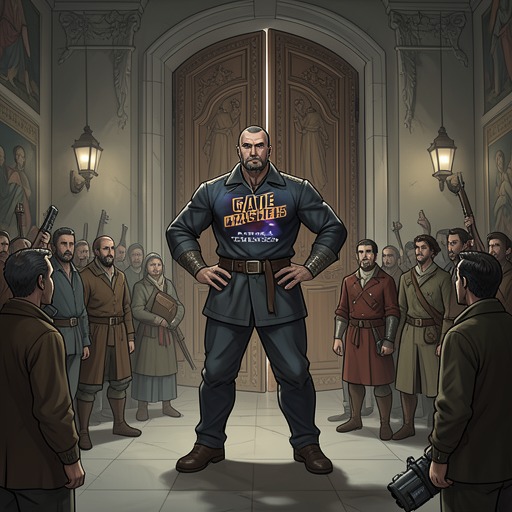
Vel Noric’s physical presence is exceptional even among his own crew. He stands nearly an entire crest above everyone else aboard his ship and outweighs his closest competitor by twenty percent. That stature is not presented as simple biological luck. Noric has cultivated favors within the hierarchy responsible for personnel assignments, ensuring that his first crew would be unusually small. The arrangement functions as a practical survival strategy for an untested Vel in the Turemok military: fewer rivals mean fewer immediate challenges to his authority.
His authority is also secured through the Pal’kuar dominance rite, a formalized contest whose outcome has effectively removed the possibility of another challenge during his tour. There has been only one such rite since Noric became Vel, but the finality of its result serves as continuing insurance. His command therefore rests on a combination of institutional patronage, physical intimidation, and a reputation strong enough to make repetition unnecessary. Even when he has not learned a subordinate’s name, the crew understands the hierarchy embodied by his presence.
Suspicion of Humanity
Noric’s first major appearance in the supplied narrative places him in a concealed pursuit of the human vessel that has recovered the alien buoy. He and his crew have been shadowing the humans since intercepting the buoy’s repair requisition. His assessment of the encounter is contemptuous: he believes the humans found the buoy by luck, hid it under their coats, and fled for home while hoping that no one had noticed. In his view, the act is not an innocent misunderstanding but an expression of humanity’s fundamentally corrupt nature.
Under ordinary military logic, Noric believes the humans could be captured or destroyed for piracy. The Assembly of Sentient Species, however, orders him to remain hidden and report on the Earth vessel’s actions. The institution’s noninterference policy protects humanity even after the apparent hijacking, and Noric regards that restraint as absurd. He wonders what humanity would have to do before the Assembly treated its rapid advancement as a serious threat—invade a member world, perhaps, or collapse a star. His frustration is therefore political as well as personal: he sees an obvious danger but is required to watch it develop from concealment.
That suspicion is sharpened by his ability to recognize patterns across apparently unrelated evidence. When Faan tells him that a Kumer Vel has reviewed his record, accomplishments, and logs, Noric immediately identifies the shared threat as the humans. The exchange confirms that his hostility is not merely a reaction to one encounter with a stolen buoy. He has built a larger interpretation of humanity’s behavior and sees himself as one of the few officials willing to acknowledge its implications.
Command Style and Conflict
Noric’s response to uncertainty is forceful control. When a Bureau of Frontier Resources cutter appears unexpectedly, he demands to know what it is doing there and reacts to J’quol’s inadequate answer by gripping the subordinate’s shoulder until his claws break through the scales and drive J’quol to one knee. The gesture is more than an outburst: it demonstrates how quickly Noric turns confusion into bodily discipline. His authority depends on making hesitation physically costly for those beneath him.
His antagonism becomes openly theatrical during the confrontation with the human fleet. After the opposing commander has endured the evening’s conflict, Noric appears triumphantly and promises to show what he has prepared. The boast frames the battle as a performance in which he controls both the violence and its presentation. He is not content merely to win; he wants the enemy to understand that the encounter has been arranged as an exhibition of his power.
Later, Noric enters the human prisoners’ room as a nearly doorway-filling shadow and introduces himself by invoking the warning, “Abandon all hope, ye who enter here.” He demands admissions of guilt for the destruction of Culpus-Alam, Okim, and Kulla, offering relief from future anguish in exchange for confession. His method combines literary menace, legal accusation, and the threat of torture. By addressing Captain Maximus Tiberius first, he turns the interrogation into a staged hierarchy: the commanding officer is invited to step forward, and the others are made to watch the authority of their leader become the first object of pressure.
The Larger Disaster Behind His Fear
Noric’s suspicion of humanity exists within a universe where planetary destruction is already part of military history. The destruction of Culpus-Alam is explained as a legacy of the Lividite war, when the Lividite military, having overreached against multiple enemies, chose to make an example of the Pu’Lan. A high-space portal bored a tunnel through the planet, and the resulting collapse devastated the surface, triggered volcanoes at the entry and exit wounds, shattered tectonic plates, and disrupted the planet’s core and magnetic field. The event establishes that Noric’s fear of civilization-scale violence is not wholly irrational: the technology and precedent for geocide are real.
The narrative repeatedly places Noric’s military certainty beside disasters too large for ordinary perception. D’armic encounters a titanic worm of fire in high-space and later discovers that its estimated mass matches, to six decimal places, the mass missing from Culpus-Alam. Elsewhere, a red-hot inverted cone rises beyond a city’s horizon, so immense that observers can scarcely contain it within their field of vision. These catastrophes make Noric’s warnings intelligible even when his conduct is cruel. He inhabits a world in which a commander’s misreading can become planetary death, but his answer to that risk is surveillance, coercion, and preemptive force.
The same logic continues when the retaliatory strike against Earth is launched before the people attempting to prevent it can arrive. The attack is described as imminent, compressing political delay into a countdown. Against that background, Noric’s insistence that humanity must be treated as a threat acquires genuine urgency, while his methods expose the danger of allowing fear to become an unquestioned military doctrine.
Narrative Function and Significance
Vel Noric functions as both antagonist and distorted counterpart to the human explorers. Like them, he interprets incomplete evidence, improvises under pressure, and tries to act before institutions can respond. Unlike them, he treats suspicion as sufficient grounds for domination. His physical scale externalizes this difference: he is a commander who literally towers over his crew, and his political imagination likewise seeks to stand above procedural restraint.
His encounters with the humans also expose the instability of official categories such as piracy, lower species, criminality, and civilization-level threat. The Assembly’s noninterference policy prevents him from acting when he believes action is justified, while later military confrontations and interrogations demonstrate what happens when restraint gives way to force. Noric’s central contradiction is therefore not that he sees no danger, but that he sees danger clearly enough to become dangerous himself.
The character’s recurring imagery reinforces that contradiction. He appears as a physically overwhelming figure, a shadow filling a doorway, and a commander speaking from behind the machinery of surveillance and high-space warfare. Yet the disasters surrounding him exceed even his control: planets are destroyed, cities face impossible celestial phenomena, and Earth approaches annihilation while officials are still trying to frame the crisis. Noric believes command can master uncertainty. The plot repeatedly suggests that uncertainty is precisely what no commander, however formidable, can finally contain.