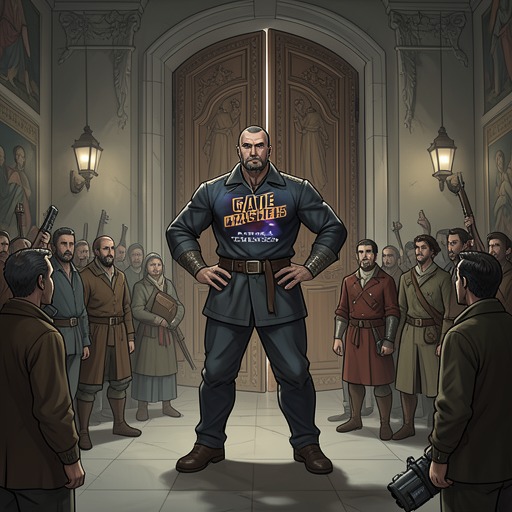
Vel Noric–J’quol relationship
Gate CrashersThe Vel Noric–J’quol relationship is built on a contradiction: Noric requires a subordinate he can control, yet the very subordinate he selects proves most capable of seeing through the assumptions that sustain his authority. Their exchanges aboard the Turemok vessel turn military hierarchy into psychological combat, with J’quol speaking deferentially while quietly redirecting decisions, and Noric responding to every independent judgment as both useful counsel and a threat to his position.
A Hierarchy Designed to Prevent Rivalry
Vel Noric’s appointment of J’quol as Hedfer-Vel begins the relationship as an exercise in defensive personnel management. Noric chooses the youth because J’quol appears deferential, lacks obvious ambition, and is too slight to convert ambition into physical rebellion. Such criteria belong to a command culture in which former commanders rarely survive long enough to need retirement benefits. Noric’s own body and position reinforce this logic: he stands nearly a crest above the other crew members and outweighs his closest competitor by twenty percent, advantages secured partly through favors among the hierarchy responsible for personnel assignments.
The arrangement is meant to make J’quol safe, not valuable. Noric has already survived a Pal’kuar dominance rite, whose finality functions as insurance against another challenge during his tour. He therefore approaches command as something preserved through preemption: rivals are minimized, subordinates are selected for weakness, and authority is made physical. J’quol unsettles that system precisely because he is not conventionally rebellious. He is methodical, does not anger quickly, does not readily cower, stands by his ideas, and can exploit disagreements among the crew to advance the Vel’s orders. His obedience is therefore active rather than passive; it gives him room to influence the command structure from inside it.
Counsel That Exposes the Vel
The first decisive strain in the relationship comes when J’quol reports that the human vessel’s evasive movements cannot be explained by debris. Noric initially dismisses the humans as dodging objects too large for their inadequate weapons to destroy. J’quol answers that navigational sensors showed no such debris. He presents the conclusion carefully, claiming that he happened to compare two data sets even though the systems would have had to be called up separately and deliberately. The fiction protects Noric from appearing foolish before the command crew, but it also demonstrates that J’quol is managing the Vel’s public authority while correcting his judgment.
Noric recognizes the maneuver. He normally considers this tactful protection an excellent quality in a subordinate, yet here it feels like performance. J’quol’s composure seems almost Lividite to him: unnervingly calm, difficult to provoke, and therefore difficult to dominate. Noric orders him to come directly to the point, but the command cannot erase the fact that J’quol has already controlled the terms of the exchange. He has shown that a subordinate may preserve the appearance of hierarchy while possessing the sharper reading of events.
J’quol’s observation reveals that the human vessel has seen through the Turemok stealth sheath. The Assembly of Sentient Species has ordered Noric to remain hidden and observe rather than destroy the ship, maintaining its centuries-old noninterference policy even after the humans have hijacked a marker buoy. Noric resents the restrictions and concludes that the vessel should have been destroyed from the beginning, since its return to Earth could expose the aliens and allow human scientists to study the buoy’s technology. J’quol’s counsel thus becomes the immediate cause of restraint, but it also sharpens Noric’s fear that the humans are advancing beyond the control of the existing policy.
From Tactical Partnership to Mutual Suspicion
Later, Noric reports to a superior that J’quol advised against destroying the unarmed human vessel because the Assembly might condemn such an act. Noric claims that he accepted this advice after considering its political consequences, presenting himself as the final decision-maker even while acknowledging J’quol’s influence. The exchange shows the relationship’s double structure: J’quol’s recommendations protect the operation from one kind of danger, while Noric’s account converts those recommendations into evidence of his own prudence.
The balance shifts when Noric learns that humans have opened a high-space portal on Earth itself. He had expected the humans aboard the tracked ship to adapt the buoy’s communications technology and perhaps accelerate their development over one or two centuries; the discovery that Earth has independently achieved high-space travel makes that timetable immediate. J’quol is part of the command system that must respond to this revelation, but the news also confirms the deeper anxiety surrounding their relationship. Noric’s authority depends on containing human progress, while J’quol’s value lies in recognizing sooner than Noric does when containment has failed.
Their conflict becomes physical when a Bureau of Frontier Resources cutter appears after a new high-space portal opens. Noric demands to know what the vessel is doing there and then grips J’quol’s shoulder scales until his claws pierce the skin. J’quol kneels under the pain but does not otherwise flinch: he neither reaches for the wound nor attempts to staunch the blood. He answers with an apology for imprecise speech and calmly proposes hailing the cutter. Noric experiences the scene as calculated. J’quol has again questioned his authority and tested his strength, and even Noric’s eventual release cannot restore the command’s former solidity. The physical dominance Noric seeks produces the opposite result, making the weakness in his foundation more visible.
The Relationship Under Escalating Violence
When Noric decides that the human ships are witnesses who must be intercepted, he orders the vessel to remain sheathed, commands the main cannons and screening portals to be readied, and instructs J’quol to assemble four hands of shock troops for boarding operations. The crews are to be taken prisoner and thrown below with their Lividite collaborator. J’quol’s role is therefore not merely advisory: he is the officer through whom Noric converts suspicion into organized violence.
Yet the division of labor also exposes their dependence. Noric supplies the doctrine of force and the rhetoric of necessity; J’quol supplies analysis, procedural competence, and the ability to phrase opposition without openly breaking rank. Their relationship is neither friendship nor simple loyalty. It is a tactical partnership formed by a coercive institution, in which every useful act can be interpreted as assistance, manipulation, or preparation for a future challenge.
Narrative Significance
The relationship gives the Turemok command structure an internal fault line. Noric represents authority founded on bodily dominance, inherited military custom, and control over what subordinates may safely say. J’quol represents a more adaptive intelligence that works through observation, timing, and carefully calibrated speech. The contrast matters because the larger conflict is also a contest between rigid systems of management and rapidly changing forms of knowledge: the Assembly confines humanity within a preserve, Turemok doctrine polices the boundary, and the humans repeatedly exceed the categories imposed on them.
J’quol’s conduct also complicates the apparent division between obedience and resistance. He does not need to denounce Noric to challenge him. By correcting the Vel while protecting his public dignity, by withholding visible reaction to violence, and by presenting objections as service, J’quol turns the protocols of subordination into instruments of agency. Noric understands enough of this strategy to fear it, but not enough to neutralize it. Their relationship therefore embodies the book’s recurring irony: systems built to guarantee control create the surveillance, calculation, and suppressed intelligence that eventually undermine the controller.