Wulaman System
Gate CrashersUlamante is the home system of the Assembly of Sentient Species and the seat of government for half the civilized galaxy. Reached by Allison Ridgeway’s two-ship convoy after the crisis surrounding Culpus-Alam, it appears first as an almost impenetrable political and military center: thousands of sensor platforms monitor the approach, escorts intercept the arriving vessels, and more than seventeen thousand ships gather around the system. Ulamante therefore transforms humanity’s voyage outward into a test of jurisdiction, evidence, and power. The humans do not merely arrive at a place; they arrive before the civilization that has secretly observed their species, transplanted human populations, and now considers itself entitled to decide their fate.
Capital of the Assembly
Ulamante is explicitly identified as the Assembly’s home system and governmental seat. D’armic seeks transport there because only the system’s authorities can authenticate his message and hear the case involving the humans. His request marks a decisive change in the relationship between the human expedition and the wider galaxy: earlier, D’armic had refused to reveal the location of the Assembly, but the destruction of Culpus-Alam and the deaths of the suspected conspirators have made concealment impossible. He must bring Allison Ridgeway and her companions to the center of the political order that has become implicated in their crisis.
The approach to Ulamante displays the scale of that order. The hyperspace corridor is crowded with sensor platforms, and the human convoy is detected seven light-years from the system. An escort arrives within minutes. When Bucephalus emerges into real space with Magellan in tow, more than seventeen thousand vessels become visible on passive sensors, ranging across an extraordinary variety of sizes and forms. One vessel is initially mistaken for a small moon before opening a hyperspace window and disappearing. The detail makes the system feel less like a single defended planet than a densely layered apparatus of surveillance, commerce, administration, and force.
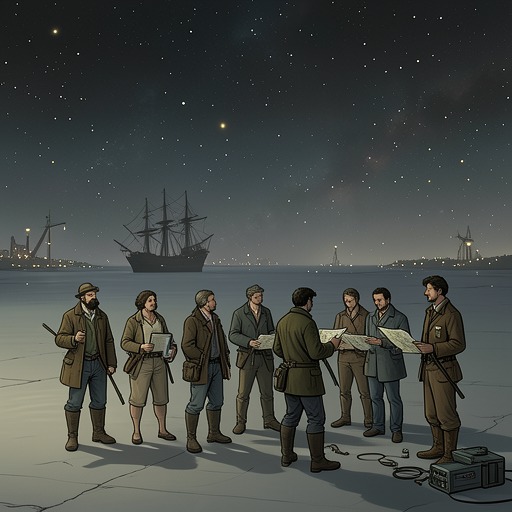
D’armic’s credentials and diplomatic skill secure the convoy permission to approach and obtain an audience with the Assembly’s ruling members, but authorization does not mean safety. Eleven Turemok prisoners held in Magellan’s cargo bay are the principal reason the escort does not simply execute the newcomers. D’armic must also instruct the humans to approach a transfer station, reduce their velocity to zero, and shut down their drive systems. The system’s hospitality is thus inseparable from procedures of inspection and control.
The Pillar and its planetary setting
The most striking visible structure associated with Ulamante is the Pillar, the destination reached through a transfer booth. Felix Fletcher first looks upward and sees an entire world through the crystal lattice of the ceiling. A blue atmospheric halo surrounds the planet; its terminator divides day from night with exactness; red plains, white-capped mountains, and purple seas cover the dayside, while the nightside is patterned with city lights linked by winding illuminated ribbons. The spectacle gives Ulamante a planetary scale that exceeds ordinary architectural comparison.
The Pillar’s base spreads into the surrounding land like an Oriental fan, with each spine extending hundreds of kilometers from the central hub to distribute the structure’s immense weight. Felix calls it a spacescraper and compares it with humanity’s tallest building, which reaches only seven kilometers and eventually fell. The comparison establishes the Pillar as both technological achievement and political symbol: it is a structure so large that human engineering appears embryonic beside it, and its physical design binds a governmental center to the planet beneath it.
The Pillar’s grandeur also complicates the system’s meaning. Ulamante presents the Assembly as capable of immense coordination, surveillance, and construction, yet the same civilization has permitted or concealed destructive interventions elsewhere. The monumental order of the capital stands against the disorder revealed in the Assembly’s treatment of other worlds. Its beauty cannot be separated from the authority that the structure embodies.
A center built on observation and intervention
Ulamante’s political significance is sharpened by what its institutions reveal about Culpus-Alam, also called Solonis B by the humans. The Assembly established Culpus-Alam as an anthropological experiment intended to model how humans would react to unfamiliar cultures. Human populations were brought from Earth: isolated tribes were preferred as the base stock, while random sampling was added to reduce the danger of inbreeding. The tribes then developed distinct cultures over many generations while being observed from outside.
The experiment arose from uncertainty within the Assembly itself. Its officials watched contradictory human broadcasts, some depicting cooperation with other species and others depicting humans and aliens destroying one another. Humanity consequently appeared both noble and tolerant and irrational, violent, and bigoted. Because the Assembly could not determine which representation was accurate, it created a controlled world on which human cultural development and intergroup contact could be observed directly. Ulamante is therefore connected to a knowledge system that treats human communities as evidence in an experiment rather than as self-governing populations with an acknowledged history and territorial claim.
The discovery of a human woman on Culpus-Alam makes that abstraction concrete. She emerges from foliage twenty meters down a riverbank, carrying a blowgun, wearing little clothing, and marked with blue-and-white paint. Despite the cultural and material differences separating her from the human teams, she is unmistakably human. Allison Ridgeway later tries to obtain the tribe’s location from a mother by showing the area on a holographic map; the woman does not know, but identifies Tolo as someone who does. These encounters expose the human populations as living communities with local knowledge and internal relationships, even while the Assembly’s description reduces them to experimental subjects.
The setting also gathers the consequences of technological intervention across other worlds. Okim was once a pre-nuclear society, but an Assembly survey vessel suffered catastrophic pressure loss in orbit and became a new star in the local night sky. The native population discovered the vessel, studied it, and accelerated its development after reaching it. Industry, population, energy consumption, and resource demand expanded rapidly; hydrocarbons powered huge cities, while pollution destabilized the environment and caused temperatures to rise and coastal areas to flood.
A failed biological technology completed the disaster. The sun-weed designed for energy production had been tested in low temperature, microgravity, and high radiation separately, but not under all three conditions simultaneously. In orbit, its reproductive mechanism malfunctioned, and the weeds multiplied exponentially. Their modified photosynthesis fueled growth faster than the Okim could destroy it, freezing the planet solid and creating the object known as Twinkling Star. Ulamante is the place from which this history is explained, but the explanation is also an indictment: advanced civilization introduced the conditions that made an entire planetary catastrophe possible, then confronted the consequences only after they had become irreversible.
Jurisdiction, judgment, and aftermath
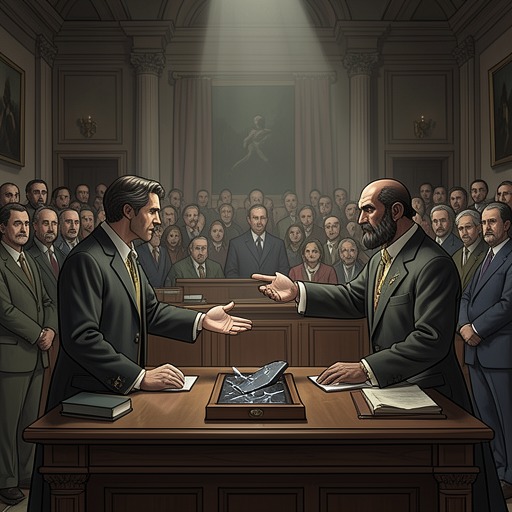
Ulamante becomes the arena in which the Assembly asserts jurisdiction over Culpus-Alam. When Allison demands the release of human officers, the Assembly’s representative clarifies that the humans are not hostages but prisoners suspected of destroying Solonis B and awaiting trial. When Bloon asks what Solonis B is, D’armic explains that it is the human name for Culpus-Alam. The distinction is politically loaded. Bloon insists that Culpus-Alam was an Assembly world and therefore fell under Assembly jurisdiction; humans, in his view, had no authority to act there.
That claim places the human expedition inside a conflict over naming, ownership, and legal standing. The same planet can be a human world, Solonis B, an Assembly world, Culpus-Alam, or an experimental preserve depending on which authority speaks. Ulamante is where those competing designations acquire institutional force. The system’s officials can convert a rescue or act of resistance into a jurisdictional offense, while the people who were relocated to the planet remain largely absent from the legal categories used to decide its fate.
The system’s authority is not left untouched. After the failed attack on the capital and the broader investigation into Culpus-Alam and other destroyed planets, D’armic reports that official proceedings have stalled because most admissible evidence and witnesses are gone. The Assembly appears eager to let the episode disappear from public scrutiny. Nevertheless, the Turemok emerge weakened: repeated military defeats have damaged public confidence, and there is already discussion of breaking up their monopoly over military and police forces.
Ulamante thus ends as a place where justice is neither fully achieved nor wholly absent. Its institutions preserve jurisdictional power, suppress inconvenient scrutiny, and fail to deliver an official punishment for geocide, yet the political consequences of the crisis are real. The system’s immense fleet and surveillance network cannot prevent the exposure of its contradictions. As the galactic capital, Ulamante embodies the civilization’s reach; as the site of hearings, revelations, and institutional retreat, it also reveals the limits and liabilities of that reach.