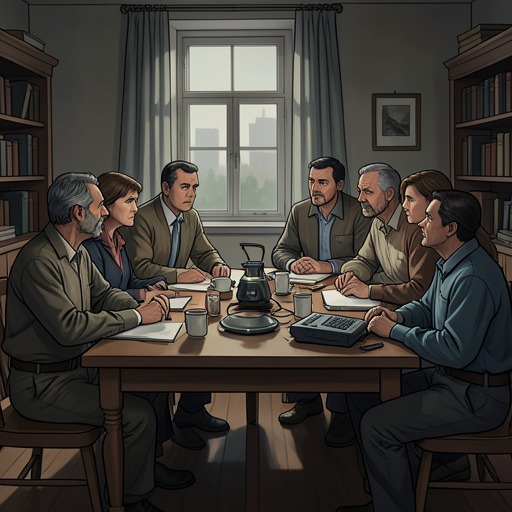
Ángela Admits She Was Once Engaged to Jonas's Brother
Gente que viene y ¡Bah!Ángela’s confession that she was once engaged to Jonás’s brother Tomás overturns the family history her daughters thought they knew. What begins as a tense comparison with Débora’s recent mistake becomes a disclosure of a hidden courtship, a canceled wedding, and a rupture that drove Ángela and Jonás away from his family. The revelation also recasts the marriage at the center of the household: it began not with an uncomplicated courtship, but with a painful betrayal whose consequences Ángela says she carried for years.
The Family History Comes Apart
The disclosure follows the daughters’ doubts about whether they can move past Débora’s conduct. Ángela responds by asking why they have never known anyone from their father’s family. Bea repeats the explanation she and her sisters had accepted: Jonás’s parents died when he was young, and he was an only child. Ángela says that neither part is true. Jonás is not an only child, and his parents are not dead. In one exchange, the family’s inherited account changes from a settled explanation into a deliberate concealment.
Ángela acknowledges that sometimes a lie is easier to live with, but the daughters do not know what to make of her disclosure. Their astonishment is sharpened by the scale of the revision: this is not a missing detail about a distant relative, but a false account of why their father’s family is absent from their lives. The confession recasts that absence as the aftermath of a specific conflict, one tied to Ángela’s earlier engagement and the relationship that displaced it.
The Engagement and the Secret Relationship
After taking a substantial drink of herbal orujo and pouring herself another, Ángela explains that she had been due to marry Jonás’s brother. Tomás was about twenty-four, around Ángela’s age; Jonás was seventeen. The age difference between Jonás and Ángela, which Bea had not previously connected to their history, now becomes part of the story’s context. Irene resists the implication that her father’s image should be disturbed, while Bea initially doubts that Ángela’s account can be true.
The relationship with Jonás had begun before the confrontation. Ángela says they had been seeing one another secretly for a couple of months. Tomás caught them together a week before the wedding, when they were having sex. The detail makes the timing decisive: the engagement was not ended after a vague suspicion or a gradual estrangement, but when the bridegroom discovered his fiancée and his younger brother together on the eve of the marriage.
Ángela recalls that after the discovery she and Jonás sought out any opportunity to be together. She describes the feeling as real, profound, and powerful enough to govern her, even as guilt made her wish she could die. The account does not present the affair as a clean escape from an unwanted engagement. Her sense of its emotional force exists alongside her recognition of the injury it caused, and her daughters hear both aspects in the same confession.
Discovery, Rupture, and Exile
When Tomás caught them, the consequences were immediate and severe. Ángela describes the confrontation as horrible and acknowledges that Tomás was deeply hurt. He canceled the wedding and repudiated both her and his brother. The rest of Jonás’s family took Tomás’s side, leaving Ángela and Jonás with no alternative, as she tells it, but to leave. Her account thus supplies the cause behind the daughters’ estrangement from their father’s relatives: the family did not simply disappear through death or lack of siblings; the couple’s relationship ended in a breach that separated them from that side of the family.
The confession changes the daughters’ understanding of their parents’ marriage as well as their family history. Ángela and Jonás ultimately married, but that outcome does not erase the canceled wedding or the rejection that preceded their life together. Débora calls the story an extraordinary one and contrasts it with her own affair, suggesting that her parents’ relationship seems beautiful because it led to marriage. Irene, by contrast, objects to romanticizing it. Their different reactions keep the story from settling into a simple tale of forbidden love rewarded.
Guilt and the Daughters’ Responses
Ángela herself rejects the idea that what happened was simply beautiful. She says her conscience tormented her every day and that the weight of guilt left her unable to breathe. She credits Jonás with staying beside her constantly; without that support, she believes she might have done something reckless, because she thought she could not live through what she had done or recover from it. Her recollection gives the family rupture an intimate aftermath: the couple’s departure was not the only consequence; Ángela continued to experience the affair as a moral burden even after she and Jonás made a life together.
Débora continues to measure the story against her own conduct, insisting that Ángela did not cheat on Jonás with a dwarf. Ángela answers by distinguishing the situations: she had betrayed the man she was about to marry with his younger brother. That response refuses to turn the confession into a contest over which transgression was worse. Instead, it names the particular betrayal at its center and leaves the daughters to absorb the difference between a secret relationship and the family-wide consequences of its discovery.
Significance of the Revelation
The scene transforms a familiar family explanation into a concealed history of engagement, infidelity, rejection, and departure. Ángela’s repeated drinking as she tells it underscores the strain of continuing, while her candid account of guilt prevents the revelation from functioning as mere romantic legend. For her daughters, the decisive new fact is that their father had a brother and living parents; for Ángela, the story remains bound to the pain of Tomás’s discovery and the burden she says she never escaped. The confession therefore enlarges the family’s past while complicating its present judgment of betrayal.