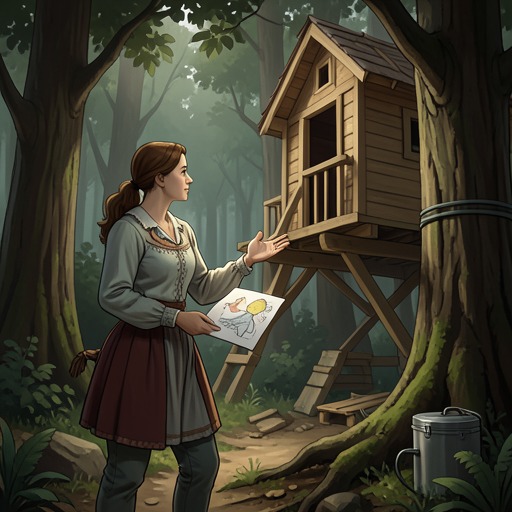
Bea Designs the Treehouse and Negotiates the Budget with Diego
Gente que viene y ¡Bah!Bea Designs the Treehouse and Negotiates the Budget with Diego is the point at which Bea’s elaborate design becomes a practical commission. The presentation is both a professional test and a personal effort to impress Diego, but the project’s defining tension is concrete: how to preserve the scale, features, and safety of her design while bringing its unusually high cost within Diego’s budget.
A Treehouse Designed to Grow
Bea unfolds the plans and brings up the finished design in three dimensions on her laptop for Ingrid and Diego. Ingrid has already approved the drawings after proposing two changes that, in Bea’s view, substantially improve the original idea. The design is intended to serve Diego’s daughter not just as a playhouse for a four-year-old, but as a retreat that will remain meaningful as she grows into adolescence. Its three levels turn that development into part of the building’s structure.
At the base of the tree, the first level is a play area with ropes and nets for climbing, a small trampoline set close to the ground, rope stairs, and a swing. The next level offers a bed from which the child can look out over the garden. Its window opens fully to make the room into a terrace. At the top is a more private space intended for the girl as a teenager, with room for her to bring one or two friends. Bea describes the upper level as somewhere the child can aspire to reach, but which is forbidden to her for now; in the meantime, Diego could use it himself.
The design’s scale is matched by its attention to safety. Bea specifies padded rubber flooring across the whole surface and around part of the tree’s base, so a fall would be less dangerous. She has planned the space so the girl could come and play there alone. The safety provisions are not an afterthought to the design: they are part of Bea’s explanation of how its independence and adventurous play can coexist.
Presentation and Personal Stakes
Bea explains the proposal with evident passion and goes into the details of what each space is for. Her investment is professional, but also personal. She wants Diego to be impressed and hopes that seeing her work will make him forget the embarrassment she associates with the note she gave him. Víctor remains present in her thoughts, although no longer with the overwhelming pain of the preceding weeks. As she presents the treehouse, her attention is therefore divided between the design itself and the complicated feelings surrounding the people in the room.
A question from Diego about a feature of the design lets Bea explain its most conspicuous flourish: a pair of black dragon wings. She has taken inspiration from Viking houses, giving the project a deliberately stylized Viking character rather than a literal historical look. The wings could be made from recycled tires by an artist Bea knows in Madrid. They would move in the wind, or the child could move them from inside the treehouse. The detail connects the design to the daughter’s fondness for a dragon-training film, while making reuse and play visible parts of the building’s appearance.
Bea continues explaining dimensions, measurements, and the purpose of individual choices in such detail that she recognizes she has overdone the presentation. Diego, who says he can read a plan without a running commentary, gives little immediate response. After seven minutes that Bea anxiously times, he says only that they should price the proposal and proceed if the amount is reasonable. His restraint disappoints her after the labor she has put into what she thinks of as the project of her life. He offers to bring her a sweet from the car that he has for his daughter, but the gesture does not substitute for the reaction Bea had wanted.
From Design to Negotiation
Diego makes clear that the timber will be his contribution and need not be included in the estimate. Bea then works with Ingrid and Ingrid’s team on the budget. Their first calculation is extremely high: Bea acknowledges that the design has grown beyond her original control. Ingrid doubts Diego would spend so much on a small house for his daughter, even if he had millions, and jokes that such a lavish gift at age four would make the eventual wedding present difficult to imagine.
Bea later brings the budget to Diego discreetly, without Ingrid knowing she has come. She is carrying the estimate, not seeking an excuse to revisit the personal conversation. Diego tells her the cost is excessive and says it must be cut in half. The request puts the design’s ambition directly against its price. Bea does not want to make the treehouse less than the version she has imagined and admits that she wants to begin construction the next day. Her eagerness makes the negotiation more than an abstract calculation: she is already attached to the prospect of building it.
Diego initially sets a stricter target than Bea will accept. She argues that halving the budget would mean losing features at every level: appearance, space, function, and, above all, safety. She asks whether he would want his daughter injured. Rather than abandon the design’s safeguards to meet the first demand, Bea holds to a limit on what can be removed. Diego recognizes her bargaining skill and offers a compromise: reduce the cost by one third without giving up any safety measure, then begin once she has revised the proposal accordingly.
Approval and Consequence
Bea leaves the meeting believing she has negotiated a workable agreement. Diego approves the reduced budget without further objection. This outcome also surprises Ingrid, who had doubted that he would accept even the original amount after Bea cut it by a third. The estimate’s initial scale remains a real concern, but the final decision does not require Bea to sacrifice the safety measures she defended.
The exchange establishes a practical balance between Bea’s expansive architectural vision and Diego’s control of the project’s resources. Her three-level plan remains oriented around the daughter’s changing needs, while the negotiation tests whether Bea can defend its essential qualities rather than simply present them. The scene’s small reversals—the muted response to the elaborate presentation, the high first estimate, and the final acceptance—make the approval earned through discussion. The treehouse advances from a carefully imagined design to a budget Diego has agreed to fund, with construction to begin once Bea has revised the estimate.