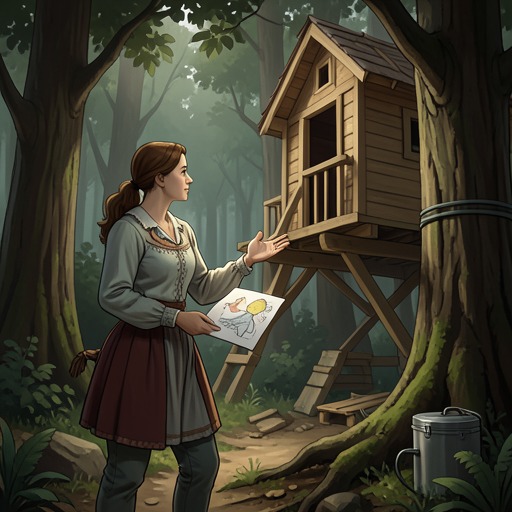
Bea Refuses to Build Diana’s Treehouse First
Gente que viene y ¡Bah!Bea’s refusal to build Diana’s treehouse first turns a seemingly practical request into a test of who gets to set the terms of her work. Diego Ariza offers a paid commission for his daughter, but Bea insists that she will finish her own treehouse before taking on another project. Her decision matters not because she rejects the work altogether, but because she refuses to let Diego’s urgency, Diana’s excitement, or her own unemployment reorder her priorities.
The Model and Its Audience
The exchange begins while Bea and Débora are absorbed in photographing Bea’s treehouse model during a wait in a consultation room. Bea has brought the model out and asked her sister to move a table beside the window so it can be displayed. Débora tries the camera from different angles, moving closer for details and using its macro setting. When they want to show the interior, Bea suggests opening the model’s door and using a mirror to direct reflected light inside. Their careful collaboration turns the model into the center of attention and gives the waiting room a welcome break from its monotony.
That concentration means the sisters do not notice Diego and his daughter arriving. Diego recognizes what the timber is for; the model is a house in a tree. He shows it to the girl, who Bea recognizes as the child she had previously seen on the train. Diana does not speak, but her response to the model is unmistakable: she opens her mouth, nods, studies it closely, and eventually points toward the fig tree in the garden beyond the window. The model is not merely a design being shown to prospective clients. For Diana, it immediately connects an imagined treehouse to a particular tree she can see.
When Diego asks what she might do for him and her grandparents if he gave her a house like the model, Diana has no verbal answer. She looks back at the model and points to her tree again. Diego suggests asking Bea to make one, though he notes that the grandparents would have to be persuaded. Bea offers to build it after finishing her own, provided the grandparents agree. Her offer leaves the possibility open while making its order clear.
The Request Becomes a Conflict
Diana does not accept that sequence easily. She begins screaming, and Diego decides to take her outside. Before leaving, he tells Bea that he has not seen his daughter so excited about anything in a long time and asks whether Bea might set aside her own treehouse to make one for them first. Bea answers no. Débora intervenes by saying that Bea can consider it, but the suggestion only sharpens the disagreement: Bea is angry that her sister seems to be deciding on her behalf.
Bea repeats her refusal emphatically. The project she has already begun is the one she wants to do, and she intends to complete it. She explains that she does not want to leave something unfinished and is tired of other people telling her what to do. She has had to accept instructions from bosses and clients in professional settings, but she does not believe she has to yield to a child’s wishes or to a father overwhelmed by the situation. The distinction is important to her: she is not claiming that no one may commission her work; she is insisting that a commission does not automatically entitle its client to dictate her current priorities.
Diego tests whether payment will change her answer, adding that he can be generous. Débora again encourages Bea to consider the offer, but Bea remains firm. She says she will build whatever treehouse they want once she has finished her own, and even suggests that it could be better than the model. For the present, however, her attention is committed to her own project. She also offers a practical compromise: Diana can come and play at the completed house while Bea builds hers. The child continues to protest, but her distress does not cause Bea to reverse her decision.
Work, Authority, and Aftermath
The dispute becomes more personal when Diego points to Bea’s unemployment and implies that an architect without work should welcome a commission. Bea answers that she does welcome it, but has her own deadlines; neither Diego nor his daughter will make her change them. His offer is therefore not dismissed as worthless or unwanted. What she rejects is the assumption that the offer, combined with her professional circumstances, gives him the right to move her existing project aside.
After Diego leaves, Débora questions why Bea is so determined to make her own treehouse, particularly given that Bea had previously opposed Diego and even chained herself to a tree. Bea answers that accepting a project does not erase that history: Diego offered work, and she expects to discuss it with him after completing her own house. Débora says he left unhappy and treats resistance as pointless. Bea counters that she is not afraid of the Golden Widower. The disagreement thus outlasts the consultation-room encounter, but Bea’s position remains consistent: she can work with Diego without surrendering control of the sequence or terms of her work.
Significance of the Refusal
The scene hinges on a distinction between refusing a person and refusing an immediate demand. Bea does not reject Diana, whose fascination with the model is evident, and she does not rule out designing a treehouse for the family. She offers both a later commission and interim access to the completed house. Her no is specifically a refusal to abandon her own project before finishing it. That precision keeps the conflict from being a simple choice between generosity and indifference.
The model makes that boundary visible. Before Diego arrives, Bea and Débora are treating it as something to examine, photograph, and illuminate; for Diana, it becomes an urgent wish, and for Diego, an opportunity to commission work. Bea sees it as a project already underway, one she has chosen and intends to complete. The same object therefore gathers several claims on her labor, but Bea refuses to let another person’s excitement—or a paying offer—make her unfinished work disappear. Her decision establishes that accepting future work can coexist with setting limits in the present.