Bea and Ángela’s Mother-Daughter Relationship
Gente que viene y ¡Bah!Bea and Ángela’s Mother-Daughter Relationship joins everyday intimacy to an unusual form of care: Ángela can sense and identify other people’s pain by touch, yet Bea is wary when that same gift is turned on her. Their exchanges move between teasing, irritation, reassurance, and practical help. After Ángela dies, Bea’s grief reveals how much of her sense of home rested on her mother’s presence; the notebook Ángela leaves behind becomes a final, deliberate extension of that presence.
Home, Habit, and Intimacy
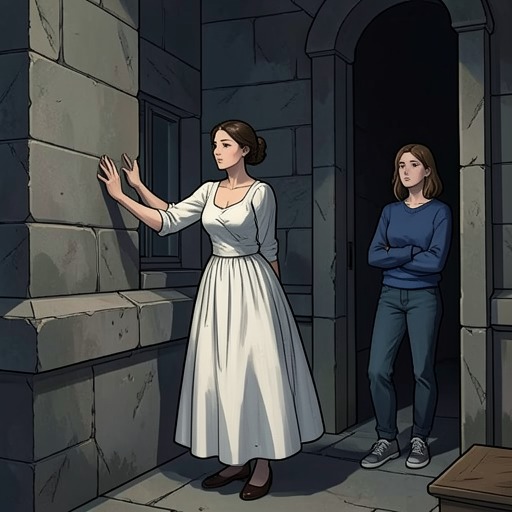
During Bea’s return to her family home, the mother-daughter bond appears in ordinary moments as much as in crisis. When Bea is unsure what to wear, Ángela asks how she is and looks over the suitcase. The exchange is familiar enough to carry a small edge of comic exasperation: Bea does not feel helped by her mother’s response. That closeness also makes Ángela’s physical attentiveness difficult for Bea to sidestep. When Ángela places a hand on her back, Bea wriggles away and protests. A gesture intended as care is, for the daughter, also an unwanted invitation to be read.
Their shared history extends beyond the months of Bea’s return. Ángela accepts food rather than money from the people who come to her for help, and her poor cooking means the family is often fed by the patients’ pots. As a child and adolescent, Bea rode her bicycle around town returning those pots, marked with their owners’ names and addresses. The errand made her familiar with the people of the village and tied her daily life to her mother’s work. Years later, Bea recognizes that returning to the family home has given her precious time with Ángela, time she might otherwise have missed.
Ángela’s Gift and Bea’s Resistance
Ángela’s empathy is not presented as healing: through touch, she can identify symptoms and direct people to the appropriate specialist, but she does not offer cures, folk remedies, or prayer. She has refined the ability through study and is said to diagnose more accurately than doctors in Cantabria. People come to the house in large numbers, and the family’s meals and Bea’s childhood pot-delivery route are among the practical consequences of this public role. For Bea, her mother’s gift is therefore both extraordinary and woven into the domestic routines of growing up.
The gift becomes more complicated inside the family. Ángela tends to exaggerate her children’s symptoms, and Bea expects a minor complaint to become, in her mother’s assessment, something far more serious. The worry is not entirely baseless: one of Ángela’s overcautious predictions led to Irene’s ovarian tumor being found early. But Bea does not want her own pain enlarged or converted into an emergency. When Ángela touches her back, Bea explains that she has a contracture from carrying a heavy suitcase and resists being pitied. She also objects to the apparent mismatch between this concern and her view of Ángela as someone who generally does not make a show of worrying. Ángela answers that she worries quietly. Their disagreement is affectionate but real: the daughter wants control over how her distress is interpreted, while the mother’s way of caring begins with sensing it.
Reassurance and Family Care
Ángela responds to Bea’s distress with a broad assurance that people can get through what seems impossible. Her counsel includes work, discipline, enthusiasm, effort, support from loved ones, therapy, and medication, as well as the importance of not giving problems too much weight. The range of that advice matters: Ángela does not frame recovery as a matter of her own gift or as something achieved by touch. She points Bea toward sustained effort, other people’s support, and professional help. Bea is startled by how seriously her mother seems to have sensed her pain, but the exchange also establishes that Ángela’s comfort is not limited to diagnosis.
The wider family scenes show Bea and Ángela within a household where concern and responsibility pass between relatives. When Juan is distressed about Óscar’s diagnosis and suspects that Débora has concealed its cause, Bea tries to calm him and gives her sister a way to explain the delay. Later, angry with Débora, Bea calls Juan and puts the phone to her sister’s ear; after speaking with him, Débora asks Bea to help choose clothes and look after the child while she meets her husband alone. These are Bea’s actions rather than Ángela’s, but they help define the family world in which mother and daughter are closely bound: care is practical, sometimes intrusive, and often carried by one relative on behalf of another. Ángela’s own advice to Bea explicitly names the support of loved ones as part of getting through difficulty.
Death, Grief, and the Last Gift
The relationship changes irrevocably when Irene calls Bea and tells her that Ángela has died. The news interrupts Bea’s familiar, joking complaint that Irene has forgotten her number. At the family home, Bea embraces her father and breaks down in his arms. His familiar address to her as his little girl, rather than as an architect, meets her in a moment when she feels helpless and orphaned. Her grief is not abstract: she longs for the mother she can no longer see and cannot make sense of a world in which Ángela no longer exists.
After the funeral and cremation, Bea goes alone to her room with the red Hello Kitty notebook Ángela had prepared for her. She realizes that Ángela had written it for the whole family, not just for her: it is a set of notes for each of them, described as an instruction book for when Ángela is no longer there. Bea gathers her father, Débora, Irene, León, Fin, Jacobo, Teo, and the child so that they can read it together. The first note is for her father, Jonás, and addresses his new ability to cook, the loss of the food brought by Ángela’s patients, and a way of making her absence more bearable. The notebook’s organization turns private remembrance into shared family care, with Bea acting as its reader and custodian.
Continuing Bond and Narrative Significance
Bea’s understanding of her time at home changes in the aftermath. She acknowledges that the painful events involving Víctor and the TV News Presenter brought her back, allowing her to spend those months and the last spring with Ángela. The disappointments that once seemed to define her troubles now look small beside her mother’s death, but Bea also sees that painful mistakes can lead to unexpected good: without the return, she would not have shared that time with her family. She hugs the notebook before opening it, treating it as a tangible remnant of Ángela’s attention to her and to the family.
When Diego returns after four months apart, Bea is still carrying her grief. She trembles at the sight of him and restrains the impulse to seek his embrace. In the car, she tells him she cannot imagine living without her mother and asks how he survived the death of his wife. Her question connects her loss to Diego’s bereavement, but it also makes clear that Ángela’s absence has become the immediate measure of what Bea can bear. Across the relationship, the mother’s touch first exposes pain Bea would rather minimize; after death, the notebook and the family’s shared reading offer a different form of contact. Ángela can no longer diagnose or reassure her in person, yet the habits, memories, and instructions she leaves behind continue to organize Bea’s experience of family and grief.