Casa del árbol de Bea
Gente que viene y ¡Bah!Casa del árbol de Bea is both a detailed architectural model and the origin of the treehouse project that restores Bea’s sense of purpose. Conceived as a small refuge within a living chestnut tree, it gives physical form to her belief that architecture can be intimate, imaginative, and connected to nature rather than monumental for its own sake. When Bea carries the model from the attic to show Ingrid, she is not merely presenting an old student exercise: she is recovering a version of her architectural ambition that work and self-doubt had nearly erased.
Rediscovery and Design
Bea finds the model while searching the attic for work that might represent her more honestly than her poor final-year project. She empties boxes of clothes and toys and uncovers three battered, somewhat crushed models. Two seem almost as bad as the project she has been ashamed of; the third, Casa del árbol de Bea, still feels capable of expressing what she wants architecture to be. Its rediscovery makes her reconsider whether the work she had done since university had taken her away from the reasons she wanted to design buildings at all.
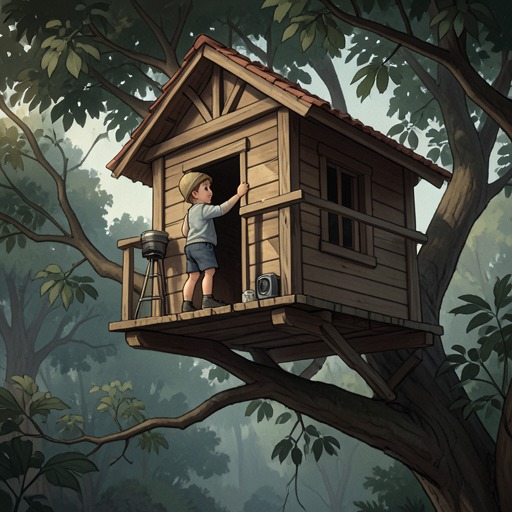
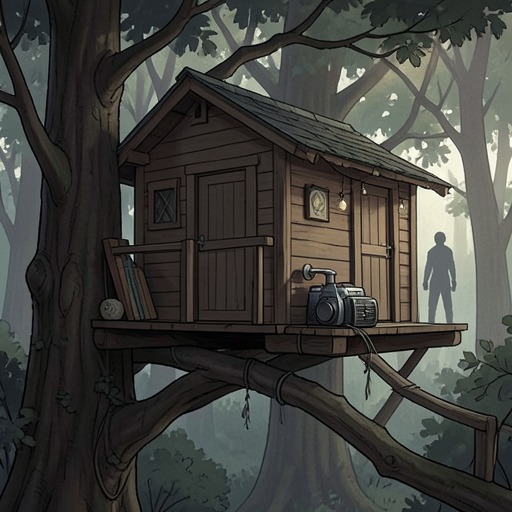
The proposed house is made of oak timber and set on a chestnut tree. It offers shelter from everyday problems and a place to withdraw from the world without separating from nature: its setting changes with the seasons, from red autumn leaves to spring green and bare winter branches, while the tree also bears large chestnuts. The compact twenty-square-metre interior is designed to make room for a bed, a table, and even a shower. A broad lookout and skylight open the small house to its surroundings, while a low terrace provides space to sunbathe in spring or dance in autumn rain. In the model, constraint is not a defect to be overcome by scale; it is the condition that makes the design resourceful and intimate.
Bea remembers how much pleasure designing it gave her and how often she imagined building it for real. The model therefore carries more than a finished architectural idea. It reconnects her with an earlier desire to make places that could make the world, or one small part of it, more beautiful. That recovered ambition also becomes a source of personal hope after the collapse of her wedding plans.
From Model to Professional Challenge
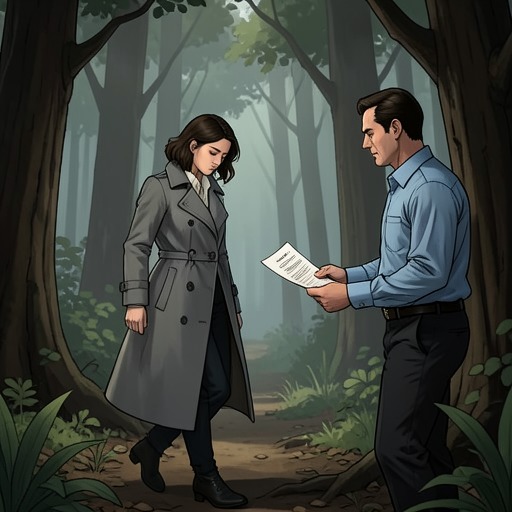
Bea takes the model to Ingrid’s architecture studio in the town’s main square, despite her sister’s warning that she might actually try to present it. She has prepared a speech about the house’s intentions, its architectural influences, and whether such a building could be constructed. She hopes to impress Ingrid and, if offered work, to have the choice of accepting it. Knowing that selling a project is not her strongest skill, she nevertheless wants to make the case herself rather than rely on Víctor’s talent for presentation.
The studio’s open, industrial interior and its large windows looking onto the square and baroque church frame the meeting between Ingrid’s established practice and Bea’s small-scale proposal. Ingrid reacts dismissively. On the walk home, Bea is angry with Ingrid, with her mother, and with herself for failing to defend either the model or her architectural vision. She objects to the assumption that a treehouse must be infantile, or that serious architecture has to mean huge buildings. Her argument is not that Ingrid’s work has no value, but that monumental projects should not be treated as the only valid form of architecture. A smaller, more human design can also be ambitious; a woman’s work need not imitate a supposedly masculine standard of solidity to be taken seriously.
Instead of abandoning the project after the rejection, Bea decides to build the house herself, improved from the model. The proposal that had begun as a possible portfolio piece becomes a test of whether she can carry her own design from imagination into material reality. The model’s value thus changes: what Ingrid sees as an unserious object becomes, for Bea, a plan of action and a declaration of independence as an architect.
Choosing a Tree and Beginning Construction
With help from her brother-in-law, Bea visits a stand of six chestnuts. Three are rotten or dead, but the others are in good condition. She chooses a century-old tree with a very broad trunk and five strong branches growing almost horizontally, a form that appears suited to the house she designed. Standing there, she imagines the terrace above the landscape and feels genuinely happy for the first time in a long while. Her brother-in-law notices her excitement and asks whether she likes the tree. Bea replies that this is where the house will be perfect, and estimates that she can finish the plans in a week if she works hard.
The design is no longer confined to the model. Bea loads her mother’s old van with the tools gathered from the garage and those she has bought for the work: an angle grinder, compressor, toolbox, chainsaw, electric hammer, wood adhesives, trestles, two ladders, and pieces for a small scaffold. Her parents’ interest in furniture restoration has given her practical do-it-yourself knowledge since childhood. She also brings printed plans, a three-dimensional project on her laptop, and notes about similar constructions she has found online. Equipped as both architect and builder, she expects the work to unite the family around a shared task and to offer the satisfaction of making something tangible among the trees.
The first delivery reveals how much the real construction depends on other people and physical effort. The sawmill truck can bring the pine boards only as far as the nearest forest track, leaving about three hundred metres to carry them to the chosen chestnut. Jacobo has anticipated the problem and persuaded three Guardia Civil colleagues to help. He, León, the sawmill employee, the transport driver, and the officers move the boards to the tree; by the end of the morning, the timber is stacked beside it. The model’s neat, self-contained design has become a collective building project involving tools, transport, labour, and a particular tree.
The Model in the Family’s Life
Casa del árbol de Bea also gives Bea a way to explain her intentions to people who encounter the project before its construction is complete. At a medical consultation, she fetches the model and asks Débora to move a table toward the window so the model can be displayed in better light. The people present admire it, and the wait becomes a photographic session: Débora tries different angles, moves closer to details, opens the tiny door to photograph the interior, and uses a mirror to redirect light inside. The scene makes the model briefly function as an exhibit, its small rooms and construction details rewarding attention in a new way.
Diego arrives with his daughter and observes how excited Bea has become. He asks whether she might put her own treehouse aside and build one for them first. Bea refuses; Débora says she can at least consider the idea. The exchange exposes a tension between the model as Bea’s chosen project and the expectations that other people attach to her skill. Its appeal does not mean that Bea has agreed to redirect her work toward every request, even when the request is connected to a child who wants a treehouse.
Destruction and Significance
After only a few days of work, the construction is interrupted by the felling of the chestnuts, including the century-old tree Bea selected. When she reaches the site, the trees are already down. The planned house is barely built, yet Bea experiences the scene as the destruction of something complete: the project had become the focus of her effort and hope during the weeks after her wedding plans fell apart. The loss is not simply that she can no longer use one tree. The material basis of the design, and the future she had begun to imagine around it, have been removed before the house can take shape.
The model remains distinct from the unfinished construction: it was the design that survived in the attic and inspired the project, while the felled tree was the site on which Bea had begun to realize it. That distinction sharpens the object’s significance. Casa del árbol de Bea can preserve an architectural possibility, but it cannot by itself protect the living tree or guarantee that the idea will become a building. Its journey from attic, to presentation, to working plans and finally to a devastated site traces both Bea’s recovered confidence and the vulnerability of the work she is trying to make real. The model’s refuge among branches is at once a design for shelter and a challenge to architectural values that dismiss small, personal spaces as unserious.