Diego’s Daughter Begins to Speak
Gente que viene y ¡Bah!Diego’s revelation that his four-year-old daughter has begun speaking turns a practical conversation about a treehouse into a moment of recovery and renewed possibility. Her recorded request is both a condition on Bea’s work and proof of a change Diego has long hoped for: after her mother’s death, his daughter is speaking again. The scene connects that breakthrough to the family’s altered home, Diego’s quiet actions, and Bea’s own grief.
Background and the Treehouse Request
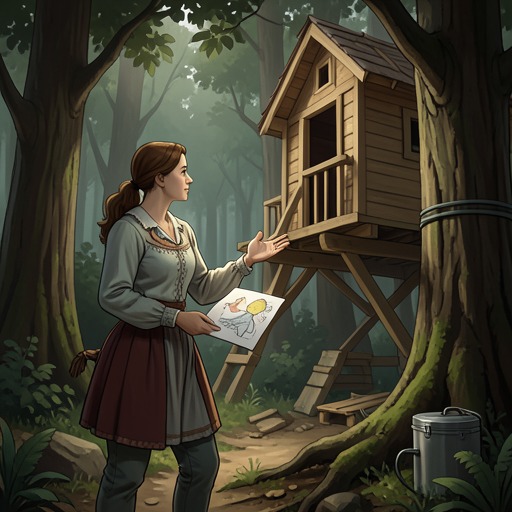
Diego introduces the request as a condition. His daughter wants Bea to finish the treehouse she began at her grandparents’ house, so that the child will have a special place when she visits them. The unfinished structure is therefore not simply an item on Bea’s design agenda: in the daughter’s understanding, it is a place made for her, associated with visits to her grandparents and with the work Bea has already begun.
The request arrives alongside news that Bea did not know. Diego and his daughter no longer live at the estate; they have moved to Santander. Diego says that he managed to save the estate and its house, but the family’s move means that the girl will visit rather than live there. The treehouse is imagined within that changed arrangement: it will give her a place of her own when she returns to her grandparents’ home.
For Bea, Diego’s explanation also clarifies the meaning of his actions. She understands that he is no longer living with his in-laws and that he wants her in his life, or at least wants her to work as the architect for his hotel. The distinction matters: his intentions are being communicated less through eloquence than through practical steps. The daughter’s condition seems at first to be another such step, until Bea notices that the way it was conveyed does not quite fit what she had assumed.
The Voice Recording
Bea asks how Diego’s daughter could have told him what she wanted. Diego answers that she said it in full words, then takes out his phone and plays a voice recording. The child says, “Bea, quiero mi casa del árbol.” Her short request gives a voice to the change Diego has just described and makes it immediate for Bea: this is not merely Diego reporting progress, but the child herself speaking.
The recording also binds the emotional revelation to the practical condition. The daughter does not speak in the abstract; she asks for the treehouse, addressing Bea by name and claiming it as her own. The words make the child an active participant in the project. What had been an unfinished design now carries a specific personal meaning for its intended occupant, and the request supplies Diego’s condition with a force that goes beyond negotiation between adults.
Diego’s response shows how much the sound means to him. Tears appear in his eyes, and he quickly wipes them away with the back of his hand. He apologizes and calls himself silly for still being unaccustomed to it. Bea rejects that self-description in her thoughts: she sees his tears not as foolishness but as the response of a father who has, on his own and without anyone’s help, watched his four-year-old daughter overcome the death of her mother and begin to speak.
Grief and Recognition
The daughter’s speech is presented as a consequence of bereavement, not as an isolated milestone. Bea understands the change through the loss of the child’s mother, and Diego’s emotion makes visible the weight of the silence she has overcome. The scene does not explain the process in detail; instead, it concentrates the change in a voice recording and in Diego’s attempt to compose himself after hearing it. The modest scale of these details keeps the achievement intimate: a phone, a child’s request, and a father wiping away tears.
Bea’s response then turns the revelation toward her own loss. As she considers what Diego has accomplished for his daughter, she wonders whether he could help her overcome the death of her mother. The question links two distinct experiences of grief without treating them as identical: the daughter has begun to speak after losing her mother, while Bea is still confronting her own bereavement. Diego’s tenderness offers Bea a possible source of support, but the scene does not present her grief as already resolved.
Consequence for Bea
When Diego asks what she says, Bea does not need much time to answer. Her decision is framed through her mother’s teaching about mistakes: they must be accepted and taken responsibility for, and they can lead people to unexpected places. Bea recognizes that her own errors, missteps, and entanglements have brought her to this point. The exchange thus makes the daughter’s voice more than welcome news for Diego. It becomes part of the circumstance in which Bea can choose to move forward.
The scene’s emotional turn rests on the difference between what people say and what their actions show. Bea has been reading Diego’s practical choices as evidence that he wants her involved in his life; the recording supplies an answer of a different kind, one that makes his family’s changing circumstances and his daughter’s recovery unmistakable. At the same time, the treehouse joins the child’s need for a special place to Bea’s professional work and to the possibility of a renewed relationship with Diego. The request does not settle the future of either relationship, but it gives the conversation a concrete point of connection: a place the child wants Bea to finish, and words she can now say aloud.