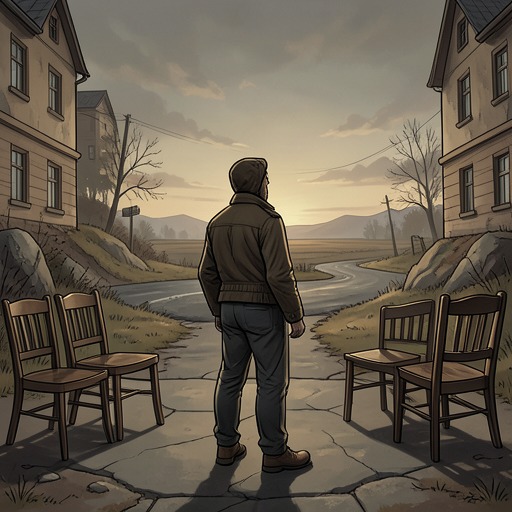
Diego's unresolved grief for his wife
Gente que viene y ¡Bah!Diego's unresolved grief for his wife, Diana, shapes both his resistance to a new relationship and the support he can eventually offer Bea. He rejects the idea that love can erase bereavement: after insisting that neither of them can rescue the other from the past, he remains silent when Bea challenges him to take the risk of what might grow between them. Later, when Bea is overwhelmed by her mother's death, he acknowledges that he has not learned to grieve well, but offers to help her face the absence.
Grief and the Limits of Rescue
Diego describes himself as trapped in a pit, with a painful life and the memory of his wife still present. He asks Bea whether she truly expected to arrive and cure him, make him forget Diana, or let him make her forget the damage caused by her former fiancé. His questions draw a firm boundary around what a relationship can accomplish: affection cannot simply undo loss or repair another person's past.
Bea answers that she had not planned to return to her hometown or become involved with a widower who lives in the past, but that the relationship arose and she had been willing to see where it led. In her view, Diego wanted the treehouse and a few good moments while refusing the risks of anything beyond them. He does not answer her accusation. His silence leaves their disagreement unresolved and underscores the distance between Bea's willingness to try and Diego's guardedness.
A Bereavement Reopened
After Bea's mother dies, Bea's own grief makes Diego's loss newly immediate to her. In the family's mourning, she encounters her mother's writing in a red Hello Kitty notebook and learns that it had been written for her. The notebook preserves a connection with her mother, but it cannot soften the fact of her death. Bea tells Diego she cannot imagine living without her mother and asks how he managed to live without his wife.
Diego initially gives no answer. He starts the car and drives for a couple of kilometres in silence, allowing Bea time to express her distress—or, as she considers, perhaps because he does not know what to say. The pause matters: he does not offer an easy consolation or claim that grief can be mastered. His own bereavement gives him a point of recognition, not a ready-made explanation.
Two Years of Mistakes
When Diego finally speaks, he says he does not know how he endured Diana's absence. He believes he did so badly and describes the preceding two years as a long period of making mistakes. His account resists the idea of grief as a completed passage with a clear technique or timetable; what he has learned has come through living imperfectly with the loss.
That admission places his earlier refusal of Bea in a different light without erasing it. He had been unable to promise that a relationship would rescue either of them, and he had kept their possible future at the level of the treehouse and brief intimacy. Now he does not claim to be healed or to have put Diana behind him. Instead, he recognizes that he may have learned enough to accompany someone facing a comparable absence.
An Offer, Not a Cure
Before Bea gets out of the car, Diego tells her that he does not know how he survived the absence of Diana, but that he has learned something at last. If Bea wants, he will help her. The offer moves their exchange beyond his earlier silence, while carefully avoiding a promise that he can remove her pain. Bea realizes that she does want his help and that it may be what allows her to continue.
The scene therefore defines Diego's grief through both its persistence and its changed relation to another person's suffering. His loss remains unresolved; the text gives no indication that he has forgotten Diana or reached a final state of recovery. What changes is his capacity to turn painful experience into presence for Bea. He cannot cure her, just as she could not cure him, but he can offer to face the work of grieving alongside her.