Energía de biomasa y energía verde
Gente que viene y ¡Bah!Energía de biomasa y energía verde is both the public promise and the central dispute surrounding the proposed biomass electricity plant in San Esteban. The project is presented as a way to turn forest material into affordable power and employment, but its dependence on large volumes of wood makes the forests, landowners, and local decision-making part of the controversy. As the plan grows from a pellet-producing factory into an ambitious power project, the story tests whether the language of clean energy can withstand scrutiny of how its fuel is obtained, what its emissions are, and who bears the consequences.
The project and its promises
At first, Irene describes the biomass factory as a source of clean, inexpensive energy, a market for otherwise unusable forest wood, and a generator of employment. The existing facility produces pellets: compressed, dried sawdust used as fuel in boilers. Beside it, a much larger plant is under construction to generate electricity. That expansion depends on a broad supply arrangement: combining privately owned forests, using public forests, and establishing short-rotation plantations harvested every three years. The scale of the plan helps explain why it divides the town. Its supporters see a new industry and a future beyond the familiar emphasis on anchovies and tourism; its opponents see a transformation of the surrounding forests and land use.
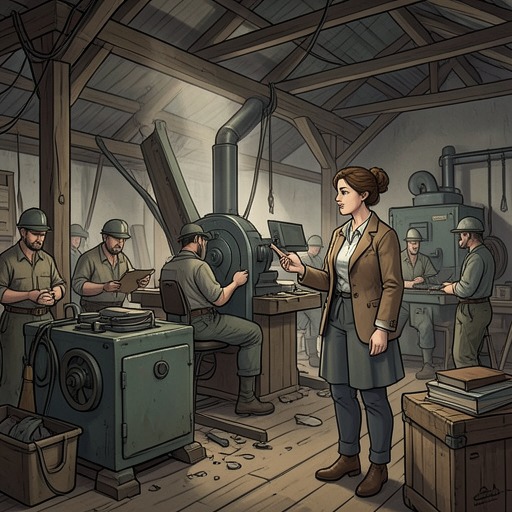
Bea initially repeats Irene’s optimistic account when she visits the sawmill with Débora to find inexpensive timber for her treehouse. The industrial site has become immense: the biomass factory dwarfs the sawmill, while the power plant beside it is larger still. An expansive yard holds hundreds of stacked logs, especially pine and eucalyptus, and a huge shredder reduces wood to chips. Bea is strongly drawn to wood as a material, recalling its varied species, textures, and uses, and remembering a childhood visit to the sawmill with her father. Her pleasure in the timber does not settle the political argument, but it gives the conflict a material closeness: wood is at once a source of beauty and craft, industrial fuel, and a resource whose extraction is being contested.
Forests, ownership, and access
The disagreement becomes concrete when the family encounters workers preparing to extract timber from land they regard as theirs. A man uses a forest map to locate them about two hundred metres north of forest track seven, then says the wood in the surrounding hectares belongs to the sawmill. Some is destined for the biomass factory and the rest for lumber. Bea’s family disputes that claim, but the man says the timber has been bought from its owners and that the purchase includes the right to remove it. The question is therefore not only whether biomass is environmentally beneficial, but also whose agreements and understanding of ownership govern the forest.
Débora’s objection is direct: she sees the factory as consuming the forests rather than making useful use of their by-products. Bea, repeating the case she has heard from Irene, argues that the facility uses wood residues, brush, and other organic waste, and that clearing neglected woodland gives this material another use. The contrast exposes a basic uncertainty in the project’s green rationale. The biomass system is described as making use of waste, yet it also requires an organized and continuing supply of forest material. As the planned power station increases demand, the difference between clearing woodland and depleting it becomes a practical dispute over land, harvesting, and the scale of the operation.
That dispute also reaches municipal policy. Irene tells two landowners that the sawmill is paying well for timber and offering to buy land for short-rotation plantations. She argues that public expropriation and conversion of the land into public forest could be another route, while warning that the municipality would not pay as much as the Andrada family. Later, a newspaper article alleges that Irene threatened two landowners with expropriation if they did not agree to sell their trees to the biomass factory. The article turns a contested method of assembling forest resources into a charge of political coercion, sharpening the question of whether affected owners have meaningful influence over decisions made in the name of a wider public benefit.
Political division and competing accounts
San Esteban is divided between supporters and opponents, and that division reaches into Bea’s family. Débora remains opposed to the project even after Bea challenges her for campaigning against Irene. Her position is not simply a disagreement about whether the plant will create jobs; she regards the forest cost as decisive. Their disagreement parallels the town’s wider conflict, where claims about employment, energy, and land are inseparable from differing judgments about what should be protected and who should decide.
Pacheco’s reporting intensifies the political crisis. After the article about alleged expropriation threats, he publishes further accusations, including claims that Irene’s administration falsified environmental reports, bought support, and persuaded agricultural engineers to endorse the plant’s viability. His articles argue that the project chiefly benefits the Andrada family and Irene’s political career, and suggest that she hopes to use it as a path to national office. Bea learns that Irene’s ex-husband is providing Pacheco with information. Irene insists that the articles are biased and manipulated, and Bea manages to believe her; nevertheless, the reporting deepens local division, and a mass demonstration appears imminent. The distinction between an allegation and an established fact matters, but the political effect is already visible: public confidence in the project and its advocates is under pressure.
The environmental questions behind the green claim
The controversy receives a sharper public test in a televised interview with Irene. The journalist questions the broader environmental case for biomass electricity, raising the emissions produced by transporting forest material by truck, the treatment of waste after combustion, the carbon dioxide released by burning biomass, and the number of thousands of hectares needed to supply a plant of this scale. She also cites other plants that have closed, the heavy subsidies required to keep some operating, and employment outcomes that fell far short of promises. Irene has answers to many of the questions, but the journalist’s rapid succession of figures and examples leaves her struggling to defend the project convincingly.
The interview then shifts from the general limitations of biomass energy to the specific terms of the San Esteban project. The journalist says that a major national energy company had been choosing between this plant and another in Catalonia, and that the San Esteban offer was reduced by four percent. She connects that reduction to cheaper boilers and filters and claims the revised equipment would increase pollutant emissions by twenty percent. When Irene denies the claim, the journalist shows a copy of the agreement with the changed parameters. Irene says she knows the agreement in detail, but the document reveals a change of which she was unaware. The scene gives the debate its most consequential complication: even if the plant’s green purpose is accepted, its environmental performance depends on technical and commercial decisions that the mayor does not appear to control.
Significance
The project’s promise and its costs are never separable into a simple contest between progress and resistance. Pellet production offers a use for wood residues; electricity generation requires a much larger and more organized supply. The same forest is treated as fuel, private property, a potential public resource, and part of the town’s livelihood and identity. Employment and investment are invoked as benefits, while transport, combustion, pollution controls, and the scale of harvesting raise questions about what the label of clean energy leaves out.
By linking these environmental questions to land negotiations, newspaper accusations, family disagreements, and the exposure of a revised emissions agreement, the story makes the project’s legitimacy depend on more than its declared purpose. Its green credentials are contested not only through abstract arguments about renewable energy, but through specific decisions about who supplies the wood, who participates in those decisions, and whether pollution safeguards survive commercial pressure. The power plant thus becomes a test of how local development is justified—and of whether the people and forests expected to bear its costs have a real voice in that justification.